






 Demand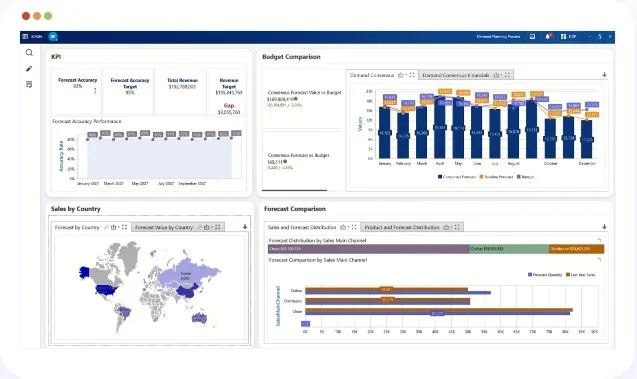
ICRON Demand Planning is a decision intelligence solution that enables organizations to predict future demand, analyze demand signals accurately, and translate them into executable plans by combining historical data, market behavior, and real-time inputs within a unified planning environment, leveraging AI-powered decision intelligence.
Accurate demand planning is essential for balancing customer service, inventory levels, and operational efficiency. In volatile markets, limited visibility and fragmented demand signals reduce an organization’s ability to anticipate changes and respond effectively.
ICRON Demand Planning provides a unified and data-driven planning environment that enhances resilience and supply chain visibility. By consolidating historical demand patterns, market behavior, and real-time signals, organizations can generate reliable forecasts and align downstream decisions across supply, inventory, capacity, and financial planning.
Measurable Business Outcomes
Organizations using ICRON Demand Planning achieve*:
increase in forecast accuracy
reduction in out-of-stock situations
improvement toward optimal inventory levels
reduction in inventory holding costs
*Typical outcomes reported by customers. Results vary by industry, constraints, and planning horizon.
Key Capabilities That Power ICRON Demand Planning
AI and ML-powered demand planning
Leverage AI and machine learning to identify multiple demand streams, generate composite forecasts, and support scenario-based decisions for greater agility and resilience.
Data-driven demand forecasting
Analyze historical data, market behavior, and sales targets to predict customer demand accurately and consistently.
Demand sensing and signal management
Define and incorporate internal and external demand drivers, actual order pacing, and market-level signals to improve demand sensing accuracy.
Flexible demand modeling and granularity control
Create demand models with multiple levels of granularity on a unified platform to enhance decision intelligence and planning visibility.
Product life-cycle–aware demand planning
Identify high-growth and declining products, and enrich demand planning by using demand profiles from existing products to support new product launches.
Decision intelligence-driven demand planning
Create demand forecasts to meet strategic plans using decision intelligence for resource allocation, budget planning, and performance monitoring.
Scenario-based demand planning
Evaluate alternative demand scenarios to understand risks, opportunities, and impact across supply chain functions.
Unified planning visibility and accountability
Improve end-to-end demand visibility across large product portfolios, omnichannel structures, and multi-region operations through a single planning environment.
Who Uses ICRON Demand Planning
Demand planners responsible for forecast accuracy and responsiveness
Supply chain planners aligning demand with supply, inventory, and capacity plans
Sales and commercial teams contributing market insights and demand signals
Business leaders requiring a reliable demand plan for planning and financial decisions
How ICRON Demand Planning Drives Results
Improved Forecast Accuracy
Generate reliable demand forecasts that reduce uncertainty and support confident decision-making.
Enhanced Resilience and Visibility
Strengthen supply chain resilience by detecting demand changes early and maintaining unified planning visibility.
Reduced Inventory Risk
Lower excess inventory and stockouts by aligning demand signals with inventory and replenishment plans.
Aligned End-to-End Planning
Provide a consistent demand baseline that feeds production, capacity, inventory, S&OP, and financial planning processes.