MENU
Request Demo
D
E
C
I
S
I
O
N
S
sidebar-close-icon
Customer Centric Supply Chain Planning

Sales and Operations Planning (S&OP)

Sales and Operations Planning (S&OP) Software for Global Supply Chains

What is S&OP Software?

Sales and Operations Planning (S&OP) software enables organizations to align demand, supply, capacity, and inventory decisions within a single, feasible planning process. By combining demand forecasting, constrained supply planning, inventory alignment, and scenario-based evaluation, S&OP software ensures that agreed plans are executable under real operational constraints rather than aspirational targets.

ICRON Sales and Operations Planning software integrates with existing enterprise systems to provide a structured, decision-driven approach, from demand consolidation and feasibility validation to optimization, scenario comparison, and financial alignment. This supports faster, more reliable cross-functional decisions across sales, operations, and finance.

Factory floor with robotic arms and AI analytics overlay, representing Sales & Operations Planning (S&OP)

How Sales and Operations Planning Works:

Below is how Sales and Operations Planning (S&OP) software works in practice, from demand consolidation to financial alignment.

  • 1) Demand & forecast consolidation

    Consolidates demand signals and applies AI/ML forecasting to model demand patterns and variability, providing a realistic starting point for S&OP scenarios.

  • 2) Validate feasibility under real constraints

    Automatically checks demand against finite capacity and material availability to ensure plans are feasible under real operational constraints.

  • 3) Compare and refine scenarios before committing (Agentic AI–enabled)

    Compare scenario against one or more alternatives by running “what-if scenarios” such as demand shifts, capacity changes, material limits, or service targets. Refine scenarios using ICRON Co-pilot, while evaluating trade-offs across cost, service levels, inventory exposure, and capacity utilization (e.g., "What happens if a key supplier is delayed by 2 weeks?").

  • 4) Financial alignment and plan approval

    The selected S&OP scenario is aligned with financial targets and published as the agreed plan. Outputs can be shared with ERP and downstream planning processes to ensure consistency between S&OP decisions and execution.

What ICRON Delivers Across End-to-End Sales and Operations Planning

ICRON delivers end-to-end S&OP capabilities, supporting strategic, tactical, and investment-level decisions across the supply chain.

ICRON supports this by enabling organizations to:

End-to-End Demand and Supply Planning

End-to-End Demand and Supply Planning

  • - AI-powered demand forecasting and production scheduling

  • - Dynamic inventory optimization and stock level management

  • - Real-time decision-making and scenario analysis

Scenario Planning and Investment Decisions

Scenario Planning and Investment Decisions

  • - What-if analysis to test demand shifts, supply disruptions, and capacity changes

  • - Resource allocation modeling and capacity planning

  • - Scenario-based planning for long-term structural planning, including alignment with supply chain network design decisions such as manufacturing footprint, sourcing strategies, and distribution structures

Inventory Optimization

Inventory Optimization

  • - Multi-echelon inventory optimization (MEIO) ensures that safety stock and inventory levels are balanced across all points in the supply chain

  • - Service-level simulation and inventory control policies

  • - Demand-driven inventory replenishment strategies

Data-to-Decision Platform Foundations

Data-to-Decision Platform Foundations

  • - Seamless data integration and real-time analytics

  • - Collaborative decision environments across teams

  • - Visual dashboards for monitoring supply chain performance

Sales and Operations Planning (S&OP) Customer Stories

ICRON supports Sales and Operations Planning initiatives for complex global and European enterprises across
chemicals, electronics, and industrial manufacturing. These examples illustrate how S&OP connects demand,
constrained supply, and execution in real-world environments.

Customer Story
Modern TV with a bright multicolor display, used as a generic visual.

Vestel – S&OP for Planning Accuracy and Speed

Vestel, a leading European electronics manufacturer implemented ICRON Sales and Operations Planning solution to replace siloed planning processes with a unified, scenario-driven planning environment.

What it delivered: Vestel’s S&OP preparation time was reduced from 2 weeks to 1 day and boosted planning accuracy by 20%. S&OP enabled faster planning cycles, improved alignment between sales and operations, and more responsive decision-making under demand volatility.

Read The Customer Story
Customer Story
Upward view of a contemporary high-rise with reflective glass facades

Leading Glass Manufacturer – S&OP for Feasibility and Cross-Business Alignment

A leading global glass manufacturer implemented ICRON Sales and Operations Planning solution to coordinate demand, capacity, and production decisions across 7 business units, 45 plants, and operations in 14+ countries. ICRON replaced fragmented, spreadsheet-driven planning with a single S&OP environment supporting scenario-based decision-making at scale.

What it delivered: A 13% increase in forecast accuracy, stronger financial and operational alignment across business units, and improved visibility into capacity utilization and demand fulfillment risks. S&OP enabled consistent, data-driven decisions across regions while supporting complex product portfolios and high operational variability.

Read The Customer Story
Video
S&OP Flavour Day partner session banner highlighting agility, alignment, and optimized actions, featuring Dr. Melis Teksan

S&OP Driving Agility, Alignment and Optimized Actions

Dr. Z. Melis Teksan, SVP at ICRON, shared at S&OP Flavour Day how businesses can evolve from a linear, calendar-based S&OP process to a dynamic, event-driven decision environment. This is achieved by integrating real-time data, faster decision- making, alignment across teams, and optimized operational performance. This approach empowers organizations to respond to disruptions and opportunities in real time, ensuring planning agility and alignment with strategic goals.

Real-world examples include: a leading European TV manufacturer reducing S&OP preparation time from 1 week to 3 hours, inventory levels decreased by 5% while planning accuracy increased by 20%.

Watch The Customer Video
Supply chain network with trucks

Optimized Supply Chain Planning:
AI-supported Decision-Making in S&OP

19 March 2026 4-5 PM CET
Register Now

Business Benefits of Sales and Operations Planning

Sales and Operations Planning delivers measurable improvements in inventory performance, service
reliability, capacity utilization, and planning efficiency across the end-to-end supply chain.

15
-
30

reduction in inventory levels achieved by aligning demand forecasts, replenishment decisions, and production plans within a single S&OP process, reducing excess stock while protecting service levels.

10
-
50

improvement in OTIF delivery performance driven by improved synchronization between demand plans, constrained supply plans, and inventory positioning.

10
-
50

Improvement in capacity utilization enabled by balancing forecasted demand with production capacity, improving the allocation of constrained resources across products.

Days
-
minutes

Reduction in S&OP preparation time from days to minutes achieved through automated data integration, scenario-based planning, and embedded analytics.

*Typical outcomes reported by customers. Results vary by industry, constraints, and planning horizon.

Gartner customer quote 2
Gartner customer quote 1

Business Impact of Sales and Operations Planning (S&OP)

S&OP improves cost efficiency, service performance, resilience, and sustainability by optimizing planning decisions across the supply chain.

Warehouse worker scanning box for inventory tracking

Drive Cross-Functional Collaboration

S&OP fosters seamless collaboration across sales, marketing, finance, and supply chain teams. By integrating data and insights from all departments, organizations can ensure alignment across functions allowing teams to make data-driven decisions and drive efficiency

Logistics team managing warehouse operations with digital tools

Leverage AI/ML for Forecasting and Consolidation

S&OP leverages AI/ML demand forecasting and machine learning algorithms to analyze historical data, market trends, and external factors. This enables organizations to generate accurate predictions to proactively response to shifting demands and improving alignment across the entire supply chain.

Engineer using tablet to monitor production line performance

Achieve Supply Chain Agility

Incorporating real-time demand sensing into S&OP enhances supply chain agility by enabling organizations to quickly adapt to market shifts. The ability to adjust production schedules, inventory levels, and transportation routes based helps companies stay ahead of changes, mitigating supply chain risks and increasing responsiveness to changes.

Team analyzing project schedule on computer screen for planning

Boost Supply Chain Resilience

S&OP strengthens supply chain resilience by using predictive analytics to model supply and demand scenarios. By simulating disruptions (e.g., supplier failures or demand spikes), organizations can proactively adjust their capacity planning and sourcing strategies, ensuring business continuity even during periods of uncertainty.

Aerial view of large logistics port with shipping containers

Optimize Supply Capacity Allocation

S&OP uses scenario-based evaluation models to align supply with demand across all areas of the supply chain, ensuring optimal capacity utilization. By balancing production rates & inventory levels organizations can ensure that resources are allocated efficiently and keeping costs in check.

Businessperson using digital interface for workforce analytics

Align Planning and Execution

S&OP continuously aligns strategic planning with operational execution, ensuring optimal performance throughout the supply chain. Real-time monitoring and data-driven insights allow organizations to continuously assess planning outcomes and make necessary adjustments. This ensures that the entire supply chain is working toward the same goals, improving service levels, reducing inefficiencies, and achieving optimal cost-to-serve.


How ICRON Addresses Sales and Operations Planning Challenges

ICRON Sales and Operations Planning solution empowers businesses to navigate the complexities of demand variability and capacity constraints by utilizing real-time scenario-based simulations, enabling proactive adjustments to operations.

This enables companies to:

  • Model multiple demand-supply scenarios to simulate changes in demand or disruptions in the supply chain.

  • Evaluate trade-offs between cost, service levels, and risk, helping to balance short-term performance with long-term objectives.

  • Integrate real-time data from multiple systems, ensuring that all decisions are based on accurate, up-to-date information

ICRON Sales and Operations Planning software helps manufacturers align demand, supply, capacity, and inventory through scenario-based, constraint-aware planning. It enables decision-makers to compare multiple feasible plans, assess cost and service impact, and approve a single executable plan. The solution is used by global manufacturers to reduce planning cycles, improve forecast accuracy, and increase service levels.

ICRON named a Visionary in the 2025 Gartner® Magic Quadrant for Supply Chain Planning Solutions

ICRON Named a Visionary in the
2025 Gartner® Magic Quadrant for
Supply Chain Planning Solutions

Read More

Decision Intelligence Capabilities for Sales and Operations Planning (S&OP)

Decision intelligence in S&OP enables organizations to coordinate demand with constrained supply and capacity decisions under uncertainty, reflecting industry-recognized best practices for scenario-based planning rather than static consensus plans.

Customer Centricity

  • ICRON S&OP helps organizations to promptly respond to changes in customer preferences and market trends to ensure products’ availability when and where needed.
  • Customer-centric S&OP ensures the availability of products when customers require them is essential for reducing stockouts and improving customer satisfaction.
  • By explicitly modeling service-level targets, lead times, and demand variability, S&OP decisions ensure product availability where and when customers require it. This empowers businesses to build loyalty, generate positive word-of-mouth, and establish long-term relationships through customer satisfaction.
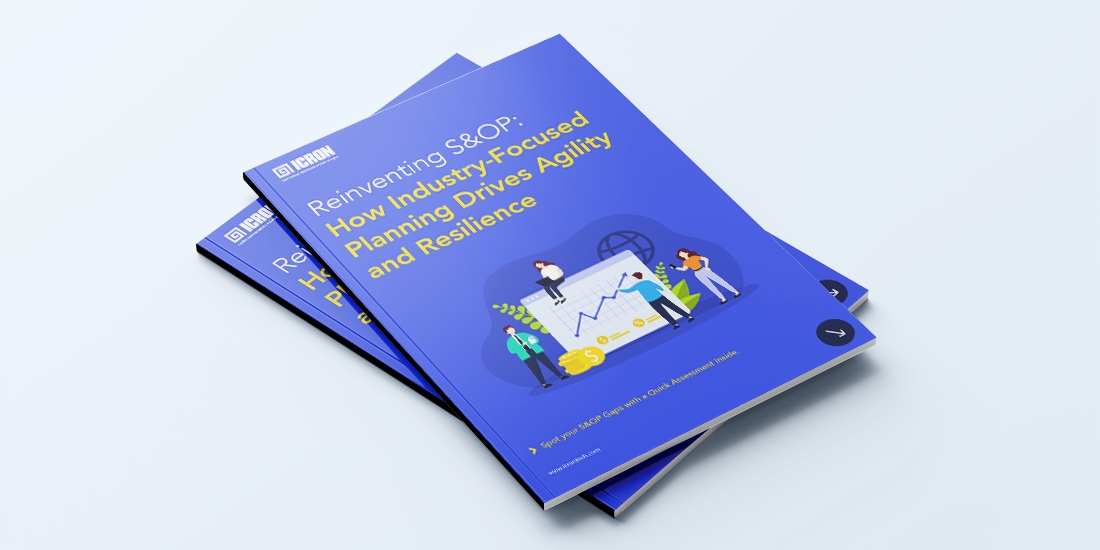
Read E-Book

Dynamic Global Pegging

  • Dynamic global pegging in S&OP elevates inventory management by fine-tuning stock levels and distribution strategies across diverse locations.
  • By connecting demand forecasts to constrained supply plans, organizations can evaluate the feasibility of S&OP decisions before execution. This supports realistic planning outcomes by accounting for capacity limits, lead times, and material availability, ensuring finished products reach their destinations promptly and efficiently.
  • Through dynamic global pegging, you can strategically prioritize efficiency, cost reduction, and ultimately, enhance customer satisfaction across your global supply chain.
Read E-Book

Embedded Analytics

  • Embedded analytics integrate demand, supply, inventory, and capacity analysis directly within the S&OP decision environment, providing comprehensive real-time data access supports well-informed decision-making in your S&OP processes.
  • Organizations can achieve greater demand forecasting accuracy by leveraging historical data and market trends, leading to improved balance between supply and demand.
  • Recognizing the significance of collaboration among your sales, marketing, operations, and finance teams, ICRON S&OP offers a shared space for data analysis and decision-making, enabling your teams to seamlessly collaborate.

Risk Management

  • Risk management in S&OP enables organizations to evaluate disruption before they impact execution. Early identification of potential disruptions enables businesses for the development of proactive strategies to address them
  • Creating contingency plans for a range of risk scenarios ensures readiness for unexpected events and minimizes their potential impact.
  • Enhanced visibility throughout the supply chain and the provision of data-driven insights strengthen your S&OP Decision Process. This, in turn, equips your organization to effectively manage risks and maintain operational resilience.
Read E-Book

Sustainability

  • Sustainability in S&OP is addressed by achieving the alignment of manufacturing processes with your customers' actual needs, consequently reducing energy consumption and emissions.
  • ICRON S&OP significantly contributes to your sustainable operations by minimizing inefficiencies, promoting responsible resource allocation, and optimizing transportation routes. This aligns perfectly with the growing emphasis on environmentally conscious practices in supply chain sales and operations planning.
Read E-Book

Adaptive Scenario Planning

  • Adaptive scenario planning enables organizations to compare multiple S&OP scenarios under changing assumptions such as demand shifts, capacity changes, or supply disruptions. For longer-term structural questions (such as network footprint, site roles, or flow allocation) scenario analysis can be extended through supply chain network design.
  • By evaluating scenarios side by side, planners can assess their decision before committing to an agreed plan. This supports data-driven S&OP decisions that remain robust under uncertainty.
Read E-Book

Features of Sales and Operations Planning Software

Sales and Operations Planning software provides capabilities that enable organizations to synchronize demand signals with feasible supply plans across planning horizons while ensuring feasibility, transparency, and execution readiness.

Demand and Supply Planning

  • Integrates demand and supply planning to align forecasted demand with production, procurement, and inventory scheduling strategies.
  • Ensures optimal resource allocation to reduce stockouts and excess raw material.
  • Real-time data analysis and scenario simulations support agile decision-making across the supply chain.

Cross-Functional Alignment and Decision Support

  • Aligns sales, operations, and finance teams around a single, unified planning process.
  • Provides decision support tools, ensuring consistent, up-to-date information for all stakeholders.
  • Facilitates better communication and coordinated decision-making across departments for integrated supply chain scheduling and decision support.

Scenario-Based Planning and Risk Mitigation

  • Runs and compares multiple scenarios to evaluate risks, trade-offs, and optimal solutions.
  • Proactively adapts to changes and uncertainties in the supply chain.
  • Helps mitigate risks like supply disruptions, demand fluctuations, or strategic changes with scenario analysis for risk management.

Financial Projections and Profitability Analysis:

  • Provides visibility to align operational decisions with long-term financial goals.
  • Optimizes costs, margins, and overall profitability through data-driven financial insights.

Agile and Resilient Supply Chain Operations

  • Delivers flexibility through dynamic workflow orchestration and a flexible architecture to adapt quickly to new information.
  • Ensures supply chain resilience in the face of disruptions like demand spikes, raw material shortages, or regulatory changes.
  • Quickly adjusts plans to maintain business continuity and agility with agile supply chain planning that can adapt to evolving market conditions.

Inventory Optimization

  • Multi-echelon inventory optimization (MEIO) ensures that safety stock and inventory levels are balanced across all points in the supply chain, from warehouses to distribution centers, improving service levels and reducing excess stock.
  • Utilizes demand-driven stock replenishment strategies and service-level simulation to optimize inventory across all locations.

Real-Time S&OP KPI Dashboards

  • Tracks key performance indicators (KPIs) in real-time, providing insights to support continuous improvement and smarter decision-making.
  • Offers post-game analysis to refine future planning cycles and enhance forecast accuracy.

Constrained Supply and Production Planning

  • Aligns production plans with available capacity, material constraints, and lead times.
  • Ensures that agreed S&OP plans are feasible and executable, enabling organizations to take action based on realistic constraints.

Capacity Planning and Allocation

  • Supports evaluation of capacity utilization and allocation across plants, lines, and resources.
  • Enables comparison of alternative capacity scenarios to balance demand fulfillment, cost efficiency, and operational constraints.

Agentic AI

  • ICRON’s Agentic AI, integrated within Microsoft 365, enables users to create complex business scenarios using simple natural language prompts.
  • The AI-driven co-pilot commands multiple agents to trigger an automated workflow that streamlines S&OP decision-making.
  • Key Use Cases:
    • Increasing demand forecasts for specific products.
    • Adjusting resource capacities in production plants.
    • Composing a scenario with new demand and supply inputs.
    • Optimizing the new supply plan based on live data.

Resources

Gain insights, and stay ahead of supply chain trends and updates with the latest thinkings on the supply chain.

View All

Sales and Operations Planning FAQ

Business Value & Outcomes of S&OP

1. What business problems does Sales and Operations Planning (S&OP) solve?

Sales and Operations Planning resolves misalignment between demand, supply, capacity, and inventory by creating a single feasible plan agreed across sales, operations, and finance. It helps organizations reduce excess inventory, improve service levels, stabilize operations, and respond more effectively to demand and supply uncertainty.

2. How does S&OP improve inventory performance?

S&OP improves inventory performance by aligning replenishment and production plans with realistic demand forecasts and lead times. This reduces excess stock while protecting service levels by avoiding overreliance on safety inventory to compensate for planning misalignment.

3. How does S&OP improve OTIF and customer service levels?

S&OP boosts OTIF (On-Time-In-Full) performance by ensuring that realistic production and inventory plans are aligned with demand forecasts. ICRON’s solution enhances cross-functional collaboration using real-time data and AI to anticipate disruptions, prevent late deliveries, and increase customer satisfaction. For example, Vestel improved OTIF by 15% by optimizing inventory and production schedules.

4. Can S&OP reduce planning effort and decision cycle time?

Yes. By automating data consolidation and enabling scenario-based evaluation, S&OP reduces manual reconciliation across functions. Planning cycles that previously took days or weeks can be reduced to hours or minutes, improving decision speed and consistency.

S&OP Fundamentals & Core Concepts

5. What is Sales and Operations Planning in practical terms?

Sales and Operations Planning is a cross-functional planning process that aligns demand forecasts, supply plans, capacity constraints, and financial objectives into a single, agreed plan over a medium-term horizon.

In practice, S&OP software is used by heads of supply chain and operations, S&OP and IBP leaders, manufacturing and capacity planning managers, and finance leaders involved in plan approval.

6. How is S&OP different from demand planning or supply planning?

Unlike demand or supply planning, which focus on isolated functions, ICRON’s S&OP integrates real-time demand forecasting, production planning, and inventory optimization into one coherent plan. By ensuring feasibility across all functions, ICRON provides organizations with a comprehensive strategy that adapts dynamically to disruptions in demand or supply.

7. How is S&OP different from IBP (Integrated Business Planning)?

Sales and Operations Planning (S&OP) focuses on aligning demand, supply, capacity, and inventory decisions, while IBP extends the scope to include financial planning, strategic alignment, and executive governance. S&OP often serves as the operational planning foundation for IBP.

In many organizations, S&OP provides the operational decision foundation upon whichIntegrated Business Planning (IBP) extends financial alignment, strategic targets, and executive governance.

8. What planning horizon does S&OP typically cover?

S&OP typically covers a mid-term horizon of 3 to 24 months. This horizon bridges short-term execution planning and long-term strategic decisions, allowing organizations to proactively manage demand variability and capacity constraints. Many organizations review S&OP plans on a rolling monthly cadence.

Many organizations define S&OP service-level targets for priority customers and products and review plans on a rolling monthly cadence.

S&OP Process, Scope & Use Cases

9. What decisions are made during the S&OP process?

S&OP decisions include demand shaping, supply allocation, production volume planning, inventory targets, capacity adjustments, and service-level trade-offs across products, regions, and time periods.

10. When should organizations implement or redesign S&OP?

Companies typically use S&OP software in the following situations:

  • When demand volatility makes spreadsheet-based S&OP unreliable
  • When sales plans must be validated against finite capacity and material availability
  • When leadership requires side-by-side scenario comparison before committing to a plan
  • When finance, operations, and sales must align on one approved, executable plan

S&OP software becomes essential once manual coordination and static plans can no longer scale with business complexity.

11. How does S&OP support multi-country global supply chains?

S&OP supports global supply chains by coordinating demand and supply across multiple countries while accounting for lead times, transportation constraints, regulatory differences, and cross-border complexity common in EU and global operations.

12. Can S&OP be applied to regulated industries?

Yes. S&OP can incorporate regulatory constraints such as pharmaceutical compliance, food safety requirements, and country-specific distribution rules, ensuring that plans remain feasible and compliant.

13. How does ICRON use AI to enhance decision-making and scenario planning in Sales and Operations Planning (S&OP)?

ICRON’s data-driven S&OP solutions for global supply chains integrates Agentic AI through its Co-pilot Chat Agent, embedded in Microsoft 365. This allows planners to interact with the system using natural language commands to create dynamic business scenarios.

Planners can:

  • Adjust demand forecasts, modify capacity constraints, and recompose supply scenarios in real time
  • Compose a scenario with the new demand

14. What is scenario-based planning in S&OP?

Scenario-based planning enables businesses to simulate alternative demand and supply situations, such as demand surges or supply disruptions, and evaluate trade-offs. ICRON’s platform allows real-time scenario comparison to maintain optimal service levels under changing conditions.

15. How does S&OP handle uncertainty and demand volatility?

S&OP handles uncertainty by explicitly modeling forecast variability, capacity constraints, and alternative responses. This allows planners to evaluate the robustness of plans rather than relying on a single forecast.

16. Which capabilities distinguish modern S&OP software platforms?

Modern S&OP platforms are distinguished by feasibility-aware planning, AI-driven forecasting, multi-scenario comparison, embedded analytics, and explainable decision logic. Integration with ERP and execution systems ensures plans translate into actionable outcomes.

Data, Integration & Scalability for S&OP

17. What data is required to start S&OP?

S&OP typically starts with aggregated demand, capacity, inventory, and cost data. The focus is on decision relevance rather than transactional precision, allowing data maturity to evolve over time.

18. How does S&OP integrate with ERP and execution systems?

S&OP integrates with ERP, APS, and execution systems by consuming master data and demand aggregates and feeding agreed plans into downstream processes such as production scheduling, procurement, and replenishment.

19. What should companies look for when evaluating S&OP software?

Companies should assess whether the software supports feasibility-aware planning, scenario comparison, transparent decision logic, cross-functional collaboration, and seamless integration with existing enterprise systems.

20. Which software platforms are used for Sales and Operations Planning (S&OP)?

Sales and Operations Planning is supported by dedicated S&OP or integrated planning platforms that combine demand forecasting, constrained supply planning, inventory alignment, and scenario evaluation to deliver a single feasible plan across the planning horizon.

The best S&OP software is selected based on planning complexity, constraint intensity, and the need for executable, scenario-evaluated plans.

21. Has ICRON been recognized by leading industry analysts for S&OP and supply chain planning software?

ICRON has been recognized by leading industry analysts for its supply chain planning platform, which includes Sales and Operations Planning (S&OP) as a core capability.

This includes recognition in the Nucleus Research 2025 Supply Chain Planning Technology Value Matrix, inclusion in the 2025 and 2023 Gartner Magic Quadrant for Supply Chain Planning Solutions, and positioning as a Major Player in the IDC MarketScape for Supply Chain Planning Overall 2024.

These recognitions validate ICRON’s scenario-based planning, constraint-aware decision-making, and execution-ready planning capabilities that directly support S&OP.

Demand Decision Process

ICRON Demand empowers businesses to navigate uncertainty through accurate forecasting using AI-driven methods that take into consideration historical data, reaTime updates, and fast adaptation to changing market conditions and disruptions.

READ MORE