-
Customer Centric Supply Chain Planning
Decision Processes
-




Optimize inventory decisions with decision intelligence
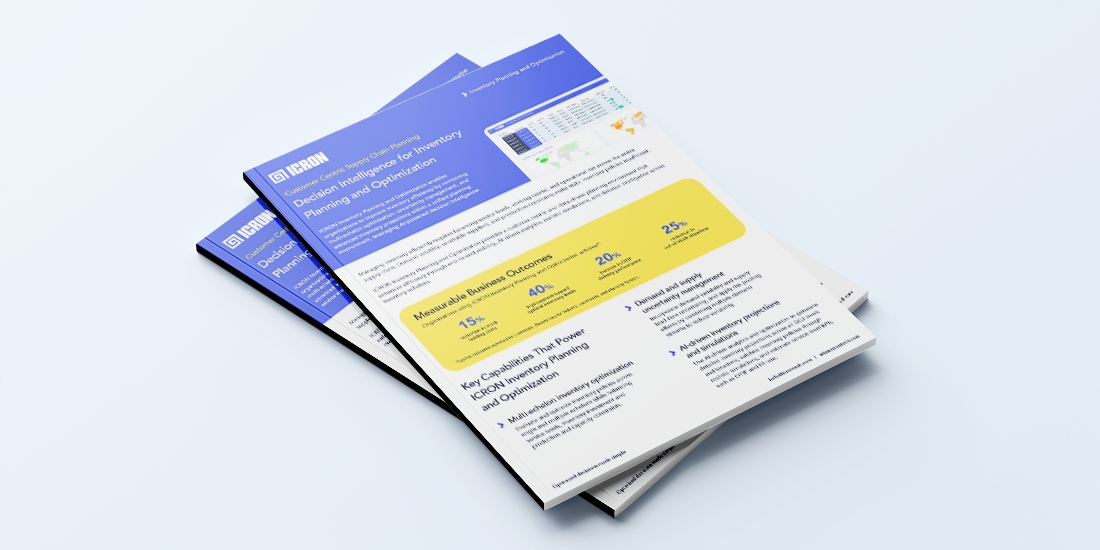
Inventory planning and optimization is the process of determining the right inventory levels, safety stock policies, and stock positioning across products, locations, and time horizons to meet service-level targets while reducing excess inventory, stockouts, and working capital requirements.
It evaluates demand variability, supply uncertainty, lead times, service commitments, capacity constraints, transportation flows, supplier reliability, and financial limitations to identify inventory policies that balance cost, service, risk, and resilience.
ICRON Inventory Planning and Optimization is an enterprise-grade inventory optimization software that enables companies to plan, simulate, and optimize inventory decisions across complex multi-echelon supply chains under real-world constraints.

ICRON enables organizations to optimize inventory planning with AI-driven analytics, multi-echelon inventory optimization, and scenario-based modeling under real-world constraints. This ensures inventory decisions are feasible, explainable, and aligned with service-level, cost, and risk objectives.
ICRON Inventory Planning and Optimization supports decisions in these key areas:
Defining optimal safety stock levels across SKUs, locations, and planning horizons
Placing stock where it best supports service levels, lead times, and demand coverage
Balancing inventory across suppliers, plants, warehouses, distribution centers, and customer-facing nodes.
Aligning inventory policies with customer commitments, order priorities, and fulfillment expectations
Modeling demand volatility, supply disruption, forecast error, and lead-time uncertainty
ICRON supports continuous inventory planning by enabling organizations to evaluate demand uncertainty, supply variability, inventory trade-offs, and downstream decision impacts through data-driven scenario modeling.
ICRON supports this by enabling organizations to:
Simulate, compare, and optimize multiple inventory scenarios in real time
Optimize safety stock and inventory policies under demand and supply uncertainty
Identify root causes of stockouts, excess inventory, and slow-moving stock through dynamic global pegging
Translate inventory optimization outcomes into actionable planning decisions across procurement, production, distribution, and customer fulfillment


IDC MarketScape: Worldwide Supply Chain
Planning Overall Vendor Assessment
ICRON delivers end-to-end inventory planning and optimization capabilities that support strategic, tactical,
and operational inventory decisions across complex supply chains.

- Safety stock optimization across SKUs, locations, and planning levels
- Inventory positioning across plants, warehouses, distribution centers, and customer-facing nodes
- Service-level simulation and inventory projection
- Stock policy management across multiple supply chain echelons
- Optimization of inventory buffers under real-world capacity, supply, and transportation constraints

- Demand variability and forecast error modeling
- Supply lead-time uncertainty analysis
- Supplier reliability and replenishment risk evaluation
- Sensitivity analysis for safety stock investment versus service-level performance
- Scenario-based simulation for demand spikes, supply delays, and disruption events

- Inventory holding cost reduction
- Slow-moving and obsolete stock analysis
- Working capital impact assessment
- Inventory investment optimization by product, location, and service priority
- Cost-to-serve and fulfillment impact analysis

- Service-level target planning
- Stockout risk reduction
- OTIF performance improvement
- Customer demand coverage analysis
- Inventory allocation aligned with customer priorities and fulfillment commitments
- Data integration and validation
- Inventory visualization and embedded analytics
- Collaborative decision environments across planning, procurement, production, finance, and sales teams
- Scenario comparison and decision traceability
- Actionable recommendations for inventory policy updates
Inventory planning and optimization delivers measurable improvements in cost, service, working capital, and
fulfillment performance across the end-to-end supply chain.
*Typical outcomes reported by customers. Results vary by industry, constraints, and planning horizon.
Inventory planning and optimization improves cost efficiency, service performance, resilience, and working capital control by optimizing inventory decisions across the end-to-end supply chain.

Inventory planning and optimization helps reduce excess stock, slow-moving inventory, and obsolescence costs by aligning stock levels with demand patterns, supply lead times, and service-level targets. This enables organizations to lower carrying costs while maintaining product availability.

By placing inventory where it is most needed, organizations can reduce stockouts, improve order fulfillment, and increase OTIF delivery performance. Better inventory availability supports customer satisfaction, stronger service reliability, and fewer backorders.

Inventory optimization enables companies to make more precise decisions about where inventory investment creates business value. By balancing service levels against inventory cost, organizations can free up working capital without increasing service risk.

By modeling demand surges, supplier delays, transportation issues, and forecast uncertainty, inventory planning helps organizations prepare for disruption. Scenario-based planning supports inventory policies that remain effective under volatile conditions.

Inventory planning and optimization gives planners visibility into stock levels, material flows, demand-supply relationships, and inventory risks across the network. This supports faster root-cause analysis and better coordination across planning teams.

Optimized inventory decisions reduce waste, excess stock, unnecessary movement, and energy consumption across production, warehousing, and transportation. This helps organizations evaluate sustainability objectives alongside cost and service performance.






Inventory planning and optimization software provides the capabilities needed to model, evaluate, and optimize inventory decisions across cost, service, risk, and sustainability dimensions. These features help organizations set realistic inventory policies, improve stock availability, reduce excess inventory, and make data-driven decisions across complex supply chains.
Optimize inventory across suppliers, plants, warehouses, distribution centers, and customer-facing locations to reduce total stockholding costs while maintaining service performance.
Define the right safety stock levels by considering demand variability, supply lead times, service-level targets, capacity limits, and replenishment risks.
Simulate future inventory positions across products, locations, and time horizons to identify potential shortages, excess stock, and replenishment gaps before they affect operations.
Model forecast error, demand volatility, supplier reliability, and lead-time variability to create inventory policies that remain robust under changing conditions.
Compare different inventory policies against service-level targets, working capital impact, and fulfillment performance to select the most balanced strategy.
Use visual analytics and performance dashboards to monitor inventory health, identify root causes of stock issues, and support faster planning decisions.
Gain insights, and stay ahead of supply chain trends and updates with the latest thinkings on the supply chain.
View AllHow inventory planning and optimization improves cost efficiency, service levels, resilience, working capital, and sustainability performance.
ICRON reduces inventory holding costs by optimizing stock levels, safety stock policies, and inventory positioning across the supply chain network. The platform helps organizations reduce excess inventory, slow-moving stock, and unnecessary working capital tied up in inventory while maintaining service-level performance.
Inventory planning and optimization improves customer service levels by ensuring the right inventory is available at the right locations to meet demand reliably. By aligning stock availability with service-level targets, order priorities, and fulfillment commitments, organizations can reduce stockouts, backorders, and delivery delays.
Inventory optimization reduces stockouts and excess inventory by balancing demand variability, supply uncertainty, lead times, and service-level requirements in one planning model. This helps organizations avoid understocking in high-priority areas while preventing unnecessary inventory buildup across products, locations, and supply chain echelons.
Inventory planning improves OTIF delivery performance by aligning inventory availability with customer demand, replenishment timing, and fulfillment priorities. When inventory policies reflect real demand patterns and supply constraints, organizations can improve product availability and deliver orders on time and in full more consistently.
Inventory optimization supports sustainability goals by reducing excess stock, obsolete inventory, waste, and unnecessary movement across production, warehousing, and transportation. By evaluating inventory decisions alongside cost, service, and CO₂-related impact, organizations can improve both operational efficiency and environmental performance.
What inventory planning and optimization is, what problems it solves, and why it matters for strategic, tactical, and operational decision-making.
Inventory planning and optimization is the process of determining the right inventory levels, safety stock policies, and stock positioning across products, locations, and time horizons. The goal is to meet service-level targets while reducing excess inventory, stockouts, working capital requirements, and operational risk.
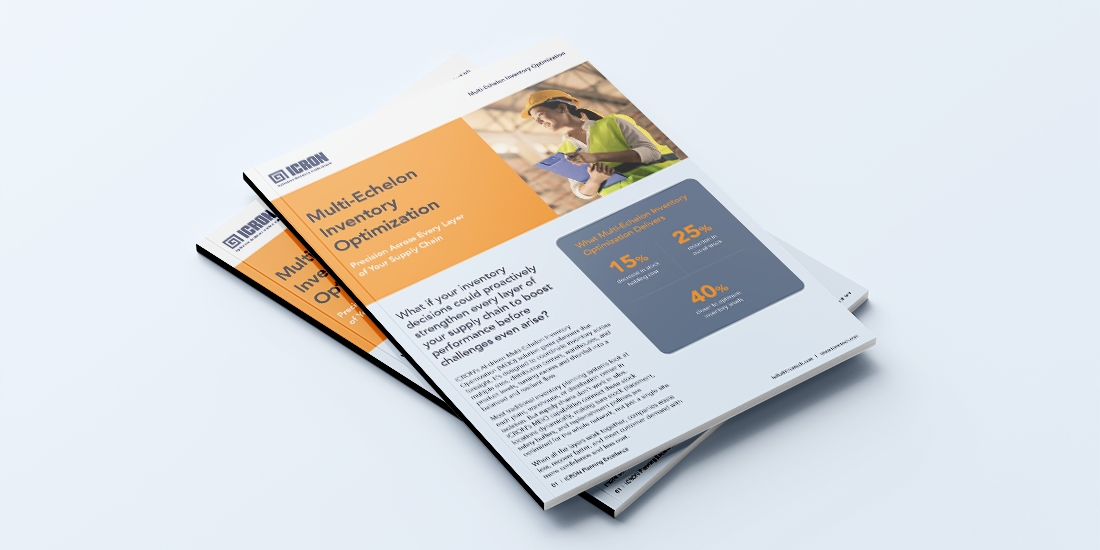
Multi-echelon inventory optimization is the process of optimizing inventory across multiple connected supply chain levels, such as suppliers, plants, warehouses, distribution centers, and customer-facing locations. Instead of optimizing each location separately, it evaluates the full network to balance inventory cost, service levels, replenishment risk, and demand coverage.
Safety stock optimization determines the right buffer inventory needed to protect service levels against demand variability, supply delays, forecast error, and lead-time uncertainty. Effective safety stock optimization helps organizations reduce stockout risk without carrying more inventory than necessary.
Inventory planning software can optimize safety stock levels, inventory positioning, replenishment policies, service-level targets, working capital allocation, and stock buffers across the supply chain. It can also evaluate trade-offs between cost, service, risk, and sustainability before inventory policies are implemented.
Inventory optimization is important for long-term supply chain performance because inventory directly affects cost, service reliability, resilience, working capital, and customer satisfaction. A well-optimized inventory strategy helps organizations respond to demand changes, supplier disruptions, and capacity constraints without overinvesting in stock.
How inventory planning works, when organizations should apply it, and which planning decisions it supports.
What-if scenario planning in inventory optimization allows organizations to test different demand, supply, lead-time, service-level, and disruption assumptions before making inventory decisions. By comparing scenarios side by side, planners can identify which inventory policies remain feasible, cost-effective, and resilient under changing conditions.
Companies should apply inventory planning and optimization software when inventory decisions become too complex for spreadsheets, static rules, or isolated planning processes. It is especially valuable when organizations manage many SKUs, multiple locations, volatile demand, long lead times, supplier uncertainty, or strict service-level commitments.
Inventory optimization is a continuous planning process because demand, supply conditions, lead times, costs, and service expectations change over time. Organizations need to regularly update inventory policies and scenarios to ensure stock levels remain aligned with current business conditions and future risks.
Inventory planning supports procurement, production, and distribution decisions by showing how inventory policies affect material availability, replenishment needs, production feasibility, and customer fulfillment. This helps teams coordinate decisions across suppliers, plants, warehouses, and distribution networks instead of managing inventory in isolation.
Organizations with complex supply chains benefit most from inventory optimization software, especially companies with multiple products, locations, suppliers, production sites, warehouses, and customer service requirements. Industries such as life sciences, consumer goods, food and beverage, chemicals, manufacturing, and retail can use inventory optimization to balance cost, service, and risk.
How optimization, scenario analysis, risk modeling, sustainability trade-offs, and predictive analytics support advanced inventory decisions.
ICRON handles demand and supply uncertainty by modeling forecast error, demand volatility, supplier reliability, replenishment risk, and lead-time variability. This enables organizations to create inventory policies that remain robust under changing market conditions and supply disruptions.
ICRON supports AI-driven inventory optimization for large, multi-country organizations by combining advanced analytics, optimization, scenario planning, and multi-echelon inventory modeling. The platform helps organizations evaluate inventory decisions across complex global supply chains with real-world constraints.
Inventory optimization software is better suited than spreadsheets for complex inventory decisions because it can model multiple products, locations, constraints, uncertainties, and scenarios at scale. Spreadsheets often struggle to capture demand variability, supply risk, multi-echelon dependencies, and real-time trade-offs between cost and service.
ICRON supports resilient inventory planning under disruption and supply volatility by enabling scenario-based inventory optimization, risk-aware stock policy analysis, and dynamic evaluation of demand and supply changes. This helps planners prepare for supplier delays, demand spikes, capacity constraints, and transportation disruptions.
Dynamic global pegging improves inventory planning decisions by linking customer demand to supply, inventory, production, procurement, and distribution across the network. This visibility helps planners identify the root causes of stockouts, excess inventory, and slow-moving stock, so they can take targeted actions instead of relying on broad inventory buffers.
ICRON Demand empowers businesses to navigate uncertainty through accurate forecasting using AI-driven methods that take into consideration historical data, reaTime updates, and fast adaptation to changing market conditions and disruptions.
READ MORE