


 Blogs
Your rules, configured rather than coded
No-code, configurable decision logic lets your team model machine restrictions, changeovers, and sequencing rules, and keep them current as the plant changes.


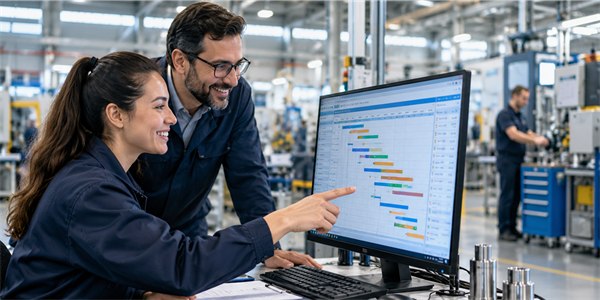
In some plants, the team now spends hours rebuilding the schedule in spreadsheets, hoping they haven't missed a constraint. In others, planners see within minutes which orders are affected, compare recovery options, and choose the one that protects the most important deliveries.
That gap is what production scheduling software exists to close. In 2027, the pressure on it is growing: more product variety, persistent disruption, a shrinking pool of experienced talent, and AI moving quickly into everyday operations software. So what do manufacturers actually need from scheduling software, what should "AI-native" really mean, and how can you tell whether a solution delivers? Let's start with the needs.
Production scheduling software decides exactly when, where, and in what sequence each job runs, down to the machine, line, and shift. It turns committed orders into a sequence the shop floor can actually execute. In 2027, manufacturers need it to deliver seven things:
| What manufacturers need | What the software must do |
|---|---|
| Schedules the shop floor trusts | Model every real constraint and avoid reshuffling the whole plan after each change |
| Faster decisions when things go wrong | Resequence automatically and compare scenarios side by side |
| Trade-offs tied to customer priorities | Show which customer orders are affected and how each option performs on service, utilization, and flow |
| Scheduling knowledge captured in the system | Capture planners’ know-how, such as which orders can’t run together, so it isn’t lost when people leave |
| Growth without more manual effort | Handle more products, orders, and variants without increasing manual scheduling work |
| Schedules built on live data | Pull current order, material, and machine status from ERP and execution systems |
| AI you can govern | Put AI to work within your rules, with people in control where judgment matters |
Most manufacturers don't set out to buy scheduling software. They set out to solve a business problem: missed deliveries, too much work in progress, planners stretched thin, or growth the current process can't absorb. Before comparing features, be clear about the needs underneath.
A schedule that can't be executed is worse than none. It trains supervisors to ignore it and work from their own lists. Manufacturers need schedules that respect every real constraint and don't change wholesale every time something shifts.
Why it matters more in 2027: as AI starts proposing schedule changes, trust becomes the gate. If supervisors don't trust the schedule, they won't trust automated changes to it either.
Disruptions are guaranteed; slow responses are not. What matters is the time between "the machine went down" and "we've decided what to do," and whether that decision was the best available option or just the first workable one.
Why it matters more in 2027: governed AI agents can now detect a disruption and draft recovery options automatically, so the benchmark for response time is moving from hours to minutes.
A Gantt chart shows what will happen, not who it affects. When a machine goes down, planners need to see which customer orders are at risk. They also need to see how each recovery option performs on service, utilization, and production flow, so the most important commitments are protected first.
Why it matters more in 2027: leading manufacturers are using AI-driven analytics and autonomous agents to continuously assess risk, plan scenarios, and balance cost and service as conditions shift. Scheduling decisions made without that customer view will fall behind.
In many plants, the most important scheduling rules exist only in the heads of a few experienced planners. That is a serious risk when those planners are on leave, overloaded, or approaching retirement. Manufacturers need that knowledge captured, so the system enforces the rules consistently.
Why it matters more in 2027: many plants are losing experienced planners to retirement and turnover, and replacements are hard to hire. Rules captured in the system now are far cheaper than rules rediscovered after someone leaves.
More products, variants, and orders shouldn't mean proportionally more manual scheduling work. The need is to absorb that complexity in the system, so planners spend their time on decisions rather than rebuilding schedules.
Why it matters more in 2027: product variety and order volumes keep rising while experienced schedulers stay scarce. Scaling through software rather than headcount is increasingly the realistic option.
A schedule built on last night's data can be out of date before the first shift starts. Manufacturers need schedules that reflect current order status, material availability, and machine condition.
Why it matters more in 2027: manufacturers increasingly see real-time data as critical to optimizing operations. Scheduling on live data is quickly becoming a competitive advantage.
AI is moving from pilots into everyday scheduling work: resequencing after disruptions, comparing scenarios, and flagging risks early. Manufacturers need AI that works from their real constraints and rules, and that keeps people in control where judgment and accountability matter.
Why it matters more in 2027: adoption is accelerating, but trust and readiness are lagging. Most are held back by gaps in data readiness, the need for upskilling, and fragmented vendor landscapes. The winners will be manufacturers whose AI operates within governed rules, not those with the longest AI feature list.
Maxion İnci Wheel Group, Europe's largest single-location wheel producer, faced exactly this problem.
StarGrup produces custom glass for large architectural projects. Every order follows its own production route, hundreds arrive daily, and customers expect delivery within 7-10 days. Its planners were spending at least three hours a day scheduling in spreadsheets. After implementing ICRON planning and scheduling, connected to its MES, ERP, and glass-cutting optimization software, StarGrup:
| Role | What they need most |
|---|---|
| Planner / scheduler | Less manual rework, confidence the schedule is feasible, fast what-if answers |
| Plant / operations manager | Stable schedules, fewer firefights, better equipment utilization |
| Supply chain leader | Reliable OTIF, visible trade-offs, schedules that hold up on the shop floor |
| Customer service | Reliable delivery dates, and early warning when an order is at risk |
Reliable scheduling decisions have to be grounded in operational constraints, business rules, and domain logic. A language model can suggest a production sequence, but on its own it cannot guarantee that real-world production constraints and business rules are respected. Therefore, reducing AI capabilities to chatbot-level functionality is misleading and fundamentally misses the point of AI-driven production scheduling.
In production scheduling, AI-native means AI is built into how scheduling decisions are made, checked, and carried out, not added as a separate feature. In practice, that comes down to three capabilities:
| Capability | What it means for scheduling | Why it matters |
|---|---|---|
| Trusted decisions | Every schedule is grounded in your constraints, business rules, and priorities, and every decision is explainable, auditable, and traceable | Planners and supervisors can see why a job sits where it does, and trust it |
| Optimization-led execution | A multi-solver core (heuristics, mathematical optimization, and simulation) finds feasible, high-quality sequences. Shop-floor outcomes feed back into the next reschedule | The schedule is executable, and each cycle starts from what actually happened |
| Governed AI agents | Specialized agents plan, optimize, and execute schedule changes within defined business rules and policies, with approval, override, or escalation where required | Faster responses without losing control |
When AI is simply added on top, a chatbot or prediction tool sits next to the scheduling engine, and nothing ensures its suggestions follow your rules. With AI-native, the platform enforces those rules, not the AI model.
The planner's role changes as well. With a human-on-the-loop approach, routine adjustments within agreed rules can run automatically, while trade-offs and exceptions go to the planner. Over time, governed feedback from actual outcomes refines the scheduling parameters and policies, so each cycle gets a little better.
Routine adjustments within agreed rules.
Trade-offs and exceptions.
The needs above are universal, but the constraints behind them are not.
| Industry | Common scheduling challenges | What the schedule must handle |
|---|---|---|
| Food & Beverage | Short shelf life, recipe constraints, ingredient availability, cleaning cycles | Balance throughput, operational efficiency, service levels, and freshness through multi-objective, constraint-based scheduling |
| Pharmaceuticals & Life Sciences | Strict quality rules, regulatory compliance, batch production, traceability | Manage multi-step batch processes within compliance rules while maximizing capacity utilization |
| Chemicals | Complex formulations, batch processing, raw material limits, equipment dependencies | Coordinate sequences across interdependent equipment and material availability |
| Glass | Continuous processes, furnace constraints, high changeover costs, custom orders | Coordinate furnace, forming, and downstream operations while optimizing throughput, energy efficiency, and production continuity |
| Industrial | High-mix, low-volume production, complex routings, shared resources, multi-stage assembly | Optimize job sequencing and synchronize machining, fabrication, and assembly operations while managing bottlenecks, resource constraints, and delivery priorities |
| Automotive | Mixed-model assembly, takt time constraints, vehicle sequencing, JIT component availability | Optimize vehicle sequencing and synchronize production stages to balance assembly line workloads, maintain component availability, and meet delivery targets |

Bring a real disruption scenario from your plant. We'll show you how the schedule responds.
ICRON Production Scheduling is built on the AI-Native Decision Execution Hub, which combines a proprietary multi-solver optimization core, and governed AI agents. For scheduling teams, that means:
No-code, configurable decision logic lets your team model machine restrictions, changeovers, and sequencing rules, and keep them current as the plant changes.
Initial deployments in weeks rather than months, with your constraints embedded quickly.
Integration with SAP ECC, SAP S/4HANA, and multi-instance ERP environments, as well as shop-floor execution systems such as MES.
SaaS, on-premises, or private cloud.
Governance rules you define decide which scheduling decisions run autonomously and which require approval or escalation.
Rather than replacing planners, AI-native decision execution helps planners make faster, more informed decisions in increasingly complex manufacturing environments.
ICRON's capabilities in detailed manufacturing scheduling have also been featured in the Gartner® Market Guide for Detailed Manufacturing Scheduling, highlighting its strength in operational planning capabilities.
Production scheduling software determines the exact sequence, timing, and resource allocation for manufacturing jobs. It accounts for machine capacity, materials, changeovers, workforce, and delivery commitments, so the schedule can actually be executed on the shop floor.
Not quite. APS (Advanced Planning and Scheduling) is a broader category. Production scheduling software focuses on the detailed, execution-level question of when, where, and in what sequence each job runs.
Seven things: schedules the shop floor trusts, faster decisions under disruption, trade-offs tied to customer priorities, scheduling knowledge captured in the system, growth without more manual effort, schedules built on live data, and AI you can govern.
It means AI is built into how scheduling decisions are made, not added on top. Schedules are grounded in your constraints and rules, an optimization core ensures they are feasible, and AI agents act only within governance rules you define, with approval or escalation where judgment matters.
Yes. Advanced systems automatically resequence tasks, highlight the orders affected, and help planners compare recovery options quickly, ideally without reshuffling the entire plan.
No. It takes over the manual effort of building and rebuilding schedules, so planners can focus on trade-offs and priorities.
Back to that Tuesday morning. The machine will break down, the materials will run late, and the rush order will arrive. None of that is going away in 2027.
What’s changing is how quickly a scheduling team can see the impact, compare its options, and commit to a decision it trusts. The manufacturers that pull ahead will start from their needs: schedules the floor trusts, faster decisions, knowledge that stays in the system, and AI they can govern. They will choose software that understands their real constraints and can explain its reasoning.
ICRON Demand empowers businesses to navigate uncertainty through accurate forecasting using AI-driven methods that take into consideration historical data, real-time updates, and fast adaptation to changing market conditions and disruptions.
READ MORE