






MENU
Request Demo
D
E
C
I
S
I
O
N
S
sidebar-close-icon
Customer Centric Supply Chain Planning

Flow Scheduling for Stable,
Optimized Production Flow

Strengthen production efficiency and production floor control
with intelligent Flow Scheduling

Flow Scheduling brings together AI-driven optimization, end-to-end visibility, and scenario intelligence to support reliable production schedules in high-velocity, constraint-heavy manufacturing environments. Its value is most apparent in liquid production, where interconnected tanks, lines, flow rates, and routing rules tightly affect planning decisions.

Manufacturers in these environments operate under constant pressure to keep production stable, synchronized, and cost-efficient. In liquid operations, small deviations in flow behavior, tank availability, or routing can quickly impact downtime, quality risks, and missed commitments that other planning and scheduling tools are not designed to handle.

ICRON Flow Scheduling applies mathematical decision intelligence directly at the production-floor level, enabling faster schedule adjustments, earlier risk anticipation, and confident decisions that protect throughput, quality, and delivery performance.

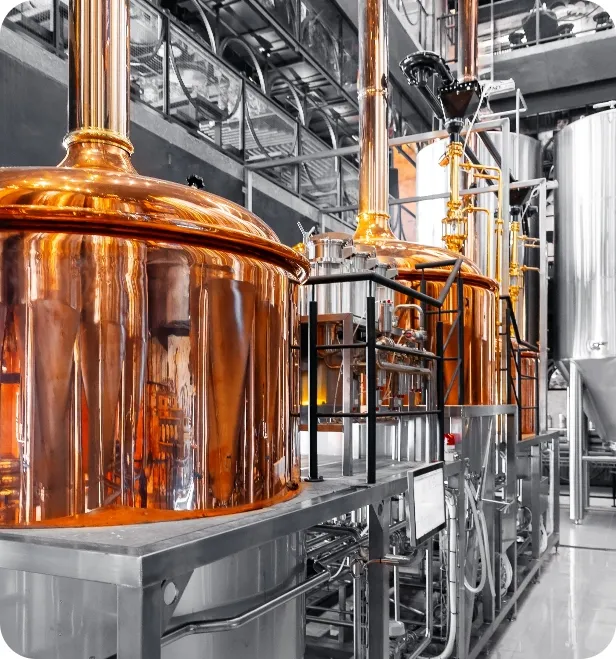
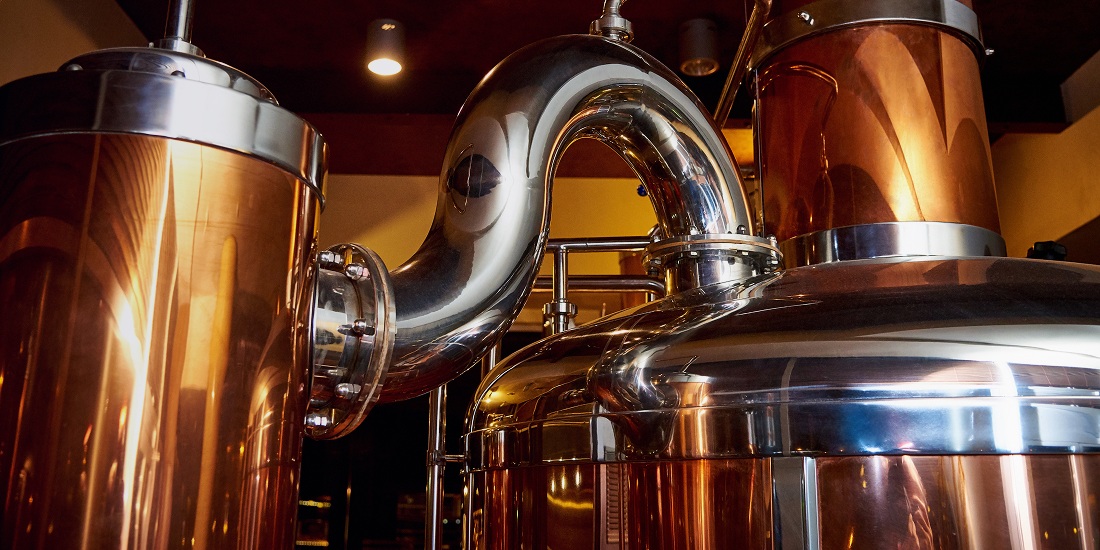
Flow Scheduling Brew Kettles

What is Flow Scheduling Software?

  • ICRON is a software provider delivering Flow Scheduling as part of an end-to-end supply chain planning platform. Flow scheduling software supports the creation and execution of production schedules in environments where material flows, tanks, lines, and strict operational rules are tightly interconnected.

  • In liquid manufacturing, even small disruptions can cascade into downtime, quality risks, and missed commitments. Flow scheduling explicitly models flow behavior, tank capacities, routing logic, and time-dependent constraints so schedules reflect actual production realities rather than simplified assumptions.

  • Unlike generic APS or discrete production scheduling tools, flow scheduling is purpose-built for continuous, batch, and tank-based operations where shared storage and flow dependencies must be modeled explicitly.

How ICRON Supports Flow Scheduling Decisions

ICRON Flow Scheduling provides a purpose-built, AI-driven and optimization-based environment designed for liquid manufacturing and other highly constrained operations.

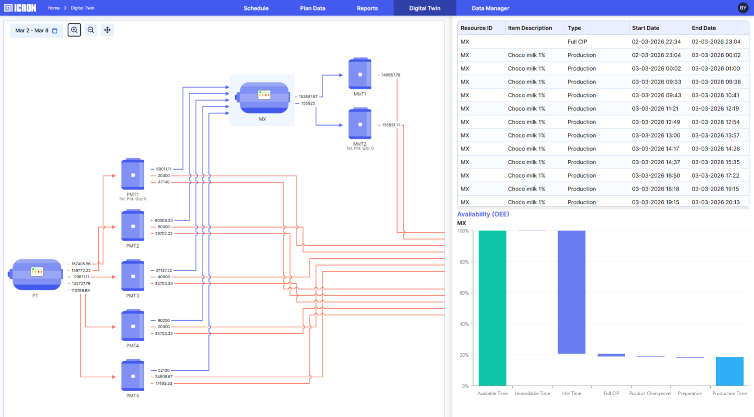
By unifying operational data, tracking tank behavior, and simulating flow interactions through a native digital twin, the solution gives planners end-to-end visibility and a dynamic decision framework to adjust schedules quickly as conditions change.

Core Flow Scheduling Capabilities

  • Constraint-based scheduling across tanks, lines, and flow networks

  • Explicit modeling of flow rates, tank capacities, and routing rules

  • Instant rescheduling under material, capacity, or execution changes

  • Native digital twin simulation for what-if analysis and decision validation

ICRON Recognized as a Representative Vendor in the 2026 Gartner® Market Guide for Supply Chain Network Design Tools

ICRON Recognized as a Representative
Vendor in the 2026 Gartner® Market Guide
for Supply Chain Network Design Tools

Read More

How ICRON Addresses Flow Scheduling Challenges

Liquid production introduces a level of complexity that makes scheduling one of the most demanding tasks in manufacturing.

The interaction between tanks, lines, flow rates, and strict operational rules means even a small oversight can disrupt the entire plan.

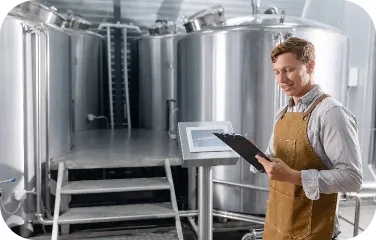
Technician reviewing production data on tablet in front of large industrial tanks.

End-to-End Visibility

Fragmented visibility across tanks, materials, and capacity often prevents planners from anticipating downstream effects.

Worker in safety jacket taking notes on clipboard inside a manufacturing facility.

Material And Supply Alignment

Unplanned inventory shortages or timing misalignment can halt production and destabilize schedules.

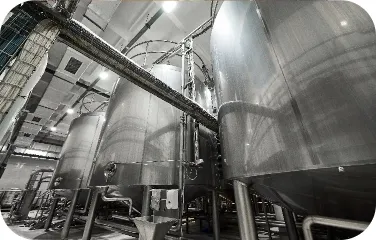
Large stainless steel storage tanks inside an industrial processing plant.

Balanced Resource Utilization

Overloaded lines and idle tanks reduce overall effectiveness and constrain throughput.

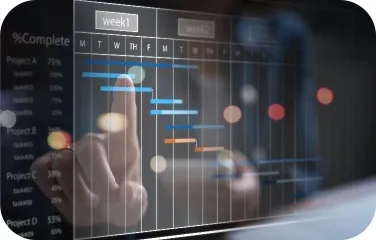
Digital production planning dashboard with charts and timelines on a touchscreen.

Consistent Scheduling Execution

Manual adjustments introduce variation and reduce repeatability across shifts and sites.

Factory worker in safety vest inspecting stacked materials with a handheld device.

Rapid Disruption Response

Quality incidents, cleaning requirements, and equipment changes demand rapid re-optimization.

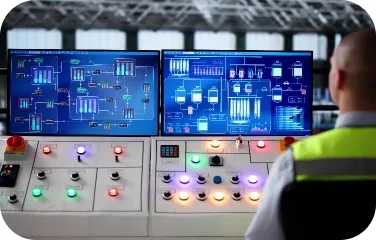
Control room operator monitoring multiple industrial process screens and panels.

Flow-Specific Operational Rules

Precedence dependencies, CIP requirements, simultaneous filling and emptying, and tank treatment rules require mathematical modeling rather than manual coordination.

What ICRON Delivers Across End-to-End Flow Scheduling

Advanced Scheduling and Sequencing

  • Executable schedule generation across interconnected tanks, lines, and materials as illustrated in brewery flow environments .
  • Sequencing aligned with routing rules, capacity limits, and sanitization constraints
  • Rapid re-optimization when materials, capacity, or conditions change
  • Support for continuous flow, shared tanks, simultaneous filling and emptying, and varying vessel sizes

Integrated End-to-End Visibility

  • Unified visibility across tanks, materials, production orders, and capacity
  • Real-time monitoring of flow behavior, tank levels, delays, and bottlenecks
  • Forward and backward pegging to trace demand and material dependencies
  • ATP and CTP evaluation grounded in real flow and capacity constraints
  • Configurable rules reflecting quality, routing, and operational requirements

Scenario-Based Planning and What-If Analysis

  • Creation and comparison of alternative scheduling scenarios aligned with broader supply chain network decisions
  • Clear assessment of capacity, material feasibility, and delivery impact
  • Structured visual analysis to support confident decision-making
  • Insight into root causes of instability and performance gaps

Native Digital Twin

A dynamic production model replicates tank interactions, routing dependencies, and flow behavior. Scheduling decisions can be validated before execution, with real-time impact visibility across materials, capacity, and downstream commitments. Side-by-side comparison enables selection of the most resilient plan while accelerating planning cycles.

Flow Scheduling Across Industries

Flow scheduling is particularly critical in industries where production continuity depends on synchronized flows and tank-based operations:

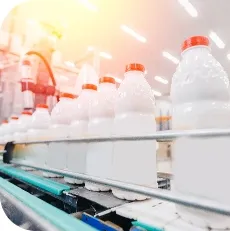
Bottles of dairy produced

Flow Scheduling for Dairy

Manages shared tanks, CIP and sanitization constraints, shelf-life sensitivity, and continuous flow between processing, storage, and filling operations.

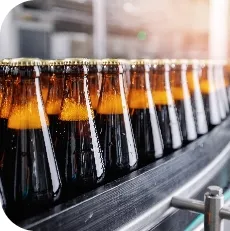
Bottles of beer produced

Flow Scheduling for Beer and Breweries

Coordinates fermentation tanks, conditioning stages, packaging lines, and cleaning cycles to maintain throughput, quality, and production stability.

Flow Scheduling Customer Stories, Use Cases, and Industry Insights

ICRON supports flow scheduling initiatives for liquid and tank-based manufacturing environments across food and
beverage, chemicals, life sciences, and process industries.

Together, these examples demonstrate how flow-based scheduling principles translate from strategy into execution.

Customer Story

Flow Scheduling for a Large-Scale Brewery Operation

A large brewery implemented ICRON to stabilize production flow across fermentation, conditioning, and bottling operations. The organization modeled CCV fermentation tanks, BBT storage tanks, sanitization requirements, transfer lines, and packaging dependencies within a flow-based scheduling environment to reflect real tank behavior and biological timing constraints.

Instead of relying on static sequencing, planners evaluated decisions through a digital twin capable of simulating flow dependencies, routing constraints, and freshness-sensitive processes across the brewery.

What it delivered: Clear identification of tank misalignment and fermentation-driven bottlenecks, improved coordination between fermentation and bottling stages, and scenario-based evaluation of disruptions such as delayed sanitization or material variability. Flow scheduling replaced reactive firefighting with system-wide visibility and consistent, constraint-aware planning across brewing and packaging layers.
Read The Customer Story
Blog

Flow Scheduling for Modern Brewery Operations

This article explores why breweries, operating with fermentation cycles, tank dependencies, and freshness-driven constraints, increasingly require flow-based scheduling instead of static production plans. It highlights how traditional tools struggle to capture real liquid flow behavior, often leading to bottlenecks, idle bottling lines, and recurring scheduling disruptions despite strong operational expertise.

By introducing digital twins, real-time visibility, and scenario-based planning, breweries can model CCV and BBT tanks, routing constraints, yeast timing, and packaging dependencies within a single flow-driven environment. This enables planners to evaluate decisions before execution and understand system-wide impacts across brewing and packaging processes.

Key outcomes: Improved visibility into flow constraints, stronger alignment between fermentation and packaging, faster response to disruptions, and more reliable schedules that support freshness, service performance, and operational stability.

Read The Blog

Business Results of Flow Scheduling

Flow scheduling is best suited for manufacturers operating tank-based, flow-driven production environments with strict sequencing, sanitization, and routing constraints, particularly in liquid and process industries.

Organizations using ICRON Flow Scheduling achieve measurable improvements across production stability, responsiveness, and resource utilization:

Flow Scheduling FAQ

1. What is flow scheduling software?

Flow scheduling software is a specialized form of production scheduling designed for liquid, batch, and continuous manufacturing environments where materials flow through interconnected tanks, lines, and processing units under strict operational constraints.

2. How is flow scheduling different from production scheduling and APS?

Flow scheduling explicitly models flow rates, tank capacities, routing logic, and time-dependent operational constraints, whereas production scheduling and APS tools typically assume discrete jobs and simplified capacity that are insufficient for liquid and tank-based manufacturing.

3. When is flow scheduling required instead of standard APS?

Flow scheduling is required when production involves tanks, continuous or batch flows, shared storage, strict sequencing rules, or simultaneous filling and emptying, which are common conditions in liquid manufacturing environments.

4. Which industries benefit most from flow scheduling?

Industries such as dairy, beer and beverages, chemicals, pharmaceuticals, food processing, and other liquid or process manufacturing sectors benefit most from flow scheduling due to their reliance on synchronized flows and shared production assets.

5. Can flow scheduling handle both batch and continuous production?

Flow scheduling supports batch, continuous, and hybrid production environments by modeling time-dependent flows and shared resources within a single scheduling framework.

6. How does flow scheduling model tanks and storage constraints?

Flow scheduling explicitly tracks tank capacities, fill levels, availability windows, and treatment or cleaning requirements to ensure production schedules remain feasible at all times.

7. How does flow scheduling prevent cascading disruptions?

By modeling system-wide dependencies across tanks, lines, materials, and production stages, flow scheduling identifies downstream impacts early and enables rapid rescheduling before disruptions escalate.

8. Can planners reschedule instantly when disruptions occur?

Planners can perform instant, optimization-driven rescheduling when materials, capacity, or operational conditions change within ICRON Customer Centri Supply Chain Planning.

9. How does flow scheduling support ATP and CTP?

Flow scheduling integrates ATP and CTP logic with real flow and capacity constraints, ensuring delivery commitments are based on feasible production plans rather than theoretical availability.

10. What role does pegging play in flow scheduling?

Backward and forward pegging expose dependencies between demand, materials, tanks, and production stages, helping planners understand how any change propagates across the system.

11. How does a digital twin support flow scheduling?

A native digital twin simulates tanks, flows, and routing behavior, allowing planners to test scheduling decisions virtually before execution and compare scenarios side by side.

12. Does flow scheduling support simultaneous filling and emptying?

Flow scheduling explicitly supports simultaneous filling and emptying, shared tank usage, and overlapping operations that are common in liquid production environments.

13. How does flow scheduling improve production stability?

By aligning sequencing, flow rates, and tank usage under real operational constraints, flow scheduling reduces unplanned stoppages, bottlenecks, and execution variability.

14. Can flow scheduling reduce downtime caused by material shortages?

Flow scheduling reduces downtime caused by material shortages by providing end-to-end visibility into material availability and flow dependencies, enabling proactive schedule adjustments.

15. How does flow scheduling handle cleaning and sanitization constraints?

Flow scheduling incorporates CIP, sanitization, and treatment rules directly into the scheduling logic to ensure compliance without manual intervention.

16. Is flow scheduling suitable for short-term execution planning?

Flow scheduling is designed for short-term, execution-level planning where rapid adjustments and real-time visibility are critical for maintaining production continuity.

17. How does flow scheduling improve decision consistency?

Rules-based optimization standardizes scheduling decisions, reducing reliance on manual judgment and improving repeatability across planners, shifts, and production sites.

18. Can flow scheduling evaluate multiple scenarios?

Flow scheduling enables planners to create and compare multiple what-if scenarios to assess capacity, material, and delivery impacts before committing to a plan.

19. What data is required to implement flow scheduling?

Typical inputs include tank capacities, flow rates, routing rules, production orders, material availability, and operational constraints such as cleaning or precedence rules.

20. Who should use flow scheduling software?

Flow scheduling software is best suited for production planners, operations managers, and supply chain teams responsible for liquid, tank-based, or flow-driven manufacturing environments.

Demand Decision Process

ICRON Demand empowers businesses to navigate uncertainty through accurate forecasting using AI-driven methods that take into consideration historical data, reaTime updates, and fast adaptation to changing market conditions and disruptions.

READ MORE