






 Blogs
Blogs

Introduction
Supply chain network design determines how quickly companies can respond to disruptions by defining sourcing, production, and distribution structures. When disruption occurs, the ability to evaluate scenarios and reconfigure the network becomes a critical factor in recovery speed.
In recent years, global disruptions such as pandemics, geopolitical shifts, energy crises, and supply shortages have exposed structural weaknesses in supply chains. While many organizations focus on operational responses, the real limitation often lies in the network itself. This is why many organizations are turning to supply chain network design software and optimization tools to improve response speed.
Supply chain network design plays a critical role in disruption management, resilience, and decision speed.
Organizations increasingly rely on network design tools and optimization platforms to:
- evaluate multiple scenarios
- balance cost, service, and resilience
- improve recovery speed under disruption
Companies that can evaluate multiple network scenarios and execute decisions quickly under real constraints recover significantly faster. In contrast, organizations with rigid structures take much longer to respond due to limited flexibility in sourcing, production, and distribution.
At a Glance: Supply Chain Network Design in Disruptions
- Supply chain network design directly impacts disruption response and recovery speed
- Network structure, not operational actions, defines performance under disruption
- Scenario evaluation and decision speed are critical competitive advantages
- Continuous network evaluation improves resilience and adaptability
- Integration with supply chain planning enables executable decisions
- Flexible network design is a key differentiator across industries
What Is Supply Chain Network Design?
Supply chain network design is the process of configuring sourcing, production, and distribution structures to balance cost, service levels, and resilience across the supply chain.
In disruption scenarios, network design directly determines how quickly companies can adapt, reconfigure flows, and recover operations.
Organizations increasingly rely on supply chain network design software and optimization tools to model scenarios, evaluate trade-offs, and enable faster, data-driven decision-making.
What Happens to Supply Chain Networks During Disruptions
Disruptions do not impact all supply chains equally.
The same event, such as a supplier shutdown, a port disruption, or a sudden demand shift, can lead to very different outcomes for different supply chains.
Most supply chains are designed for:
- cost efficiency
- stable demand patterns
- predictable flows
They are not designed for:
- rapid change
- supply variability
- continuous reconfiguration
This is also why companies increasingly rely on supply chain network design software and optimization tools to evaluate scenarios faster.
Why Some Supply Chain Network Designs Have Limited Response Speed
When disruptions occur, companies react operationally:
- expediting shipments
- adjusting production
- reallocating inventory
But these actions are constrained by the network itself.
If the network is rigid:
- alternative sourcing options are limited
- production flexibility is restricted
- distribution paths are fixed
Response speed is therefore limited by network design.
Organizations that already have network design capabilities can:
- build scenarios
- evaluate alternatives
- analyze trade-offs
Yet in disruption scenarios:
- decisions are slow
- trade-offs are unclear
- execution is delayed
The main limitation of supply chain network design is not modeling capability, but the ability to execute decisions under real operational constraints.
Recent industry analyses and market evaluations highlight a clear shift toward integrating network design with broader planning processes.
Signs Your Network Design Limits Disruption Response
In many organizations, network design limitations only become visible during disruption.
Common signs include:
- Slow decision-making despite having analytical models
- Inability to evaluate multiple scenarios quickly
- Limited flexibility in sourcing or production
- Misalignment between analysis and execution
- Difficulty incorporating real constraints into decisions
- Heavy reliance on spreadsheets or manual processes for scenario analysis
How to Assess Supply Chain Network Design for Disruption Readiness
Most organizations believe they are prepared because they have analytical models in place.
Many organizations use supply chain network design software solutions and optimization tools to enable faster scenario evaluation and decision-making.
However, disruption readiness is not defined by modeling capability alone.
It is defined by how quickly an organization can evaluate scenarios, make decisions, and execute them under real constraints.
Network Design Maturity Self-Assessment
The following self-assessment helps identify whether your network design capability supports fast and executable decisions under disruption.
For each question, rate your capability:
0 = Not in place
1 = Partially in place
2 = Fully operational
Scenario Agility
-
Can you generate and compare multiple network scenarios within hours?
-
Can scenarios be updated dynamically as conditions change?
-
Can decision-makers explore alternatives without rebuilding models?
Constraint Realism
-
Are capacity, production, and inventory constraints fully reflected?
-
Do scenarios reflect real operational limitations?
-
Can trade-offs be evaluated without oversimplifying the network?
Decision Speed
-
Does it take too much time to move from analysis to decision?
-
Can trade-offs be evaluated in hours instead of weeks?
-
Do decision-makers have direct visibility into outcomes?
Planning Integration
-
Are network decisions connected to S&OP and operational planning?
-
Can scenarios be validated within planning workflows?
-
Are structural decisions aligned with production and inventory plans?
Execution Readiness
-
Can outputs be translated into actionable plans?
-
Are decisions synchronized with execution systems?
-
Can changes be implemented without manual rework?
Continuous Evaluation
-
Is network design evaluated continuously instead of periodically?
-
Can decisions be updated as disruptions unfold?
-
Do you maintain visibility into network performance over time?
To better understand available solutions,
explore the best supply chain network design software and tools 
How to Interpret Your Network Design Score
0 – 4
Reactive Decisions are slow and disconnected from execution.
5 – 8
Analytical Strong modeling exists, but execution speed is limited.
9 – 12
Responsive Faster evaluation, but integration gaps remain.
13 - 18
Adaptive Continuous, fast, and executable decision-making.
This is where competitive advantage emerges.
What This Assessment Reveals About Supply Chain Performance
Across industries, a consistent pattern emerges:
- strong analytical capability
- weak execution alignment
- slow decision cycles
The challenge is not understanding the network. It is acting on it fast enough.
This gap between analysis and execution is one of the most common barriers to improving recovery speed. Organizations that close this gap gain a significant advantage in disruption scenarios.
Want to understand how your current network design performs under real disruption scenarios?
Explore how companies evaluate supply chain network design decisions and trade-offs
Real Example: How Network Design Affects Recovery Speed
Consider a global manufacturer facing a sudden supplier shutdown.
Company A
- limited sourcing flexibility
- fixed production allocation
- periodic evaluation
recovery takes months
Company B
- flexible sourcing and production
- continuous scenario evaluation
- integrated planning
recovery happens within weeks
The difference is the ability to evaluate and execute decisions quickly.
This type of scenario is increasingly used by organizations to test supply chain resilience and decision speed under disruption.
This difference is not driven by better data or more analysis. It is driven by the ability to evaluate realistic scenarios and execute decisions quickly under constraints.
How ICRON Improves Supply Chain Network Design and Decision Speed
ICRON has been recognized as a Representative Vendor in the 2026 Gartner® Market Guide for Supply Chain Network Design Tools.
This recognition is a testament to ICRON’s approach to integrating network design with supply chain planning and enabling more actionable decisions.
Organizations that improve recovery speed do not rely on better analysis alone. They use platforms that connect network design with real planning decisions.
Unlike traditional approaches that rely on periodic studies, ICRON enables continuous network design as part of an integrated decision-making environment.
This allows organizations to move from static analysis to ongoing, executable decision-making under real constraints.
ICRON enables organizations to move beyond static network design and make continuous, executable decisions under real constraints.
This approach directly addresses one of the most critical gaps in supply chain network design: the disconnect between analysis and execution.
As a result, organizations can significantly improve decision speed, adaptability, and recovery performance during disruptions.
Figure 1: Network structure and constraint-based modeling environment in ICRON
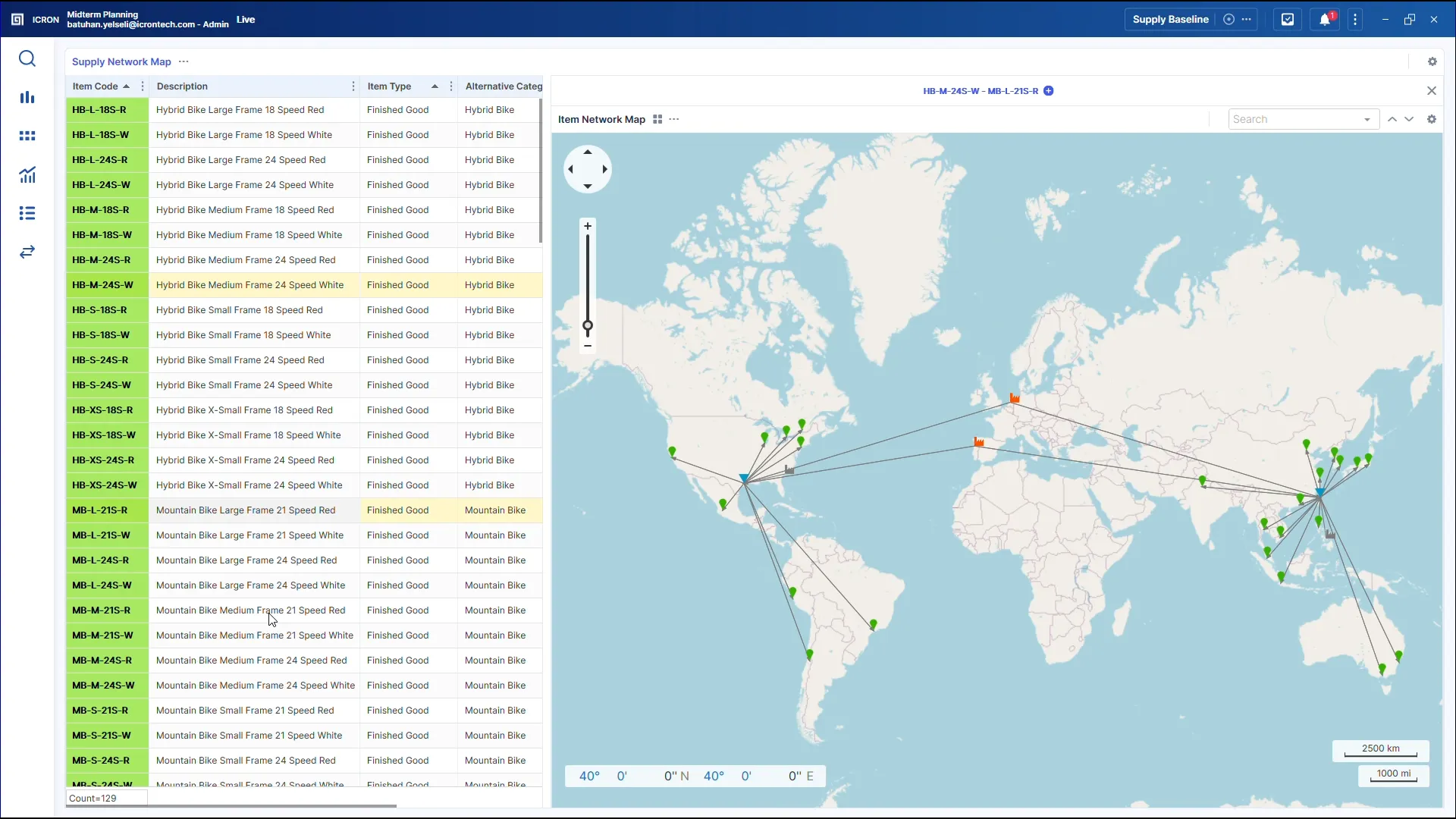
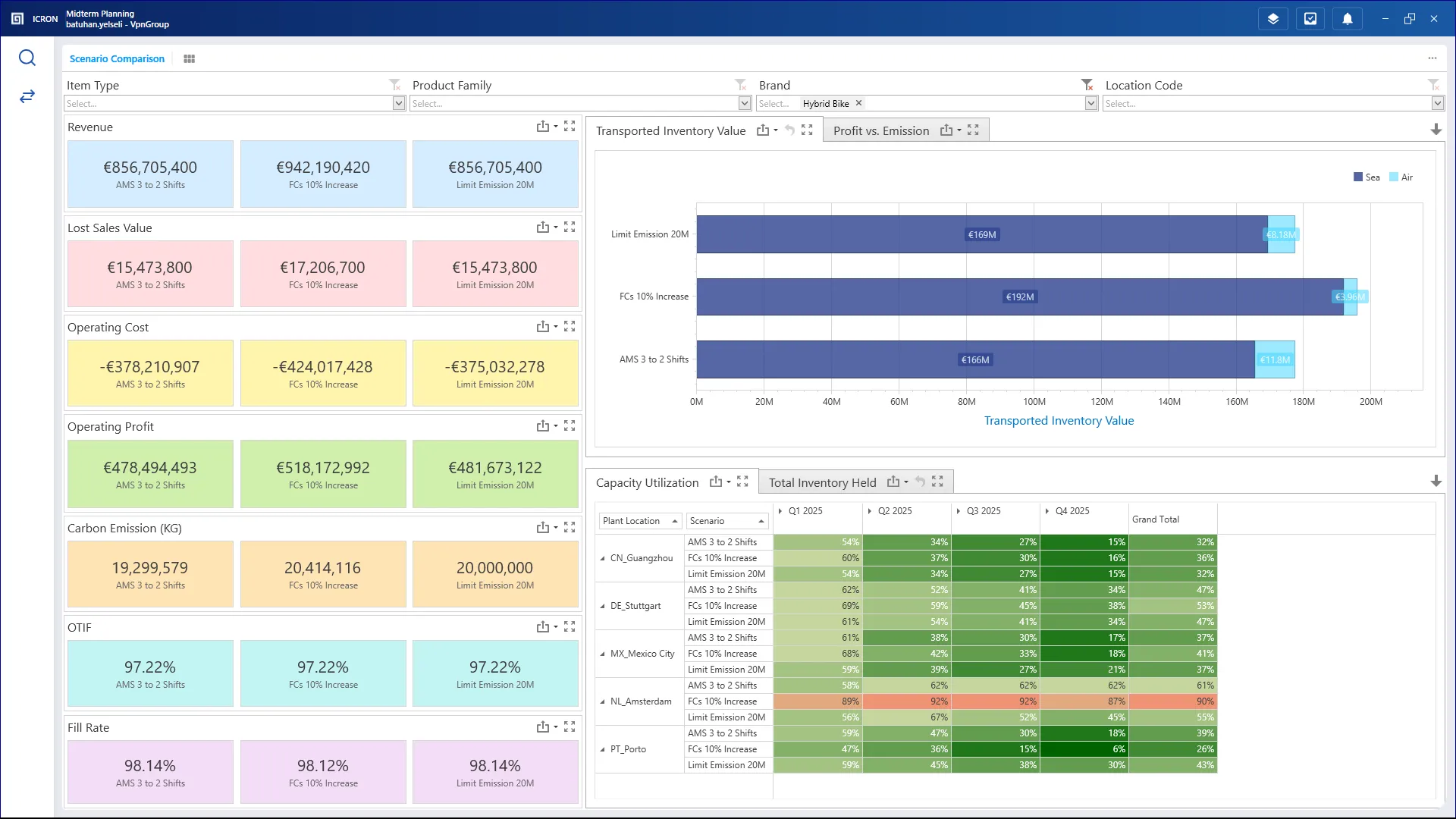
Figure 2: Scenario comparison enabling faster and more informed network decisions
Integration with Supply Chain Planning Processes
Integrated with end-to-end supply chain planning processes, including S&OP, capacity planning, production planning, and inventory optimization.
Faster Decision Cycles
- rapid scenario evaluation
- immediate visibility of trade-offs
- continuous decision updates
- reducing the time from analysis to decision from weeks to hours
- Balanced Decision-Making
ICRON evaluates:
- cost
- service
- resilience
- ESG concerns
By integrating structural optimization with downstream and upstream planning layers, network design becomes part of an ongoing decision architecture rather than an isolated analytical exercise.
This enables organizations to align structural network decisions with operational planning and long-term supply chain strategy.
How Network Design Requirements Vary by Industry
While the core principles of network design remain consistent, industry-specific constraints and priorities significantly impact how decisions are evaluated and executed.
| Industry | Network Design Challenge | Why It Matters in Disruption |
|---|---|---|
| Consumer Goods | High demand variability and complex distribution networks | Requires rapid inventory reallocation and flexible distribution |
| Chemicals | Multi-stage production dependencies and sourcing constraints | Disruptions cascade across production stages |
| Food and Beverage | Shelf-life constraints and time-sensitive delivery | Delays directly impact product usability |
| Pharmaceuticals | Regulatory constraints and strict service requirements | Supply continuity is critical |
Although these challenges differ by industry, the underlying requirement remains the same: the ability to evaluate and execute network decisions quickly under real constraints.
Supply Chain Network Design FAQs
Why do some companies recover faster from supply chain disruptions?
Companies recover faster because they can evaluate and execute network decisions quickly under real operational constraints. This enables them to adapt sourcing, production, and distribution flows without delays.
What is the main limitation of supply chain network design?
The main limitation of network design is that it is often disconnected from execution, making it difficult to translate analysis into actionable decisions during disruptions. This is why companies increasingly rely on network design software and tools to bridge the gap between analysis and execution.
What does continuous network design mean?
Continuous network design means updating network decisions dynamically, rather than relying on periodic or one-time analysis.
What is the difference between network design and supply chain planning?
Network design focuses on structural decisions such as facility locations, capacity allocation, and product flows. Supply chain planning focuses on operational decisions such as production, inventory, and demand fulfillment. Integrating both enables faster and more effective decision-making.
When should companies redesign their supply chain network?
Companies should redesign their network when they face structural changes such as demand shifts, sourcing disruptions, cost increases, mergers, or expansion into new markets.
How does network design impact disruption response?
Network design determines how quickly companies can respond to disruptions by defining available sourcing options, production flexibility, and distribution paths. A flexible network enables faster adaptation and recovery.
How to Improve Supply Chain Network Design in 5 Steps
Improving supply chain network design requires more than periodic analysis. Organizations need a structured approach to evaluate, decide, and execute under disruption.
1. Increase scenario agility
Generate and compare multiple network scenarios within hours instead of weeks.
2. Incorporate real-world constraints
Ensure capacity, sourcing, and production constraints are fully reflected in every scenario.
3. Reduce decision latency
Enable decision-makers to evaluate trade-offs instantly and act without delays.
4. Integrate network design with planning
Connect network decisions directly with S&OP, production, and inventory planning.
5. Enable continuous evaluation
Move from one-time studies to ongoing network evaluation as conditions change.
Key Takeaways: How to Improve Supply Chain Network Design for Faster Recovery
-
Network design directly impacts recovery speed
-
Structural flexibility matters more than static optimization
-
Decision speed is a competitive advantage
-
Integration with planning enables execution
-
Continuous evaluation improves resilience
Final Thought
When supply chains break, efficiency is no longer enough.
The companies that recover fastest are those that can adapt their network quickly and execute decisions under real constraints.
This capability is not built during disruption. It is designed into the network in advance.
Evaluate Your Network Design Capability
If your organization cannot evaluate and adapt its supply chain network fast enough, disruptions will continue to impact performance.
The question is not whether your network is optimized.
It is whether your organization can adapt it in time.
ICRON enables companies to evaluate network scenarios, align decisions with planning, and respond faster under real constraints.
Test how your supply chain network performs under real disruption scenarios.