






 Blogs
Blogs

At a Glance
This article compares top supply chain network design software platforms and explains how to evaluate them based on modeling depth, scenario analysis speed, scalability, and planning integration.
These solutions help organizations model supply chain structures, evaluate trade-offs across cost, service level, resilience, and inventory, and make better structural decisions under real-world constraints.
As supply chains become more volatile and globally distributed, companies need network design tools that support scenario modeling and connect structural decisions to planning and execution.
Why Network Design Has Become More Important
Over the past decade, supply chain complexity and cost pressure have increased significantly. As a result, many organizations evaluate their network structures more frequently to understand how changing demand patterns, cost structures, and supply risks affect performance.
What Supply Chain Network Design Software Does
Supply chain network design software helps organizations model facilities, sourcing options, production flows, and distribution structures in order to evaluate strategic supply chain decisions.
These platforms are used to compare structural alternatives, assess trade-offs across cost, service levels, resilience, and inventory, and support scenario-based decision-making under business constraints.
Want a broader view of supply chain network design?
For a broader view of supply chain network design, read our related article on key strategic decisions and trade-offs.
Supply Chain Network Design: Key Strategic Decisions & Trade-Offs 
Key Questions Network Design Software Helps Answer
Organizations use supply chain network design software to evaluate strategic questions such as:
- Should new distribution centers be added in emerging markets?
- How would transportation costs change if production locations shift?
- How would supply disruptions affect service levels across regions?
- What network structure minimizes total logistics cost while maintaining service commitments?
- How should production capacity be allocated across multiple facilities?
These questions show why supply chain network design software is often evaluated not just for modeling accuracy, but also for how quickly it can generate actionable scenario insights.
Common use cases include facility location decisions, production allocation, sourcing strategy evaluation, and distribution flow optimization.
Network design software enables decision-makers to analyze these questions using structured optimization models and scenario simulations.
How Network Design Is Used Across Industries
| Industry | Typical Network Design Focus |
|---|---|
| Consumer Goods | Distribution center placement and regional demand fulfillment |
| Chemicals | Production allocation, raw material sourcing, and transportation cost optimization |
| Food & Beverage | Distribution hub placement to balance freshness, service levels, and logistics costs |
| Pharmaceuticals & Life Sciences | Regulatory constraints, cold chain distribution, and global supply reliability |
Because requirements vary by industry, organizations often evaluate network design software based on the specific constraints, service expectations, and supply chain complexity of their operating model.
Standalone vs Integrated Network Design Software
Supply chain network design software platforms differ not only in functionality, but also in how closely they are connected to broader supply chain planning processes. In practice, organizations often compare these solutions based on whether network design is used as a standalone analytical tool or embedded within a wider planning environment.
Standalone Network Design Tools
Standalone tools are often used for periodic strategic studies. They help organizations evaluate structural alternatives, compare scenarios, and support long-term network design decisions.
Integrated Planning Platforms
Integrated platforms embed network design within broader supply chain planning processes such as S&OP, production planning, and inventory optimization.
This allows organizations to evaluate structural decisions more continuously and align them more closely with operational planning.
This distinction matters because it determines whether network design remains a periodic analytical exercise or becomes a more continuous capability.
Standalone vs Integrated Approaches at a Glance
| Approach | Core Capability | Typical Use |
|---|---|---|
| Standalone network design tools | Focused scenario analysis and structural evaluation | Periodic strategic network design studies |
| Integrated planning platforms | Network design embedded within supply chain planning processes | Continuous evaluation aligned with S&OP and operational planning |
These differences matter because they determine whether network design remains a periodic analytical exercise or becomes a more continuous and executable capability.
Top Supply Chain Network Design Software Platforms
The platforms listed below are examples of commonly discussed solutions in the market and are included to illustrate different modeling and planning approaches rather than to provide a definitive or exhaustive ranking.
Organizations evaluating these tools typically compare them based on optimization depth, simulation capability, usability, scalability, and how well network design connects to broader planning processes.
-
AIMMS – Focuses on advanced optimization modeling and custom scenario analysis
-
Blue Yonder – Offers integrated supply chain planning with network design capabilities
-
Coupa Supply Chain Design – Provides cloud-based network modeling and scenario evaluation
-
ICRON – Embeds network design within end-to-end supply chain planning to support continuous and executable structural decisions
-
OMP – Combines supply chain planning with strategic network design capabilities
-
Optilogic – Specializes in network optimization and digital supply chain modeling
-
Sophus Technology – Focuses on supply chain design and strategic decision support
-
The AnyLogic Company – Provides simulation-based modeling for dynamic supply chain analysis
Some of these platforms are primarily used for standalone network studies, while others position network design as part of a more integrated supply chain planning environment. That distinction matters because it affects whether analysis remains periodic and isolated or becomes part of a more continuous decision-making process.
Some organizations also develop custom network design models using optimization platforms such as Gurobi.
While all these platforms support network design, they differ significantly in how they approach modeling and decision-making.
Some focus on standalone optimization studies, while others integrate network design into continuous supply chain planning processes.
Understanding these differences is critical when selecting the right solution.
How to Evaluate Supply Chain Network Design Software
Choosing the right supply chain network design software requires more than comparing feature lists. Organizations should evaluate platforms based on modeling capability, scenario analysis speed, scalability, usability, and the degree to which network design is integrated with broader supply chain planning processes.
Modeling Capability
The ability to represent complex supply chain structures is critical. This includes multi-echelon networks, capacity constraints, and multi-objective optimization across cost, service levels, and resilience.
Scenario Analysis and Speed
Effective network design requires the ability to compare multiple scenarios quickly. Platforms differ in how efficiently they can generate and evaluate alternative network configurations.
Integration with Supply Chain Planning
Some platforms operate as standalone analytical tools, while others are integrated into broader planning environments such as S&OP, production planning, and inventory optimization.
Scalability and Data Handling
Large-scale supply chains require platforms capable of handling high data volumes, multiple constraints, and complex network structures without performance degradation.
Usability and Decision Support
User interface, visualization capabilities, and scenario comparison tools influence how effectively decision-makers can interpret and act on model outputs.
Organizations that rely only on standalone network design tools may struggle to translate analysis into execution, especially when supply chain conditions change quickly and structural decisions need to align with planning realities.
Continuous Network Design: The ICRON Approach
Figure 1: ICRON Supply Chain Network Design Interface
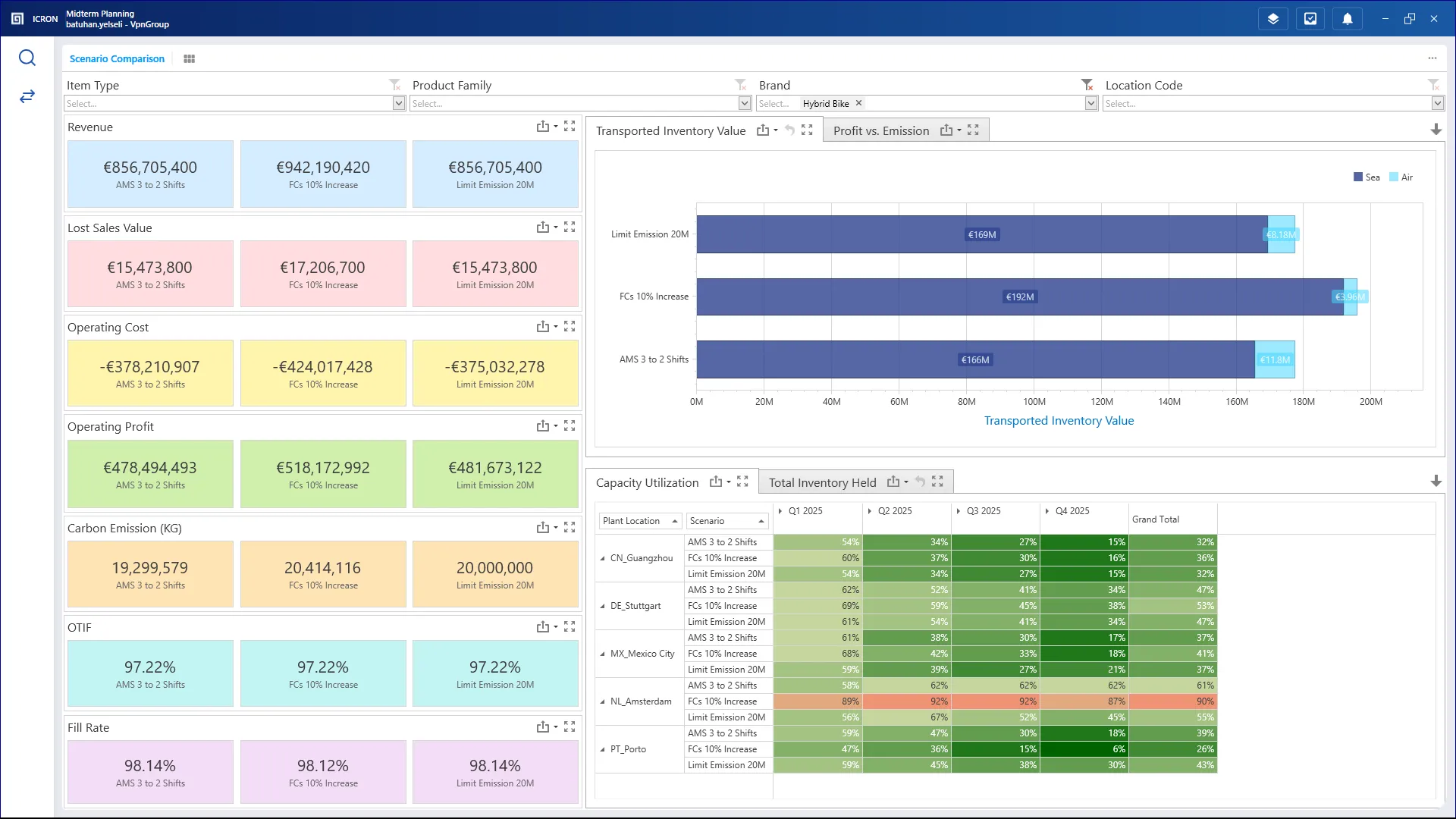
ICRON embeds supply chain network design into broader planning processes, enabling organizations to evaluate structural scenarios under real operational constraints.
Many network design tools are used as standalone analytical solutions for periodic strategic studies. While that approach can support structural analysis, it often leaves network design disconnected from day-to-day planning, operational constraints, and execution-oriented decision-making. ICRON was also mentioned in the Gartner Market Guide for Supply Chain Network Design Tools, reinforcing its relevance in the broader network design software landscape.
ICRON embeds network design directly into broader supply chain planning processes, allowing organizations to evaluate structural scenarios alongside sales and operations planning (S&OP), production & capacity planning, inventory planning.
As a result, companies can assess network alternatives in the context of real operational constraints, compare trade-offs more continuously, and turn structural decisions into faster, more executable actions rather than isolated recommendations.
This makes ICRON particularly relevant for organizations that need network design to function as an ongoing planning capability rather than a periodic standalone study.
Instead of treating network design as a one-time modeling exercise, ICRON enables companies to connect structural decisions with ongoing planning processes, making scenario evaluation more continuous, contextual, and actionable.
For organizations evaluating top supply chain network design software platforms, the key question is not only which tool can model structural alternatives, but also which one can connect those decisions to broader supply chain planning.
ICRON helps companies evaluate network configurations, compare trade-offs across cost, service, and operational constraints, and turn structural analysis into more executable planning decisions.
For companies that want to move beyond static network studies, ICRON offers a more planning-connected approach to structural decision-making.
For a real-world example, see how Bayer Pharmaceuticals used ICRON in its supply chain transformation journey.
Explore how ICRON supports continuous network design, scenario-based evaluation, and faster decision-making under real-world supply chain constraints.
Frequently Asked Questions
What is supply chain network design software?
Supply chain network design software helps organizations evaluate structural supply chain decisions such as facility locations, production allocation, and distribution flows using optimization models and scenario analysis.
What is supply chain network modeling software?
Supply chain network modeling software helps organizations represent supply chain structures digitally so they can evaluate facility locations, sourcing strategies, production allocation, and distribution flows through optimization and scenario analysis.
How often should companies evaluate their supply chain network?
While physical network changes may occur infrequently, many organizations now evaluate their supply chain structure regularly to understand how network configurations perform under changing demand patterns, supply disruptions, and transportation costs.
Which industries use supply chain network design software?
Supply chain network design is widely used in industries with geographically distributed production and distribution networks, including consumer goods, chemicals, food and beverage, and pharmaceuticals.
What is the difference between network design and supply chain planning?
Network design focuses on structural decisions such as facility locations, sourcing strategies, and distribution flows, while supply chain planning focuses on operational decisions such as production, inventory, and demand balancing. Some advanced platforms integrate both, enabling organizations to evaluate structural and operational decisions together.
How should companies evaluate supply chain network design software?
Companies should evaluate supply chain network design software based on modeling capability, scenario analysis speed, scalability, usability, and how well the platform connects structural analysis to broader supply chain planning and execution processes.
What is the difference between standalone and integrated network design software?
Standalone network design tools are often used for periodic strategic studies, while integrated platforms connect network design with planning processes such as S&OP, production planning, and inventory optimization. This makes integrated solutions more suitable for organizations that need continuous evaluation and more executable decisions.
Key Takeaway
Supply chain network design software helps organizations evaluate structural decisions with greater speed, rigor, and visibility. As supply chains become more volatile, the most valuable platforms are those that not only model scenarios, but also help connect network design to broader planning and execution processes. For many organizations, that makes planning integration a critical evaluation criterion rather than an optional feature.