


 Blogs


One plant is fully booked. Another has an open machine. Moving the order seems straightforward, until the second site lacks the approved tooling, materials or time to transfer finished goods.
Multi-site production scheduling coordinates production sequences and resource assignments across manufacturing plants, balancing local resource constraints with network-wide delivery priorities. The aim is not simply to find an available factory, but to determine where and when each order can be produced without creating problems elsewhere.
Why is multi-site production scheduling difficult?
Each plant operates with its own machines, labor skills, calendars, changeovers and material availability. Central production planning may allocate volumes by site, but plant-level finite capacity scheduling determines which operations can actually run and when.
A factory with spare hours is not necessarily capable of producing a particular order. Approved routings, tooling, qualifications and transport time can rule out an apparently attractive assignment.
Distinguish network capacity from qualified capacity: idle equipment is not necessarily capable of meeting an order’s specification or due date.
How do central planning and plant scheduling work together?
Network planning sets demand priorities, production allocations and cross-site commitments. Detailed scheduling translates those decisions into sequences that respect each plant’s operational constraints. Execution feedback then reveals whether the network plan remains achievable.
When a site cannot meet its commitment, teams should evaluate alternatives across the network rather than simply pushing the problem into its local schedule.
Multi-site planning and scheduling connect decisions about where work should be assigned with the resources and timing needed to produce it. By considering site capacity, materials, labor and transfer requirements together, manufacturers can assess how changes at one plant affect production commitments across the network.
Which constraints determine whether work can move between plants?
- Resource eligibility: approved machines, routings, tools and qualified labor at the receiving plant.
- Material readiness: usable components, work-in-progress and replenishment dates by location.
- Interplant dependencies: upstream work, transfers, transport capacity and receiving windows.
- Customer commitments: due dates, priorities, regional requirements and delivery lead times.
- Schedule stability: disruption to orders already assigned at the alternative plant.
Two less visible checks often decide the outcome. First, determine whether the receiving plant has the same approved production process and inspection requirements. Second, assess whether moving work would consume components or tooling already reserved for another order. Both can turn an apparent capacity gain into a new bottleneck.
A three-plant scheduling decision
Consider an industrial manufacturer with three facilities. Plant A has an overloaded finishing resource. Plant B has open machine capacity but requires a lengthy transfer. Plant C can process the order but lacks a qualified operator on the required shift.
The right decision is not automatically to send the order to B or C. Planners first test eligible routings, material availability, transport timing and the consequences for other customer orders.
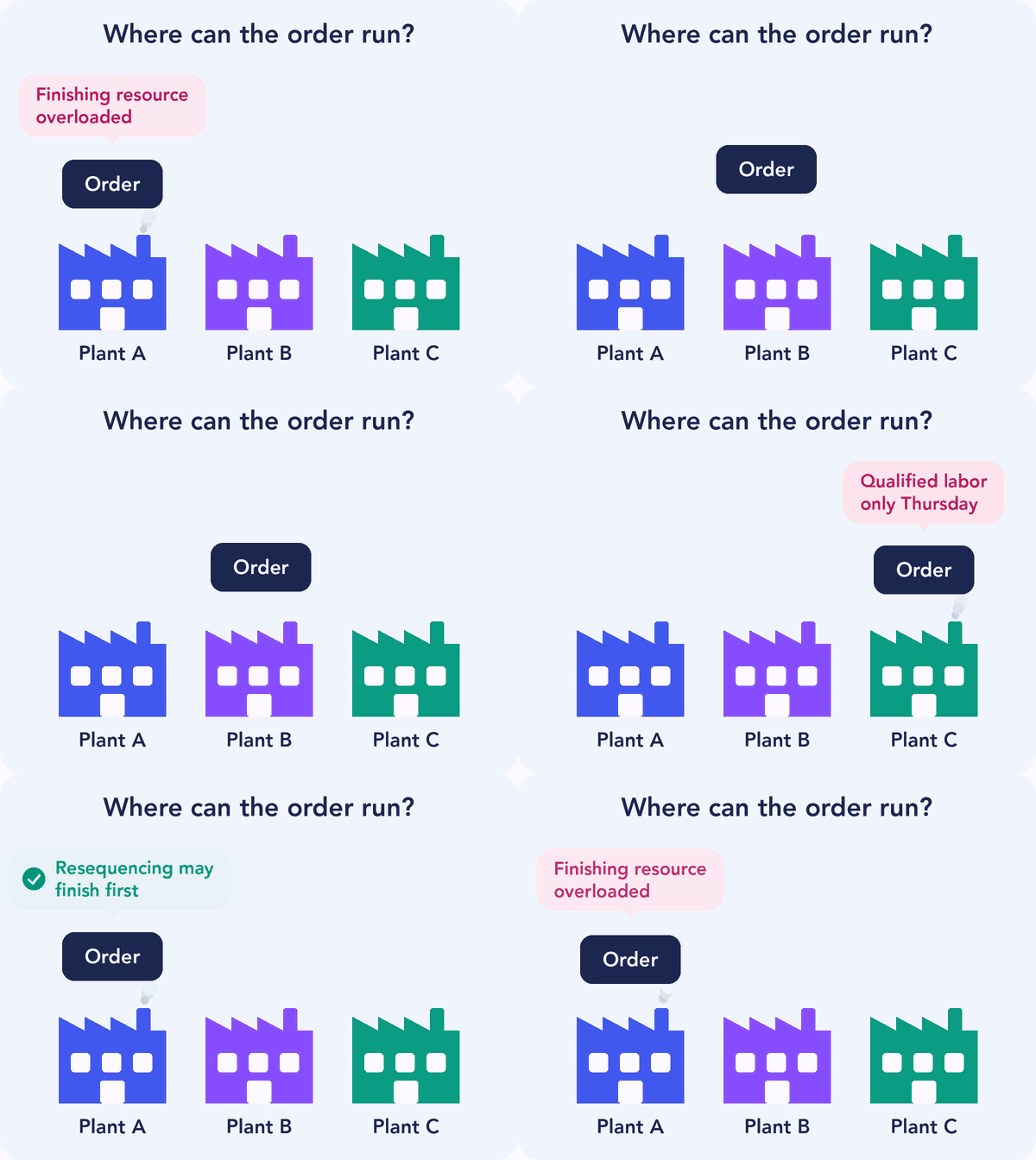
For example, Plant B has a Tuesday slot, but materials arrive Wednesday. Plant C has equipment available Tuesday, but qualified labor only Thursday. Resequencing at busy Plant A may still finish first.
How should manufacturers compare cross-plant alternatives?
| Option | Potential benefit | Constraint to verify |
|---|---|---|
| Keep work at Plant A | Avoids transfer complexity | Can capacity be recovered before the due date? |
| Move to Plant B | Uses open machine capacity | Are transfers and materials ready in time? |
| Move to Plant C | Uses eligible production equipment | Is qualified labor available without displacing other jobs? |
Multi-site production scheduling brings together order-to-plant assignments, resource allocation and production sequencing across manufacturing locations. These connected decisions allow manufacturers to evaluate their impact on delivery performance, capacity utilization, changeovers, transfer requirements and cost.
For each option, planners should compare the earliest achievable completion date, the effect on already-promised orders and the cost of transfer or overtime. The comparison should include knock-on effects: shifting one order may free a constrained resource at Plant A but introduce a setup at Plant B. No single utilization percentage captures that trade-off.
How ICRON supports connected production scheduling
ICRON helps manufacturers coordinate capacity and production scheduling decisions across multiple plants. By connecting Production and Capacity Planning with detailed Production Scheduling, manufacturers can evaluate how production requirements are distributed across facilities and translate those decisions into feasible schedules that account for machine availability, labor, materials and delivery priorities.
When one plant faces a capacity shortage, ICRON generates alternative production allocations and detailed schedules across eligible manufacturing locations, including subcontracted resources. These decisions account for available capacity, resource requirements, delivery priorities and the impact on orders already scheduled at other plants.
Through ICRON’s AI-Native Decision Execution Hub, AI-supported workflows help identify capacity conflicts, coordinate planning decisions and move approved changes toward execution. Manufacturers can respond to disruptions across their production network without treating each facility as an isolated scheduling problem.
Industry recognition adds perspective to complex manufacturing planning. ICRON was recognized in the 2026 Gartner® Magic Quadrant™ for Supply Chain Planning Solutions: Discrete Industries and named a Major Player in the IDC MarketScape: Worldwide Supply Chain Planning for Discrete Manufacturing Vendor Assessment. For manufacturers, the practical priority is turning capacity decisions into feasible production schedules across facilities.
From available capacity to executable commitments
Multi-site scheduling must establish that an order can move and that the resulting plant schedules remain executable.
After release, planners monitor production, material and transfer changes, updating affected commitments without unnecessarily disrupting other sites.
Şişecam operates a global manufacturing network. Its published ICRON customer story describes connecting production planning and scheduling with capacity, demand and enterprise planning across multiple facilities. This demonstrates integrated planning at scale, but it does not establish a specific cross-plant order-transfer result.


Frequently Asked Questions
What is multi-site production scheduling?
It coordinates detailed production schedules across multiple plants, accounting for site-specific resources, materials, dependencies and customer commitments.
How is multi-site scheduling different from production planning?
Planning allocates volumes and capacity across sites; detailed scheduling determines feasible operations, resources and timing inside each plant.
Can ICRON schedule production across multiple plants and subcontractors?
Yes. ICRON supports multi-site production scheduling, coordinating production assignments and resource schedules across manufacturing locations, including subcontracted capacity. The scheduling process takes relevant resource capabilities, site calendars, material availability and delivery commitments into account.
What data is required for multi-plant scheduling?
Orders, routings, capacity calendars, labor and tooling eligibility, material status, transfer lead times and delivery priorities are typical inputs.
How does APS support multi-site manufacturing?
Advanced planning and scheduling can compare capacity and sequencing alternatives, provided cross-site dependencies and local execution constraints are modeled.