


 Blogs


An urgent customer order arrives after the production schedule has been agreed. Adding it may protect a new commitment, but which existing orders, setups and resource assignments would change?
What-if scenario planning in production scheduling lets manufacturers test alternative production sequences against real constraints before releasing changes to the shop floor. Each scenario starts from the same baseline and shows the likely consequences for delivery, utilization, changeovers, cost and schedule stability.
A useful what-if analysis shows how proposed schedule changes affect delivery commitments, available capacity and the stability of already-released work before anything changes on the shop floor.
What is what-if scenario planning in production scheduling?
Production scheduling scenario analysis compares possible schedule changes without immediately altering the approved production sequence. It is different from simply moving tasks on a Gantt chart: alternatives must be tested for feasibility under machine, labor, materials, setups and operation dependencies.
What-if scenarios answer questions such as: Can an urgent order fit? Which orders would become late? Would an alternative machine reduce disruption? Is overtime justified?
A scenario is a controlled test, not a shop-floor instruction. Teams can discuss the consequences while the released schedule remains unchanged.
How to compare production schedules in five steps
- Capture the baseline. Preserve current orders, promised dates, resource assignments and constraints.
- Define the change. Introduce an urgent order, a new deadline or another controlled assumption.
- Generate revised schedules. Explore resequencing, alternative machines, extra shifts or revised order priorities.
- Compare consistent KPIs. Examine delivery risk, utilization, changeover time, cost and schedule stability.
- Approve and release. Choose a schedule that meets the agreed priorities, communicate affected commitments and monitor execution.
Good comparisons keep the planning horizon and shared inputs consistent while documenting the assumptions deliberately changed in each scenario. If one option assumes material arrives Monday and another Wednesday, that difference must be explicit when comparing results. Record assumptions and any protected operations so that the selected response can be explained and reproduced.
Example: A priority order enters a near-full schedule
A manufacturer receives a rush order while two shared machining resources are almost fully committed. Scheduling the new order first could delay three existing jobs; assigning it to another machine requires an additional setup.
The planning team creates three alternatives from the same baseline instead of immediately changing the live schedule.
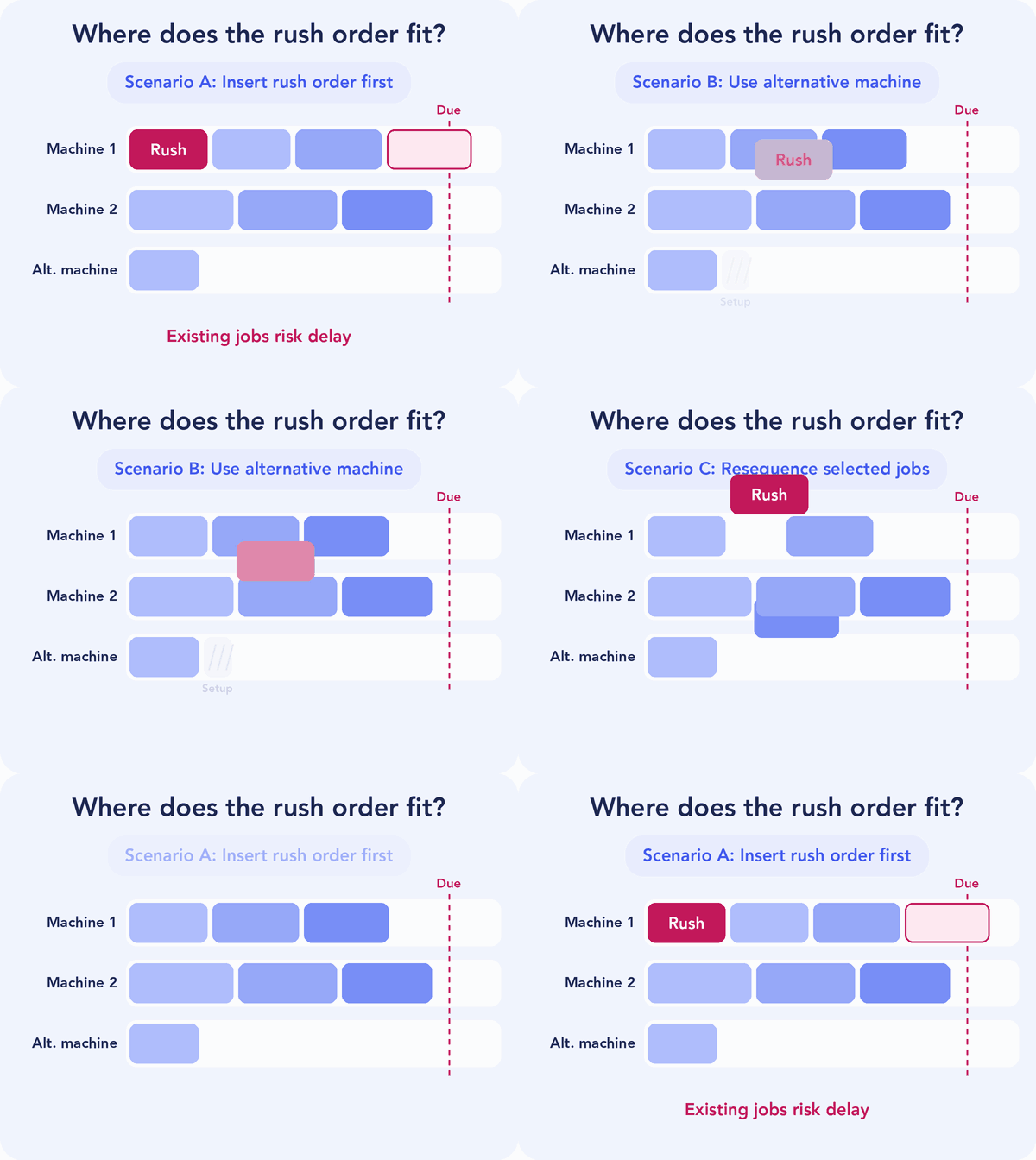
Scenario A prioritizes the rush order but risks delaying others. Scenario B uses an eligible alternative machine with an extra setup. Scenario C resequences a smaller set of jobs. All three must satisfy material, tooling and labor requirements.
Which KPIs matter when comparing scheduling scenarios?
| Scenario | Potential advantage | Trade-off to examine |
|---|---|---|
| A: Insert rush order first | Protects the new deadline | Late existing orders and schedule instability |
| B: Use alternative machine | May preserve existing commitments | Extra setup time, capability and labor limits |
| C: Resequence selected jobs | May reduce disruption | Rush order completion and downstream dependencies |
Use the same planning horizon and make any changes to assumptions explicit. Useful measures include on-time delivery, lateness, resource utilization, setup hours, overtime and the number of previously released operations changed. A high-utilization option may still be inferior if it jeopardizes critical commitments.
Schedule stability also matters. Track how many released operations move and how close those changes occur to execution. Improved utilization may not justify widespread disruption.
How Can a What-If Scenario Reveal the Real Trade-Offs?
A scenario can look attractive on a Gantt chart yet create overlapping machine assignments, start before a material delivery or delay a prerequisite operation. Constraint-aware scheduling generates revised sequences and resource assignments around modeled conditions, while scenario analysis shows what those changes mean for delivery promises, setup time, capacity use and disruption to existing work.
Scenario analysis should also expose uncertainty. If material arrival times or processing durations are unreliable, decision-makers need to understand how sensitive their preferred option is to those assumptions.
A second test is robustness. If a selected scenario depends on every machine operating at its maximum rate or a component arriving at the last possible minute, it may be fragile. Testing a slightly longer processing time or later material receipt can reveal whether the preferred option remains workable under plausible variation.
How ICRON supports what-if production scheduling
ICRON Production Scheduling helps manufacturers build schedules around machine capacity, labor availability, material readiness, setup requirements and operation dependencies. Through the interactive Gantt chart, planners can see how a change shifts operations, available capacity and delivery commitments before updating the shop-floor schedule.
Beyond individual what-if analyses, ICRON’s broader scenario-based planning capabilities help manufacturers evaluate alternative decisions and understand their operational consequences. Connected with detailed production scheduling, this supports coordinated choices about capacity, delivery commitments and resource allocation. Through ICRON’s AI-Native Decision Execution Hub, approved decisions can be connected to governed execution workflows.
Industry recognition adds another perspective. ICRON was featured in the Gartner Market Guide for Detailed Manufacturing Scheduling and named a Major Player in the IDC MarketScape: Worldwide Supply Chain Planning for Discrete Manufacturing Vendor Assessment. For manufacturers, the priority remains turning these planning capabilities into workable schedules and dependable delivery commitments.
Decide before disrupting the shop floor
What-if scheduling makes consequences visible before a proposed change disrupts production.
After approval, document the decision, release necessary updates and monitor affected jobs to test whether assumptions hold in practice.
Frequently Asked Questions
What is a what-if scenario in production scheduling?
It is a proposed change to orders, capacity, priorities or sequencing that is evaluated against a baseline before implementation.
How do planners compare two production schedules?
Use a consistent planning horizon, document deliberately changed assumptions, and compare delivery performance, utilization, setups, cost, risk and schedule stability.
Can scenario planning prevent late orders?
It cannot guarantee every due date, but it can reveal delivery risks and show how revised schedules affect commitments before a change is released.
How is scenario analysis different from generating a production schedule?
Scheduling generates job sequences and resource assignments for defined conditions; scenario analysis compares the consequences of changes to orders, priorities or capacity before a plan is released.
Does AI replace the production scheduler in what-if planning?
No. AI can help gather context, initiate planning workflows and explain trade-offs; scheduling engines generate revised plans while people govern priorities and significant commitments.