






 Blogs
Blogs

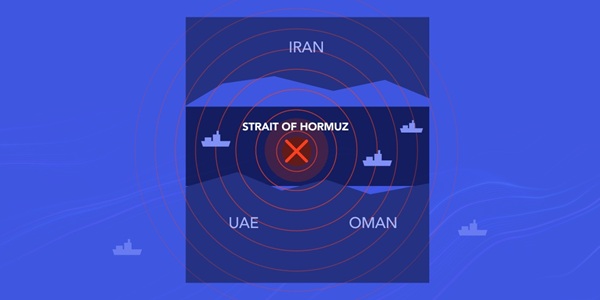
On the morning of 28 February 2026, a coordinated military operation against Iran triggered what many supply chain professionals had long feared but few had adequately planned for: the effective closure of the Strait of Hormuz. Within hours, Iran’s Islamic Revolutionary Guard Corps broadcast warnings that no vessel would be permitted to pass. By nightfall, tanker traffic had plummeted by roughly 70%, and four of the world’s largest container shipping lines (Maersk, MSC, Hapag-Lloyd, and CMA CGM) had formally suspended transits. An estimated 170 containerships carrying around 450,000 TEUs of cargo were effectively stranded.
This is not a hypothetical scenario exercise. It is happening right now. And it is a defining moment for supply chain leadership everywhere, even if your business has no direct trade relationship with the Middle East or the Gulf states.
This blog explores why the Hormuz closure matters far beyond the region, how its effects compound across the globe, and, most critically, how strategic supply chain network design can serve as both shield and sword in navigating the turbulence ahead.
1. Why the Strait of Hormuz Matters, To Everyone
The Strait of Hormuz is a narrow passage, barely 33 kilometres wide at its tightest point, located between Iran and Oman. Despite its modest geography, it is the single most critical energy chokepoint on Earth. Roughly 20 million barrels of crude oil and petroleum products transit the waterway every day, representing about 20% of the world’s daily oil supply. It also handles around 22% of all globally traded liquefied natural gas (LNG), almost all of which originates in Qatar.
But the Strait’s importance extends well beyond energy. According to the UN Trade and Development agency (UNCTAD), the waterway facilitates approximately 11% of total global maritime trade volume. Ports in the region, particularly Jebel Ali in the UAE and Khor Fakkan in Oman, serve as critical transshipment hubs that connect Asian manufacturing to European and African markets. When Hormuz closes, the disruption isn’t limited to oil tankers. It affects container vessels, bulk carriers, and the entire web of logistics networks that depend on Gulf ports as intermediate nodes.
By the Numbers
- ~20 million barrels of oil transit Hormuz daily (~20% of global supply)
- ~22% of global LNG exports flow through the strait
- 11% of total global maritime trade volume depends on Hormuz
- ~170 containerships with 450,000 TEUs were stranded within hours
- Brent crude spiked 10-13% within days of the closure
2. The Compounding Effect: How Disruption Ripples Across the Globe
A common misconception is that the Hormuz closure only affects businesses trading directly with the Gulf. In reality, the disruption compounds through at least six distinct channels, each of which amplifies the others. Even companies with no apparent connection to the Middle East find themselves exposed.
2.1 Energy Price Shocks: The Universal Tax
Oil and gas prices are global. When roughly one-fifth of the world’s oil supply is placed at risk, prices rise everywhere, not just in the countries that import Gulf crude. Brent crude jumped over 10% within days of the closure, and analysts at institutions like Goldman Sachs and Barclays have warned that prices could climb above $100 per barrel if disruptions persist. Natural gas prices spiked by nearly 50% in Europe after QatarEnergy, one of the world’s largest LNG exporters, halted production following attacks on its facilities.
This matters to every manufacturer, logistics operator, and retailer on the planet. Higher energy costs translate into higher production costs, higher transportation costs, and ultimately higher prices for consumers. Even if you source every input locally, the fuel that powers your factory and moves your products is priced on global benchmarks.
2.2 Maritime Rerouting and Cascading Delays
With Hormuz effectively closed, vessels must reroute around the Cape of Good Hope, adding approximately 3,500 nautical miles and 10 to 14 days to transit times between Asia and Europe or the Americas. Each diverted voyage also costs an estimated $1 million more in fuel alone. But the consequences are far more severe than a simple delay.
Rerouting absorbs vessel capacity. Ships that would have completed a round trip in four weeks now take six. This effectively removes a significant chunk of global container capacity from the market at a time when demand hasn’t dropped. Port congestion cascades as arrival schedules become unpredictable. Terminal berths, crane availability, and inland transport all get thrown out of alignment. The result is a system-wide slowdown that affects shipping lanes far removed from the Gulf.
Critically, this comes on top of the Red Sea disruptions that have constrained shipping since late 2023 due to Houthi attacks. Carrier plans to resume Suez Canal transits have now been shelved indefinitely, meaning both of the world’s most important east-west maritime shortcuts are simultaneously compromised.
2.3 Insurance and the Invisible Chokepoint
One of the most underappreciated mechanisms of disruption is the insurance market. War-risk premiums surged to approximately 1% of hull and machinery value, and several major Protection and Indemnity (P&I) clubs cancelled coverage entirely for Gulf transits. When insurers withdraw, ships cannot sail, regardless of whether the physical passage is open or not. The strait was technically never formally ‘closed’ by a naval blockade, but the withdrawal of insurance made the economic risk prohibitive for virtually all commercial operators.
This is a powerful reminder that supply chain risk isn’t always about physical obstacles. Financial and regulatory mechanisms can shut down trade routes just as effectively as mines and missiles.
2.4 The Fertiliser and Food Nexus
The Gulf region is a major producer of nitrogen-based fertilisers. A sustained blockage threatens fertiliser exports precisely during the Northern Hemisphere’s spring planting season, when demand peaks. If fertiliser shortages materialise, they will reduce crop yields later in 2026 and drive food price inflation in South Asia, Latin America, and Sub-Saharan Africa, all regions already under food security pressure.
Meanwhile, the Middle East itself imports approximately 85% of its food. As military logistics take priority over commercial shipping, the ability to sustain perishable food imports into the region comes under immense strain, creating a humanitarian dimension to what began as a geopolitical and logistics crisis.
2.5 Jet Fuel, Petrochemicals, and the Industrial Cascade
About 30% of Europe’s jet fuel supply originates from or transits through the Strait of Hormuz. Aviation fuel is far less fungible than crude oil; refining capacity is concentrated, and supply chains are tightly calibrated. Any sustained disruption to jet fuel flows translates directly into airline cost increases and potential flight reductions. Petrochemical feedstocks, the building blocks for plastics, pharmaceuticals, and packaging, face similar pressure. Companies that manufacture automotive components, electronics housings, or medical devices may discover that their tier-two or tier-three suppliers are energy-dependent in ways they never fully mapped.
2.6 Technology and Digital Infrastructure at Risk
EV batteries and semiconductors destined for 2026 production runs are among the cargo stranded in the Gulf. Reports have also surfaced of latency spikes at cloud computing nodes in the Middle East following missile strikes on infrastructure in Dubai and Doha. For technology companies, this is a reminder that digital supply chains are inseparable from physical ones. Data centres need power, chips need transport, and both depend on stable geopolitical conditions.
3. Five Pillars of Network Design for Chokepoint Resilience
How should supply chain leaders think about network design in an era where two of the world’s three most important maritime corridors can be compromised simultaneously? The following five pillars provide a framework.
Pillar 1: Geographic Diversification of Sourcing
The most fundamental principle is to avoid funnelling all inbound flows through a single maritime corridor. This doesn’t necessarily mean abandoning Gulf-routed suppliers. It means qualifying and maintaining alternative suppliers in regions whose shipping lanes are independent of Hormuz and Suez: Southeast Asia via the Pacific, the Americas via the Atlantic, or nearshored European suppliers for European markets. The ‘supplier +1’ strategy, already adopted by a majority of industrial companies, is no longer optional. It is table stakes.
Pillar 2: Multi-Node Distribution Architecture
A single-warehouse model creates a single point of failure. Network design should position inventory at multiple nodes, strategically located not just to optimise last-mile cost, but to provide redundancy against route-specific disruptions. A Mediterranean hub, for example, can serve as a fallback when northern European ports face congestion from Cape-rerouted vessels. A West Coast US facility can supplement an East Coast facility when Atlantic shipping patterns shift.
Pillar 3: Dynamic Inventory Positioning
Static safety stock calculations based on historical lead times are dangerously inadequate in a world where transit times can double overnight. Network design must incorporate scenario-based inventory models that dynamically adjust stock levels based on real-time risk signals. Digital twin technology and predictive analytics allow supply chain teams to simulate disruptions and pre-position inventory before a crisis fully materialises. The companies that responded fastest to the Hormuz closure were those whose inventory planning systems had already flagged elevated geopolitical risk in the region weeks earlier.
Pillar 4: Modal and Route Flexibility
A resilient network does not depend on a single transport mode or a single routing option. For high-value, time-sensitive goods, pre-established air freight agreements provide a pressure valve when ocean shipping is disrupted. Rail corridors, such as the China-Europe land bridge, offer an intermediate option for certain cargo types. At the ocean level, contracts with carriers should include pre-agreed mechanisms for route switching, surcharge caps, and priority allocation during disruptions. These clauses are far easier to negotiate before a crisis than during one.
Pillar 5: End-to-End Visibility and Decision Protocols
Network design is not purely a physical exercise. It requires an information architecture that gives decision-makers real-time visibility into where inventory is, where vessels are, what risks are emerging, and what alternatives are available. Control tower platforms, IoT-enabled tracking, and AI-driven scenario planning are not luxuries; they are the nervous system of a modern supply chain network. Just as importantly, organisations need pre-defined decision protocols: if Condition X occurs, we activate Supplier Y, shift inventory to DC Z, and notify customers of Scenario W. Speed of decision-making during a crisis depends entirely on the quality of preparation before it.
4. From Cost Centre to Competitive Advantage
For too long, supply chain network design has been treated as a cost-minimisation exercise: find the cheapest supplier, the shortest route, the leanest inventory. The Hormuz crisis, coming on the heels of COVID-19, the semiconductor shortage, the Suez Canal blockage, and the Red Sea attacks, should put that mindset to rest permanently.
The semiconductor shortage that began in 2021 was originally estimated to last twelve weeks. It persisted for two years. The Red Sea disruptions that emerged in late 2023 were still constraining shipping in early 2026 when the Hormuz crisis erupted. The lesson is clear: disruptions are not brief, predictable, or isolated. They are compounding, overlapping, and accelerating in frequency.
In this environment, the companies that invest in resilient network design do not just survive better; they gain competitive advantage. They fulfil orders when rivals cannot. They maintain customer relationships when competitors lose shelf space. They negotiate from a position of strength because they have options. The cost of resilience is real, but it is an investment with measurable returns, not an expense to be minimised.
5. The Time to Redesign Is Before the Next Crisis
The Strait of Hormuz crisis is a vivid, urgent demonstration of a truth that supply chain professionals have been circling for years: the global logistics network is only as strong as its narrowest passage. When that passage closes, the disruption radiates outward through energy markets, shipping lanes, insurance mechanisms, agricultural supply, industrial production, and technology infrastructure. No company is truly insulated.
But the crisis is also an opportunity. It is an opportunity to elevate supply chain network design from a back-office operational function to a boardroom strategic priority. It is an opportunity to invest in the geographic diversification, multi-node distribution, dynamic inventory, modal flexibility, and digital visibility that separate resilient organisations from reactive ones.
The question is not whether the next chokepoint crisis will occur. It is when. And when it does, spreadsheets and gut instinct will not be enough.
6. Automate Your Network Design Before the Next Disruption Hits
The five pillars outlined above are sound strategic principles, but implementing them across a complex, multi-country supply chain is not something that can be done with manual planning or static models. The number of scenarios to evaluate, the constraints to respect, and the speed at which conditions change all demand purpose-built technology. Companies that want to move from reactive firefighting to proactive, resilient network design need to automate.
This is where platforms like ICRON come in. ICRON’s Supply Chain Network Design solution is an enterprise-grade network optimisation platform that enables companies to design, evaluate, and stress-test end-to-end supply chain structures under real-world constraints. Rather than relying on spreadsheet-based models that break down under complexity, ICRON allows supply chain teams to simulate thousands of feasible network configurations, compare them across cost, service, risk, and sustainability dimensions, and translate the results into actionable decisions.
In practice, this means organisations can use ICRON to optimise facility locations, sourcing strategies, inventory positioning, and transportation routes simultaneously. They can run what-if scenarios that mirror exactly the kind of disruption we are seeing today: what happens to our service levels if Hormuz closes for four weeks? What if energy prices rise 30%? What if we activate a backup supplier in Southeast Asia? ICRON’s decision intelligence platform evaluates these scenarios under real capacity constraints, supplier reliability data, and demand variability, producing results that are not just theoretically optimal but operationally feasible.
Recognised by Gartner as a Visionary in the 2025 Magic Quadrant for Supply Chain Planning Solutions as well as the Gartner Market Guide for Supply Chain Network Design Tools 2026, ICRON serves complex global enterprises across life sciences, consumer goods, defense and industrial sectors. Its dynamic global pegging capability provides end-to-end alignment of supply and demand across the entire network, while its embedded analytics and adaptive scenario planning ensure that network design is a continuous, living process rather than a once-a-year project.
The Hormuz crisis has made one thing unmistakably clear: resilient supply chain network design is no longer a nice-to-have. It is a strategic imperative. And the organisations that will weather the next disruption best are those that automate and optimise their networks today. To learn more about how ICRON can support your supply chain network design, visit.