






 Guides
Key Takeaways
- Fermentation cycles, tank availability and downstream capacity determine how much production the brewery can realistically move through its system.
- CCV and BBT capacity connect fermentation with downstream beer handling and packaging.
- Yeast timing, CIP cycles, material availability and production sequencing can all affect tank availability and production timing.
- High tank or brewhouse utilization does not necessarily mean high overall brewery performance if another part of the flow is constrained.
- Scenario planning helps breweries evaluate the impact of fermentation delays, tank outages, material shortages and bottling constraints.
- The objective is to create a feasible, responsive production schedule, not simply to maximize individual resource utilization.
Why Brewery Production Scheduling Is Difficult
A brewery operates through a sequence of connected production activities, but the timing of one activity can determine what is possible later.
A fermentation tank may remain occupied longer than expected. A CIP cycle may delay the next batch. A material may not be available when production is scheduled to begin. A BBT may not be available when beer is ready to move downstream. A bottling constraint can keep beer in the brewery longer than planned.
These effects can accumulate. For example:
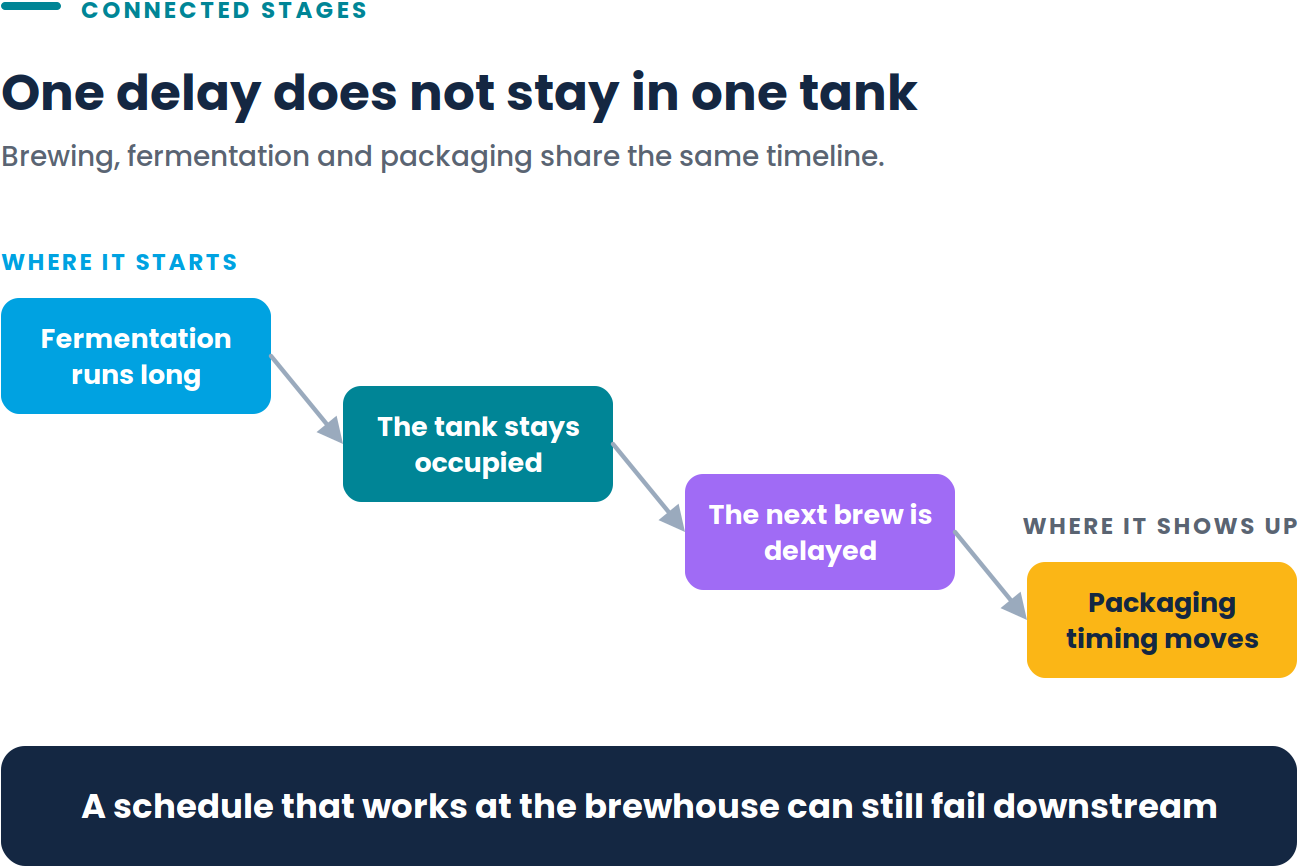
Brewing, fermentation and packaging run on one shared timeline, so a brew that ferments longer than planned keeps its tank occupied and pushes back everything behind it. The delay surfaces at packaging, but its cause sits several stages upstream.
This means a production schedule that looks feasible at the brewhouse level may not remain feasible once fermentation, tank availability and bottling are considered.
Brewery scheduling therefore needs to account for the interactions between production stages, rather than treating brewing, fermentation and packaging as independent activities.
Important Variables and Constraints in Brewery Planning
| Planning factor | Why it matters |
|---|---|
| Beer demand and production requirements | Determines what needs to be produced, in what quantities and by when. |
| Fermentation cycles | Determine how long fermentation tanks remain occupied and when capacity becomes available. |
| Fermentation tank capacity | Limits how quickly new brews can enter fermentation. |
| Yeast timing | Can affect fermentation timing and therefore tank release and downstream scheduling. |
| CCV and BBT capacity | Connect fermentation, beer storage and downstream packaging requirements. |
| CIP cycles | Affect tank turnaround and when resources can return to production. |
| Material availability | A shortage or delayed material can make a planned batch infeasible. |
| Bottling and packaging capacity | Determines when available beer can become finished product. |
| Production sequencing | The order of batches can affect tank utilization, CIP, throughput and delivery timing. |
| Freshness and quality requirements | Production and storage timing can affect how and when beer should move through the brewery. |
| Maintenance and equipment availability | Reduce usable production capacity when resources are unavailable. |
| Customer and business priorities | Determine which production requirements should be protected when capacity is constrained. |
These factors rarely operate independently.
A brewery may have available brewhouse capacity but insufficient fermentation capacity. It may have available fermentation capacity but limited BBT or bottling capacity. A production slot may appear available but become unusable because the required materials or equipment are not ready.
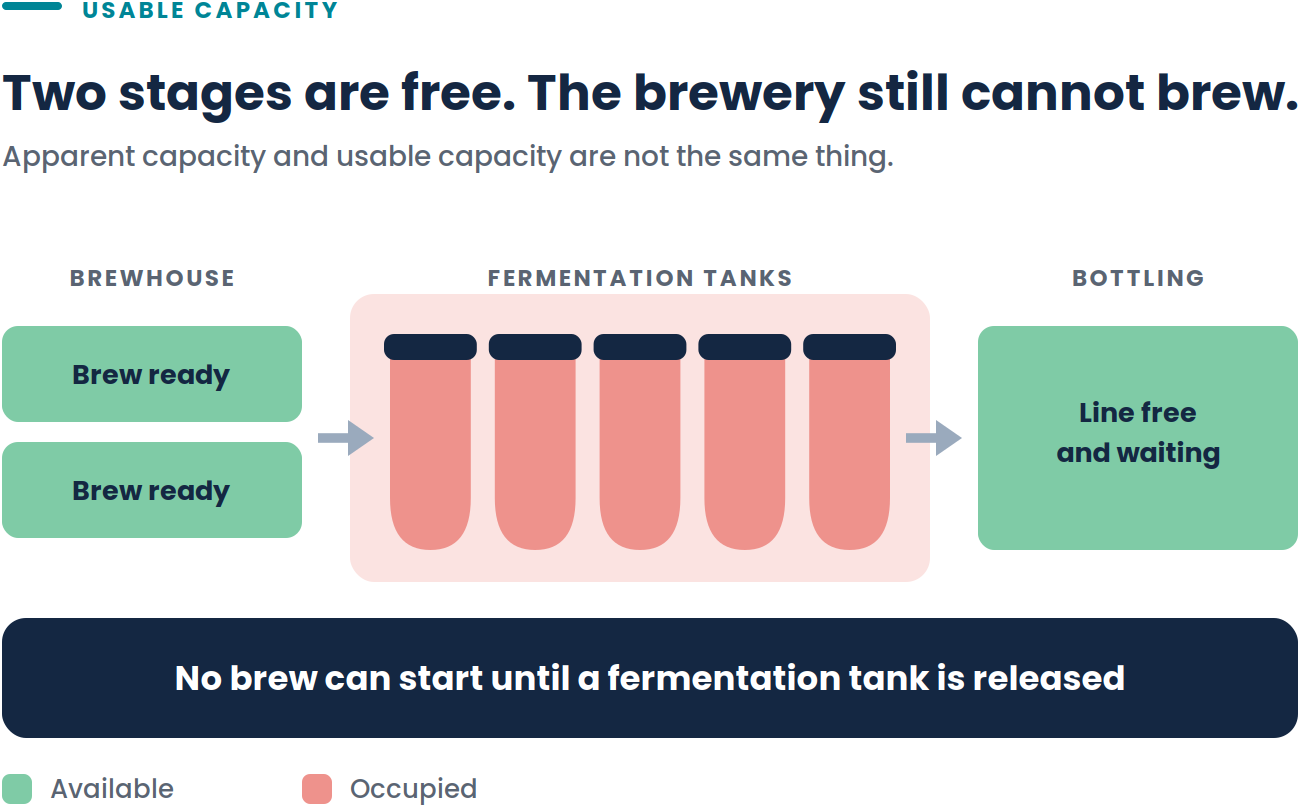
A brewery produces at the rate of its most constrained stage. When every fermentation tank is occupied, a free brewhouse and an available bottling line add waiting time rather than output, which is why tank availability decides what can realistically be committed.
The planning model therefore needs to distinguish between apparent capacity and usable capacity.
How Does Brewery Flow Scheduling Work?
Brewery flow scheduling connects production requirements with the sequence and timing required to turn those requirements into finished beer.
A simplified planning chain is:
The actual flow varies by brewery and product. The important point is that capacity and timing at one stage affect the options available at the next.
1. Establish production requirements
Orders, forecasts, inventory requirements and delivery commitments are translated into production requirements.
2. Determine production feasibility
The planning model evaluates whether the required beer can be produced using available brewing, fermentation and downstream resources.
3. Check materials and resource readiness
Material availability, tank availability, equipment status and other production requirements are checked against the proposed schedule.
4. Allocate constrained capacity
When fermentation tanks, BBTs, bottling lines or other resources are constrained, alternative assignments and timings can be evaluated.
5. Sequence production
Batches are positioned against brewing capacity, fermentation cycles, tank availability, CIP and downstream requirements.
6. Synchronize downstream operations
The schedule considers when beer will become available and whether BBT and bottling or packaging capacity can receive it.
7. Evaluate delivery and business priorities
The resulting schedule can be assessed against customer requirements, freshness considerations and other business priorities.
8. Replan when conditions change
Fermentation delays, equipment downtime, material shortages, demand changes or other disruptions can trigger a reassessment of the production schedule.
This connects production planning with detailed scheduling rather than treating them as separate exercises.
Fermentation, Tank Utilization and Brewery Flow
Fermentation is one of the most important capacity constraints in brewery production.
When a brew enters a fermentation tank, that tank becomes occupied for the required fermentation period. Its next availability depends on when fermentation completes and when the tank can be transferred, cleaned and prepared for another batch.
A simplified tank cycle is:
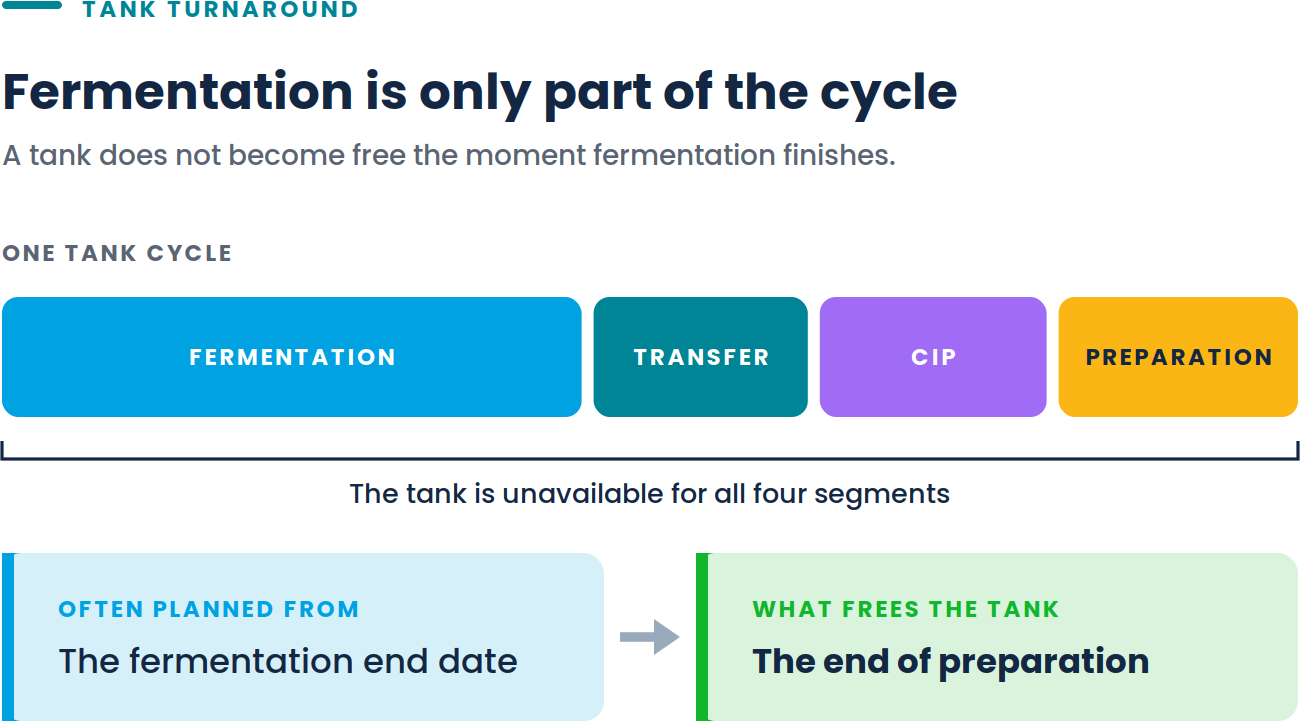
A tank is unavailable for far longer than the fermentation itself. Transfer, cleaning, and preparation all keep it occupied, so scheduling the next batch from the fermentation end date alone overstates capacity. Full turnaround time determines when a tank can be reused.
This creates a time-dependent capacity constraint.
A longer fermentation cycle can delay tank release. A delayed tank release can change the brewing sequence. The changed sequence can then affect downstream production and bottling.
Tank utilization therefore needs to be considered in the context of the wider brewery.
The objective is not necessarily to keep every tank occupied continuously. It is to ensure that tanks are used at the right time and in the right sequence to support overall production requirements.
How CCV, BBT and Bottling Capacity Interact
Fermentation tanks are only one part of the brewery flow. Depending on the production setup, beer may move from fermentation into a CCV, then to a BBT or other downstream storage resource, before bottling or packaging.
This creates dependencies between:
If a downstream resource is unavailable, beer may not be able to move when planned. That can keep upstream tanks occupied and affect the timing of other production activities.
Conversely, if packaging capacity is available but the required beer is still in fermentation, the packaging opportunity may not be usable.
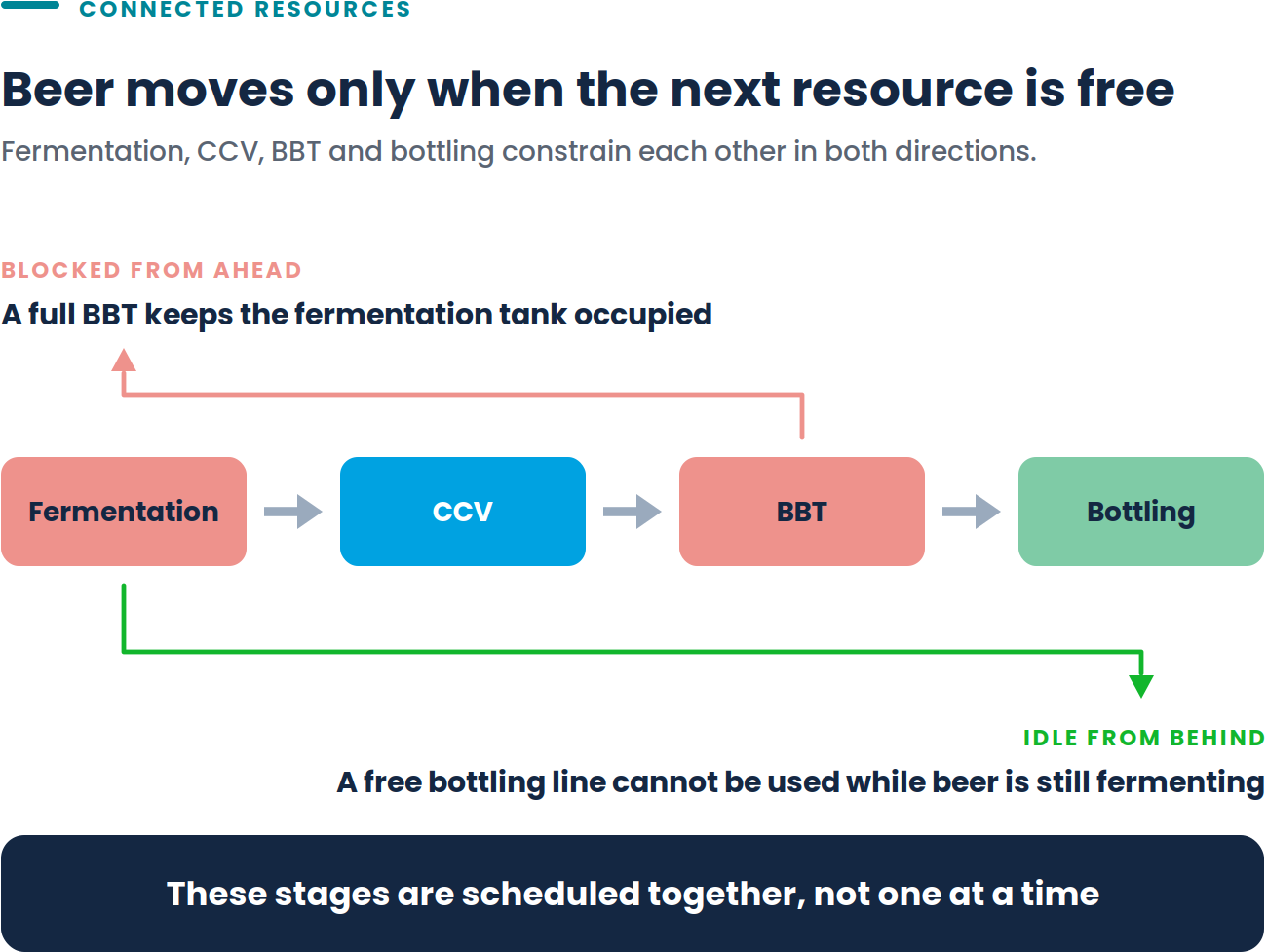
Beer can only move when the next resource is free. A full BBT keeps the fermentation tank occupied upstream, and an available bottling line cannot be used while the beer is still fermenting, which is why these stages are scheduled together rather than separately.
This is why brewery flow scheduling needs visibility across fermentation tanks, CCVs, BBTs and bottling or packaging resources rather than optimizing each stage independently.
How CIP, Yeast Timing and Sequencing Affect Production
CIP and yeast timing can both influence when a fermentation tank becomes available for the next batch. While CIP determines the time required to clean and prepare the tank, yeast timing can affect the duration of the fermentation cycle itself. Production sequencing therefore needs to account for both when determining how batches should be scheduled across the brewery.
For example, grouping compatible production may improve efficiency by reducing unnecessary cleaning or transitions. However, the sequence that minimizes CIP may not be the sequence that best protects customer priorities or downstream capacity.
Similarly, maintaining a high brew rate may appear efficient while creating congestion in fermentation tanks.
The planning objective is therefore to balance:
- production efficiency
- fermentation capacity
- tank turnaround
- yeast timing
- downstream availability
- customer priorities
Planning for Brewery Disruptions
Scenario planning allows breweries to compare alternative responses before committing to a revised production schedule.
| Scenario | Potential impact | What planning can evaluate |
|---|---|---|
| Fermentation takes longer than planned | Tank remains occupied longer | Revised tank assignments and brew sequence |
| Fermentation tank becomes unavailable | Usable fermentation capacity falls | Alternative tanks and production timing |
| CIP takes longer | Tank turnaround increases | Revised sequence and tank utilization |
| Material becomes unavailable | Planned batch may not be feasible | Resequencing and alternative production options |
| BBT capacity becomes constrained | Beer cannot move downstream as planned | Transfer and packaging alternatives |
| Bottling line becomes unavailable | Finished-product capacity falls | Alternative packaging timing |
| Demand changes | Production priorities shift | Alternative production scenarios |
| Equipment downtime occurs | Available capacity changes | Revised resource allocation and schedule |
The value of scenario planning is not simply to generate another schedule. It is to show how a change propagates through the brewery and which response best protects production, freshness, service and operational priorities.
Balancing Tank Utilization, Freshness, Efficiency and Service
Brewery production planning rarely has a single objective.
| Trade-off | What needs to be balanced |
|---|---|
| Tank utilization vs. flexibility | High utilization can reduce the capacity available to absorb changes. |
| Brewhouse utilization vs. fermentation capacity | Increasing brewing output may create downstream tank congestion. |
| Production efficiency vs. freshness | Producing too early can increase storage time and freshness exposure. |
| Fermentation timing vs. bottling availability | Beer needs to become available when downstream capacity can receive it. |
| CIP efficiency vs. production continuity | Reducing cleaning impact must be balanced against product priorities and timing. |
| Efficiency vs. delivery commitments | The most efficient sequence is not always the one that best protects customer requirements. |
The objective is not to maximize every KPI simultaneously. It is to make these trade-offs visible and evaluate which production alternatives best support the brewery’s priorities and constraints.
What Data Is Required for Brewery Production Planning?
The planning model should represent the information that materially affects production feasibility, timing and resource allocation.
- Demand data. Orders, forecasts, required quantities, delivery commitments and production priorities.
- Beer and process data. Products, recipes, batch sizes, production routes, fermentation requirements and packaging requirements.
- Fermentation and tank data. Fermentation cycles, tank capacities, tank availability, CCV and BBT availability, tank status and transfer requirements.
- Yeast data. Yeast timing, fermentation timing and relevant yeast-management constraints.
- CIP and cleaning data. CIP requirements, cleaning cycles, cleaning duration and tank preparation requirements.
- Material data. Material availability, expected receipts, material dependencies and shortages.
- Bottling and packaging data. Packaging lines, capacity, availability, packaging timing and relevant changeover requirements.
- Production data. Processing times, equipment availability, maintenance and production sequencing rules.
- Inventory data. Raw materials, work-in-process, beer inventory and finished goods.
- Business rules. Production priorities, quality requirements, freshness requirements, delivery priorities and other operating constraints.
The objective is not to collect every possible data point. It is to represent the factors that determine whether the brewery can produce the right beer, in the right sequence, at the right time and through the available production flow.
How Optimization and AI Support Brewery Production Planning
Brewery production planning involves many interacting decisions across brewing, fermentation, tanks, materials, CIP and packaging.
Mathematical optimization can evaluate feasible production alternatives against defined objectives and constraints.
This can help planners determine:
- which production requirements can be fulfilled
- when batches should be scheduled
- which fermentation tanks should be used
- how constrained tank capacity should be allocated
- how production should be sequenced
- where bottlenecks may occur
- how packaging capacity affects the production plan
- which customer commitments may be at risk
- what changes when demand, capacity or production conditions change
Scenario analysis allows planners to compare alternative schedules before committing to one.
AI-supported workflows can complement optimization by helping users investigate exceptions, explore scenarios, understand why a schedule changed and interact with complex planning information.
The important distinction is that an AI-generated recommendation is not automatically an executable brewery schedule.
The final decision still needs to respect fermentation cycles, tank capacity, materials, CIP, packaging availability, production rules and business priorities.
Powered by the ICRON AI-Native Decision Execution Hub, ICRON combines optimization, AI-supported workflows and decision intelligence to help brewery planning decisions move from analysis toward coordinated execution.
Brewery Production Planning in Practice
Consider a brewery with several fermentation tanks, BBT capacity and shared bottling lines.
Demand for one beer increases while several fermentation tanks are already occupied.
The additional demand cannot simply be added to the production schedule.
The planner needs to understand:
- which fermentation capacity will become available
- whether the required materials are available
- whether another tank can be used
- how the change affects the existing brew sequence
- whether downstream BBT capacity is sufficient
- whether bottling can accommodate the revised beer availability
- which existing customer commitments could be affected
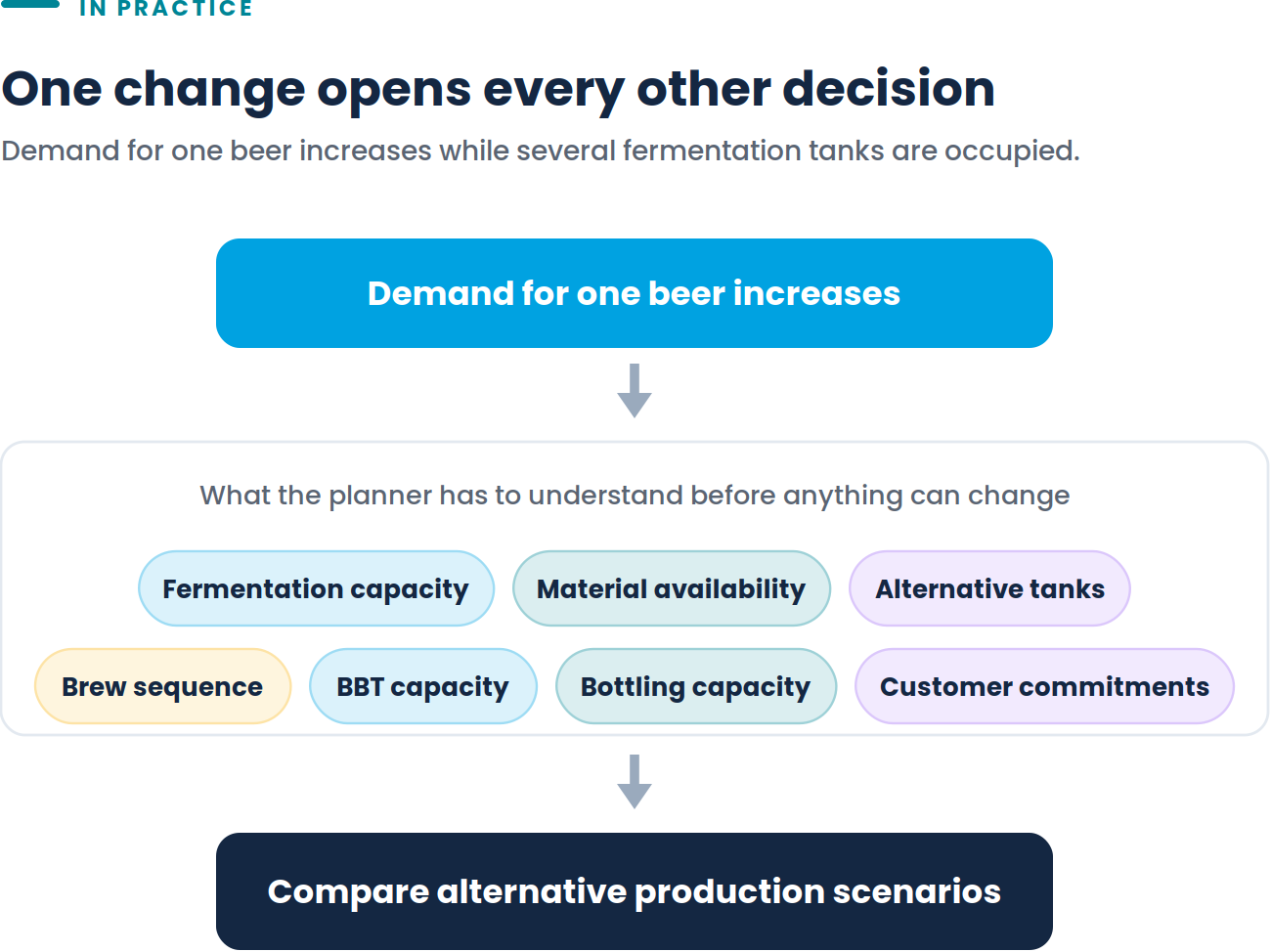
A change in demand for one beer depends on fermentation capacity, material availability, alternative tanks, brew sequence, downstream capacity, and existing customer commitments at the same time. Because these constraints move together, planners compare complete production scenarios rather than deciding batch by batch.
The planner can then compare alternative production scenarios rather than adjusting individual batches manually.
This illustrates the central principle of brewery flow scheduling:
A production decision is only useful when its consequences across the rest of the brewery are understood.
Frequently Asked Questions
What is brewery production planning?
Brewery production planning coordinates beer demand, brewing requirements, fermentation capacity, tanks, materials, packaging and production timing to create a feasible production plan.
What is brewery flow scheduling?
Brewery flow scheduling considers how beer moves through interconnected brewing, fermentation, tank and packaging operations and how decisions at one stage affect the rest of the production flow.
How does fermentation affect brewery production scheduling?
Fermentation determines how long a tank remains occupied and therefore when that capacity becomes available for another batch. Changes in fermentation timing can affect the wider production sequence.
How can breweries optimize fermentation tank utilization?
By coordinating brewing timing, fermentation cycles, tank assignments, transfers, CIP and downstream requirements rather than optimizing tank occupancy independently.
What are CCV and BBT tanks?
CCVs are commonly used as fermentation vessels, while BBTs, or bright beer tanks, are typically used for beer storage before packaging. Both connect fermentation with downstream operations.
How does CIP affect brewery production scheduling?
CIP affects tank turnaround and determines when a tank can return to production, which influences the brewing sequence and downstream timing.
Can brewery scheduling include bottling and packaging constraints?
Yes. Bottling and packaging capacity can be represented in the schedule so that upstream production does not create avoidable downstream bottlenecks.
Can brewery production planning handle disruptions?
Yes. Scenario planning can evaluate fermentation delays, tank outages, material shortages, equipment downtime and demand changes before a revised schedule is committed.

Build Brewery Production Plans That Remain Executable
Fermentation cycles, tank utilization, yeast timing, CIP, materials, CCVs, BBTs, bottling and packaging all influence when beer can move through the brewery and become finished product. See how ICRON connects these decisions through optimization, scenario planning and AI-supported decision workflows.