






 Guides
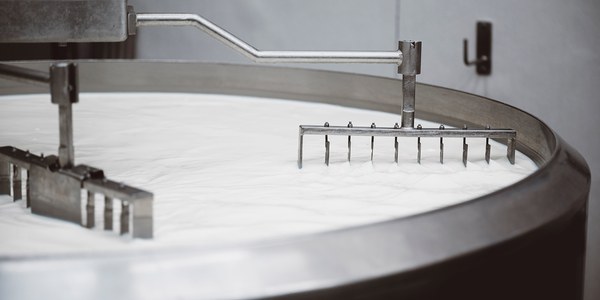
Dairy production planning determines what products need to be produced, in what quantities and when. Flow scheduling takes this further by determining how those products can move through interconnected processing, storage and packaging operations in a feasible sequence.
This distinction is important in dairy manufacturing.
A production plan may show sufficient capacity to meet demand, but the plant may still be unable to execute it. Milk may not be available at the right time, a processing resource may be occupied, a tank may be unavailable, cleaning may create a conflict, or packaging may not be ready to receive the output.
Dairy planning therefore needs to consider both what should be produced and how production can physically flow through the plant.
The exact process varies by product and plant, but the principle remains the same: decisions at one stage can affect every stage that follows.
The objective is not simply to maximize production or utilization. It is to create an executable production schedule that balances demand, material availability, processing capacity, tank availability, sequencing, cleaning, packaging and business priorities.
Key Takeaways
- Dairy production planning connects demand, milk supply, processing capacity, tanks, production resources and packaging.
- Flow scheduling considers how materials move through interconnected production stages rather than planning resources independently.
- Tanks can become time-dependent bottlenecks because their availability depends on contents, downstream processing and cleaning.
- Production sequencing affects cleaning, changeovers, capacity utilization, inventory and customer service.
- The most efficient sequence is not always the best overall schedule because downstream constraints and customer commitments also matter.
- Optimization and scenario planning help planners evaluate alternatives and create executable schedules.
How Does Dairy Production Flow Through a Plant?
Dairy manufacturing is built around the movement of materials through connected processing stages.
Raw milk may pass through separation, standardization, pasteurization and homogenization before becoming an intermediate or finished product. Depending on the product, additional processing may follow.
For example:
- Yogurt may require fermentation before filling.
- Cheese may involve additional processing and maturation.
- Milk and cream may share processing and storage resources.
Different products therefore require different production routes, processing times, equipment and storage resources.
A delay at one stage can affect tank availability, downstream processing, packaging and ultimately customer delivery.
This interconnected behavior is what makes dairy production a flow scheduling problem.
Why Dairy Production Planning Is Difficult
Dairy manufacturing combines perishable materials, shared resources and tightly connected production processes.
Perishable and time-sensitive materials
Milk availability and timing can vary, while finished products may have limited shelf life. Producing too early can therefore create unnecessary inventory exposure.
Shared production resources
Different products may require the same processing lines, tanks, filling equipment or packaging resources, creating competition for capacity.
Intermediate storage constraints
Tanks often sit between processing stages. A production resource may be available, but production can still be delayed if there is no suitable tank to receive the output.
Cleaning and changeovers
Products cannot always be scheduled consecutively. Cleaning, product compatibility and changeover requirements consume time and influence the feasible sequence.
Downstream dependencies
Production needs to align with filling and packaging capacity. Optimizing upstream processing without considering downstream constraints can create bottlenecks or excess intermediate inventory.
The challenge is therefore to coordinate the entire production flow, not individual resources in isolation.
What Makes Dairy a Flow Scheduling Challenge?
Traditional production scheduling often asks:
Which product should run on which resource, and when?
Flow scheduling asks a broader question:
How should material move through the interconnected production system so that processing, storage, downstream operations and customer requirements remain synchronized?
A schedule can appear feasible when each resource is considered independently but become infeasible when material flow is considered.
For example, a processing line may have capacity at 10:00, but if the required tank is occupied until 11:00, that capacity cannot actually be used. Likewise, a tank may become available at 14:00, but if the downstream process cannot receive its contents until 16:00, the tank may remain occupied.
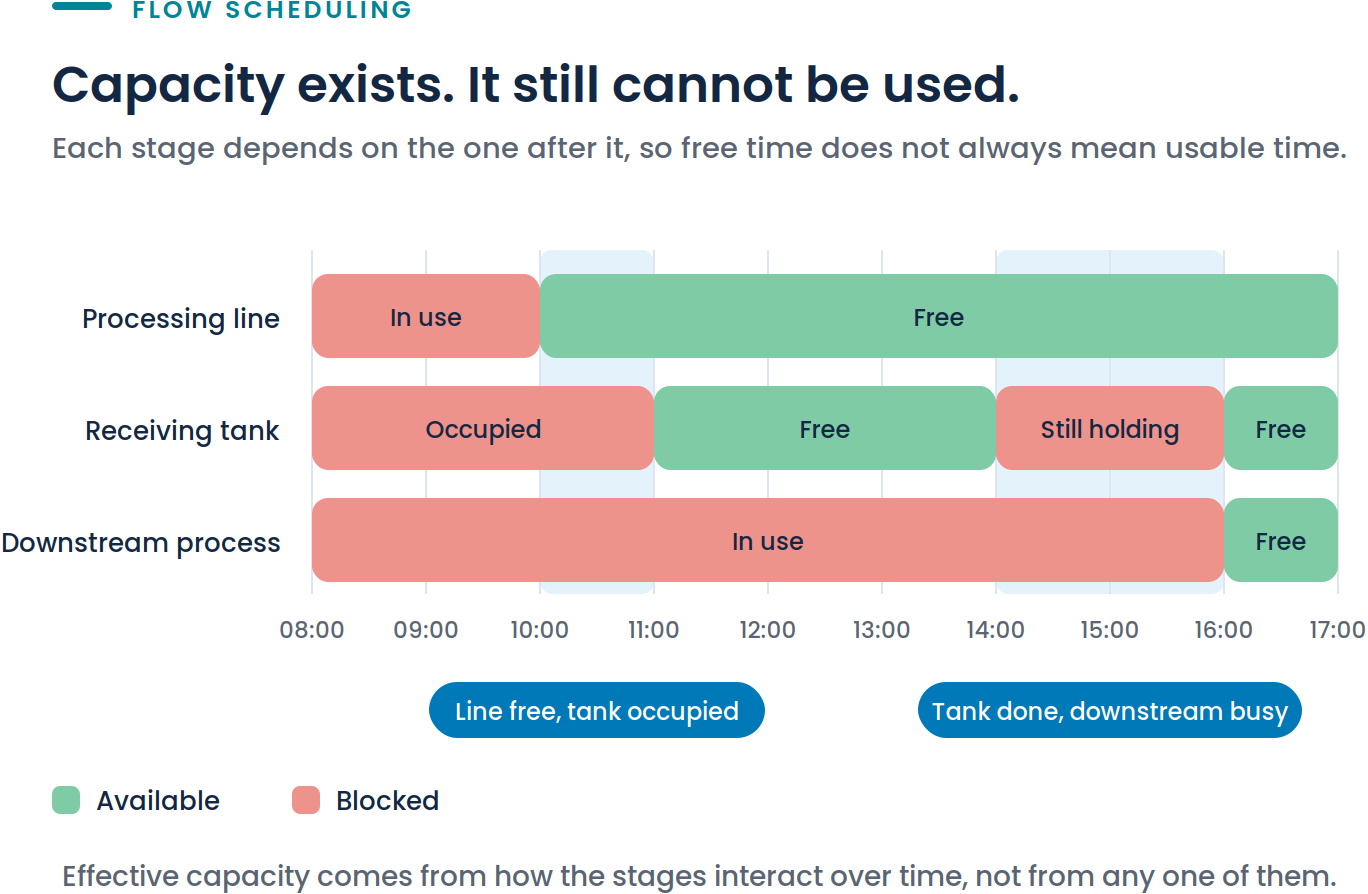
Dairy production moves material continuously between processing, tanks, and packaging, so each stage is limited by the one after it. Free time on a resource is only useful when the next stage is ready to receive its output.
The effective capacity of the plant is therefore determined not only by individual resources, but by how those resources interact over time.
Synchronizing Processing, Tanks and Packaging
Each stage creates conditions for the next. Processing requires the appropriate materials and a receiving resource. The tank needs sufficient capacity and compatibility. The next process needs to be available when the material is ready. Filling and packaging then need to receive the output.
This means increasing capacity at one stage does not necessarily increase total throughput.
Additional processing capacity may have limited value if tank capacity is constrained. Additional tank capacity may not improve throughput if packaging remains the bottleneck.
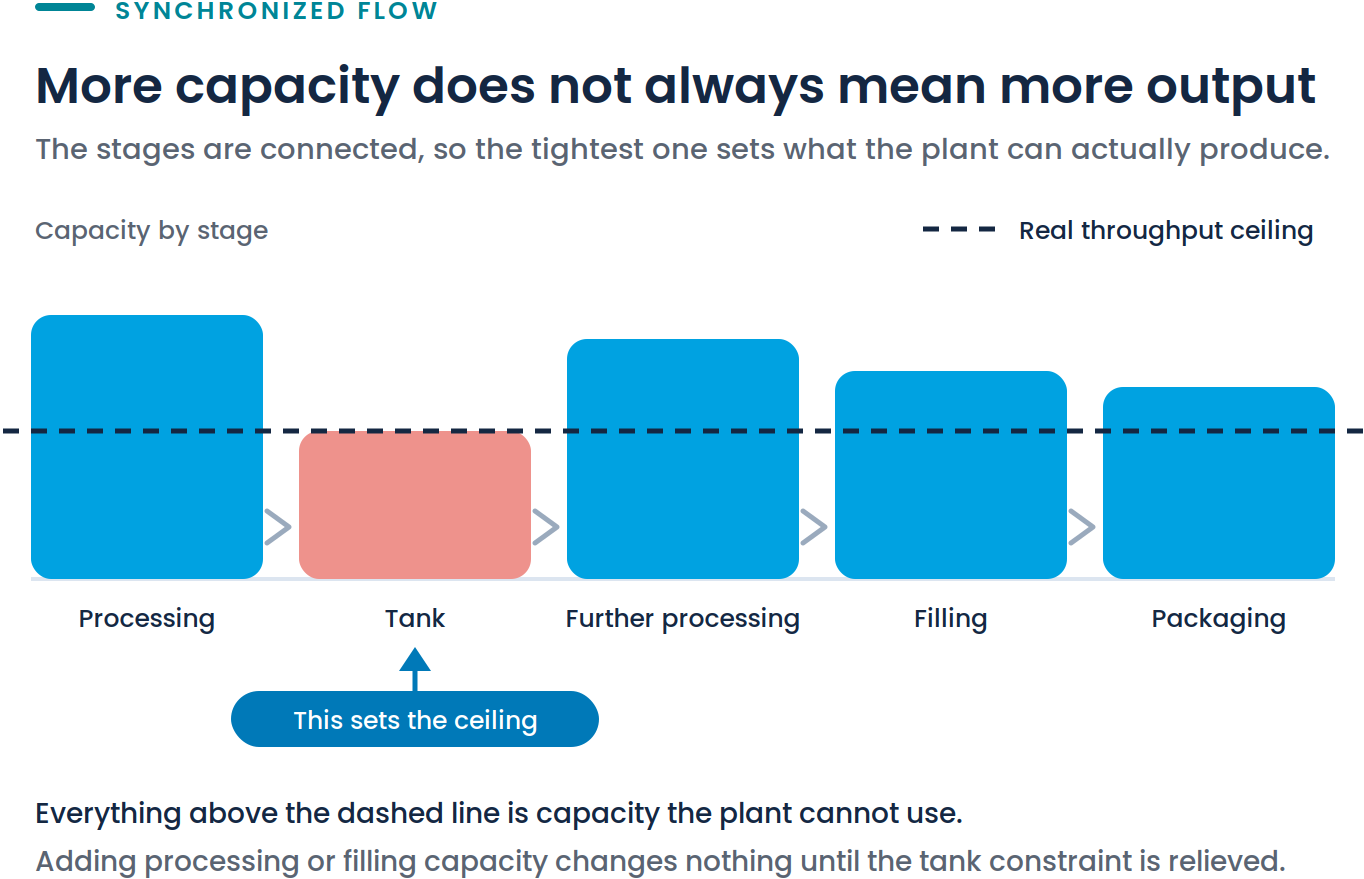
In a connected flow, total output is set by the tightest stage rather than by average capacity. Investment in a stage that is not the constraint changes cost without changing what the plant can produce.
The schedule therefore needs to synchronize the whole production flow and identify where constraints actually limit performance.
Tank Scheduling in Dairy Manufacturing
Tanks are not simply storage locations. In many dairy plants, they are shared resources that determine when material can move through the process.
Tank availability depends on:
- what product it contains
- when that product can move downstream
- tank capacity
- product compatibility
- cleaning requirements
- downstream resource availability
A tank can therefore be physically empty but not immediately usable because it requires cleaning or preparation.
Effective tank scheduling coordinates:
Poor tank scheduling can create hidden bottlenecks even when the plant has sufficient nominal processing capacity.
Production Sequencing and Changeover Optimization
The sequence in which products are manufactured affects cleaning, changeovers, resource availability, product freshness and delivery performance.
Producing compatible products consecutively can reduce cleaning requirements. However, optimizing only for efficiency may delay higher-priority products.
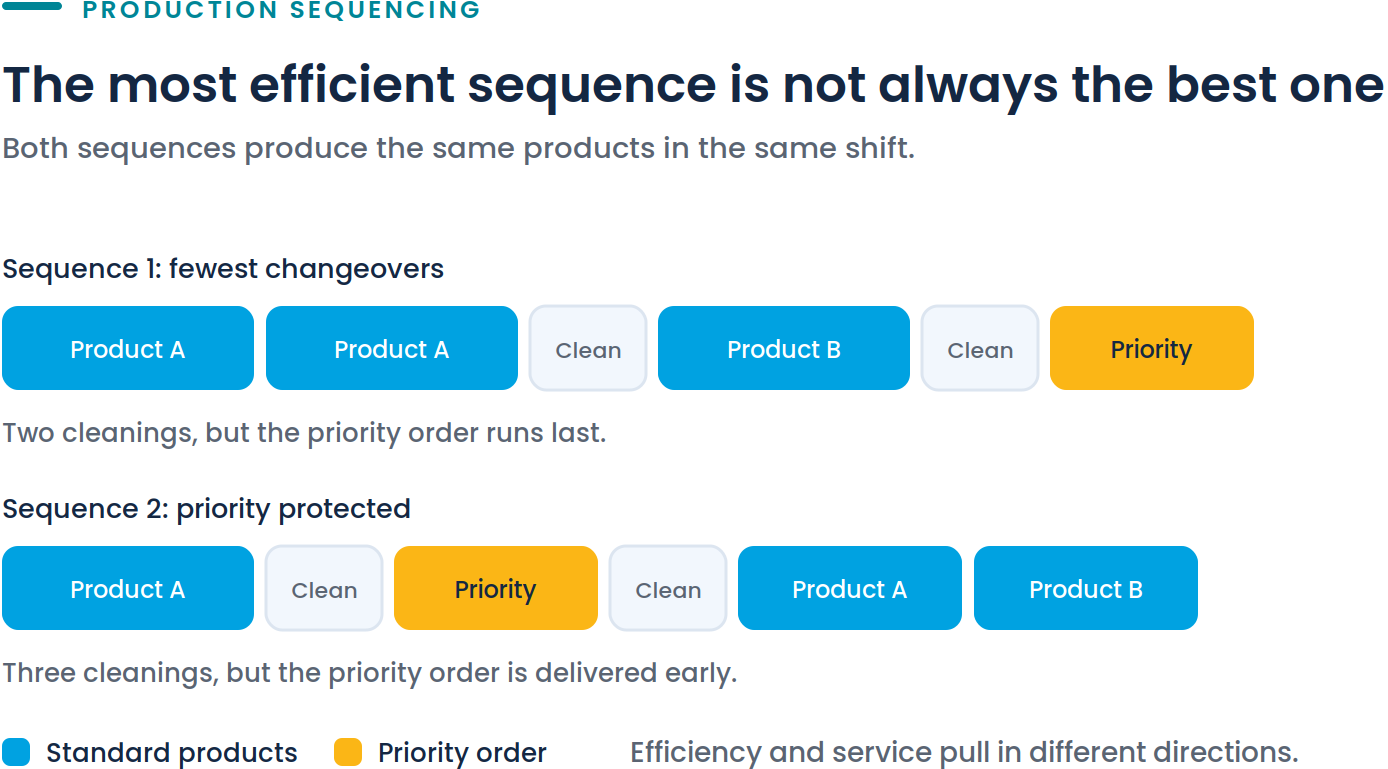
Grouping compatible products reduces cleaning and changeover losses, but it also decides which customers wait. The best sequence balances plant efficiency against delivery commitments rather than optimizing either alone.
Effective sequencing balances:
- production efficiency
- customer priorities
- delivery requirements
- cleaning and changeover time
- product compatibility
- inventory requirements
- operational flexibility
The best sequence is therefore not simply the one that minimizes changeovers. It is the one that performs best across the overall production flow.
A Practical Example: Scheduling a Dairy Production Campaign
Consider a dairy plant producing several yogurt products using shared processing equipment and fermentation tanks.
The planner needs to determine:
- when milk should be processed
- which resources should be used
- which tank should receive each intermediate product
- when fermentation can begin
- when each tank becomes available
- how products should be sequenced
- when cleaning should occur
- whether filling capacity is available
- whether customer requirements can still be met
Now assume one fermentation tank becomes unavailable for several hours.
The planner may need to evaluate alternative sequences, tank assignments, production timings or resource allocations.
This illustrates why dairy scheduling cannot always be solved by adjusting one resource at a time.
Planning for Dairy Manufacturing Changes
| Scenario | Potential impact | Planning evaluation |
|---|---|---|
| Milk supply changes | Available production inputs change | Alternative quantities, priorities and timing |
| Processing equipment becomes unavailable | Processing capacity decreases | Alternative resources and production sequences |
| A tank becomes unavailable | Intermediate storage is constrained | Tank reassignment and resequencing |
| Customer demand increases | Additional production is required | Capacity, materials, tanks and delivery impact |
| Cleaning takes longer | Available production time decreases | Revised sequence and customer commitment impact |
| Packaging capacity changes | Finished-product flow is affected | Production timing and inventory alternatives |
| A campaign runs longer | Subsequent activities are delayed | Resequencing and downstream impact |
Scenario planning helps teams understand why a schedule changes, which constraints are responsible and what the consequences are for the wider production flow.
Balancing Efficiency, Service and Flexibility
| Trade-off | What planners need to balance |
|---|---|
| Utilization vs. flexibility | High utilization vs. capacity to absorb disruptions |
| Campaign length vs. responsiveness | Fewer changeovers vs. ability to respond to priorities |
| Tank utilization vs. flow flexibility | High tank occupancy vs. ability to accommodate flow changes |
| Processing vs. downstream capacity | Upstream output vs. available tank, filling and packaging capacity |
| Inventory vs. freshness | Product availability vs. shelf-life exposure |
| Efficiency vs. customer commitments | Optimal sequence vs. service priorities |
None of these tensions has a permanent answer, because the right balance shifts with demand, supply conditions, and customer priorities. Making each trade-off explicit allows planners to choose deliberately rather than letting whichever objective the current schedule happens to favor decide the outcome.
What Data Is Required for Dairy Production Planning?
Creating an executable dairy production schedule requires a model of the production flow, resources, timing constraints and business priorities.
Demand and production requirements
- customer orders and forecasts
- required quantities
- delivery commitments
- product priorities
- service requirements
Materials and product flows
- milk availability and timing
- ingredients and packaging materials
- recipes and formulations
- production routes
- batch sizes
Processing resources
- processing equipment and lines
- production capacities
- processing times
- resource availability
- maintenance periods
- production-route restrictions
Tanks and intermediate storage
- tank capacity
- tank availability
- product compatibility
- storage duration
- tank-to-process relationships
Cleaning, changeovers and sequencing
- cleaning requirements and duration
- changeover rules
- sequence restrictions
- product compatibility
- minimum production runs
Inventory and shelf life
- raw material inventory
- intermediate products
- finished goods
- shelf life
Business and operational rules
- production and customer priorities
- quality requirements
- delivery priorities
- operational restrictions
The objective is not to collect every possible data point. Each element should help answer:
The quality of the schedule depends on how accurately the model represents the constraints that determine what can actually happen on the plant floor.
How Optimization and AI Support Dairy Production Planning
Dairy production planning involves interacting decisions across products, resources, tanks, processing stages and time periods.
Optimization can evaluate alternative production plans against operational constraints and business objectives.
It can help determine:
- which products should be produced
- when production should occur
- which resources should be used
- how tanks should be allocated
- how products should be sequenced
- where bottlenecks may occur
- how operational changes affect customer commitments
Scenario-based optimization can compare responses to changes in demand, material availability, capacity or equipment.
AI-native capabilities can complement optimization by helping planners investigate exceptions, understand schedule changes, explore scenarios and interact with complex planning information.
AI can help planners understand and interact with the decision environment, while optimization evaluates feasible alternatives against operational constraints and business objectives.
Reliable execution requires decisions to remain grounded in manufacturing reality, operational rules and business priorities.
Powered by the ICRON AI-Native Decision Execution Hub, ICRON connects optimization, AI-supported workflows and execution-oriented planning to help dairy manufacturers make complex production decisions and adapt schedules as conditions change.
Frequently Asked Questions
What is dairy production planning?
Dairy production planning determines what products need to be produced, in what quantities and when, while considering materials, capacity, inventory and operational constraints.
What is dairy production scheduling?
Dairy production scheduling converts production requirements into a sequence of activities assigned to specific resources and time periods while considering processing, tanks, cleaning, changeovers and downstream requirements.
What is flow scheduling in dairy manufacturing?
Flow scheduling considers how materials move through interconnected processing stages, tanks and resources so that production activities remain synchronized and the resulting schedule is executable.
Why is tank scheduling important in dairy plants?
Tanks are often shared resources between processing stages. Their capacity, availability, compatibility, cleaning requirements and timing can determine whether material can continue through the production process.
How can dairy manufacturers improve tank utilization?
Tank utilization can be improved by coordinating tank assignments with production timing, downstream processing, cleaning requirements and product compatibility rather than treating tanks as independent storage resources.
How can dairy plants reduce production changeovers?
Dairy plants can reduce unnecessary changeovers by optimizing production sequences, grouping compatible products and balancing efficiency with customer priorities.
How is dairy flow scheduling different from traditional production scheduling?
Traditional scheduling may focus primarily on assigning products to resources. Flow scheduling also considers how material moves between resources and how timing decisions at one stage affect downstream operations.
Can dairy production scheduling consider packaging constraints?
Yes. Packaging capacity can be incorporated into the production schedule so that upstream production does not create avoidable downstream bottlenecks or excess intermediate inventory.
Can dairy production planning handle milk supply variability?
Yes. Changes in milk availability can be evaluated through alternative production quantities, sequences, priorities and inventory strategies.
What is a digital twin in dairy manufacturing?
A digital twin is a virtual representation of a production environment that can be used to simulate production schedules, test scenarios and evaluate the potential impact of operational changes before execution.
How does optimization improve dairy production scheduling?
Optimization evaluates alternative combinations of production quantities, resource assignments, tank allocations and sequences against defined constraints and objectives to identify feasible and effective schedules.
Can AI support dairy production scheduling?
AI can support planners by helping investigate exceptions, understand schedule changes and explore planning scenarios. Optimization can evaluate the feasibility and business impact of those alternatives against defined operational constraints.

Create Dairy Production Plans That Remain Executable
Milk availability, processing stages, tanks, cleaning, sequencing, packaging and customer requirements need to remain synchronized as conditions change. See how ICRON helps dairy organizations connect these decisions through optimization, scenario planning and AI-native decision support.