


 Blogs


Coffee blending optimization helps manufacturers respond to volatile green coffee prices without losing sight of taste, availability, or production realities. AI-supported analysis and scenario planning make it easier to compare alternatives, while mathematical optimization identifies feasible choices across sourcing, blending, and operations.
Key Takeaways
- Protect margin and product consistency. Evaluate sourcing and blend options against cost, quality, inventory and production limits.
- Test changes before committing. Compare the operational and financial impact of price increases, shortages and alternative origins.
- Turn analysis into coordinated action. Connect AI-supported exploration and optimization with procurement, roasting and production decisions.
Why Coffee Price Volatility Creates a Planning Challenge
Weather, harvest yields, logistics and currency movements can change the economics of a blend overnight. A price increase rarely affects procurement alone. It can change which beans are available for each product, which facilities can use them and what must be purchased next. Planners need answers to questions such as:
- Should we continue purchasing from the same origin despite higher prices?
- Can another approved green coffee option satisfy our modeled quality and sourcing requirements?
- Would changing the blend affect production efficiency or roasting capacity?
- Should we use existing inventory or purchase additional raw materials?
- Which alternative protects margins without compromising product consistency?
These decisions are often handled by different teams. Procurement focuses on sourcing costs, quality teams evaluate blend characteristics, and production planners manage capacity and schedules. However, an alternative that appears attractive to one team may create additional costs or constraints elsewhere.
The lowest-cost coffee ingredient does not necessarily result in the lowest-cost feasible blend.
For a closer look at how origin and lot variation affect purchasing decisions, read Coffee Sourcing: Origin Matters, But Lot Quality Changes the Answer.


From Fixed Recipes to Flexible Blending Decisions
Traditional blending approaches often rely on established recipes and manual adjustments when ingredients become unavailable or too expensive. While these methods can work under stable conditions, they become harder to manage when multiple variables change simultaneously.
Consider a manufacturer producing several coffee products using different combinations of Arabica and Robusta beans. A significant price increase affects one preferred origin. Procurement identifies a less expensive alternative, but the replacement has different sensory characteristics and may require adjustments to other ingredients.
Changing one component can influence the entire formulation. Coffee blending optimization evaluates alternative ingredient combinations against defined requirements, including:
- Sensory and quality specifications
- Ingredient availability and origin restrictions
- Raw material and production costs
- Inventory levels and purchasing commitments
- Production capacity and operational constraints
Instead of evaluating substitutions individually, optimization identifies feasible combinations that meet business and product requirements. The result is not simply a cheaper recipe. It is a better-informed decision about which blend can actually be produced, at what cost, and under which conditions.
How Scenario Planning Helps Protect Coffee Manufacturing Margins
Knowing the best blend under current conditions is useful. Understanding what happens when conditions change is even more important. Scenario planning allows manufacturers to explore alternative decisions before committing to them.
Imagine that the price of a key green coffee ingredient increases by 20%. The manufacturer could evaluate three scenarios:
| Scenario | Planning decision | What needs to be evaluated |
|---|---|---|
| A | Maintain the existing blend | Higher raw material costs and margin impact |
| B | Adjust ingredient proportions | Quality compliance, availability, and total blend cost |
| C | Introduce an alternative origin | Sensory requirements, purchasing conditions, and production feasibility |
Each scenario has different financial and operational implications. A lower-cost alternative might reduce ingredient expenditure but introduce additional production constraints. Maintaining the existing formulation might preserve consistency but put pressure on margins.
Scenario planning makes these trade-offs visible. Rather than reacting to individual price changes, manufacturers can compare feasible alternatives and select the option that best supports their business objectives.
Where AI Adds Value to Coffee Blending Optimization
Optimization and scenario planning provide the mathematical foundation for evaluating decisions. AI can help manufacturers interact with this process more efficiently.
For example, planners may need to understand which blends are most exposed to an origin’s price increase, what alternatives exist if a supplier cannot deliver, which products face the greatest margin pressure, or how inventory shortages affect upcoming production.
An AI-supported planning workflow could allow a planner to ask:
“What happens to our production costs if Brazilian Arabica prices increase by 15% next month?”
The system could help translate this question into a scenario, while mathematical optimization generates sourcing and blending decisions based on the updated assumptions, business objectives and operational constraints. This is an illustrative workflow, not a claim about a specific product interface.
AI helps planners explore and understand decisions. Mathematical optimization generates sourcing, blending and allocation decisions that balance business objectives while satisfying modeled operational constraints. Together, they support faster analysis without replacing the operational knowledge and judgment of procurement, quality, and production teams.
From Scenario Planning to Decision Execution
Identifying a better alternative is only part of the challenge. Once a manufacturer selects a new sourcing or blending scenario, the decision must be reflected in purchasing, inventory allocation, and production planning.
If these processes remain disconnected, even a well-optimized decision may be difficult to implement. An integrated approach connects the stages of decision-making:
This creates a more responsive planning process in which decisions are evaluated across the operation rather than in isolation.
CUSTOMER STORY · GLOBAL COFFEE MANUFACTURER
What This Looks Like in a Global Coffee Network
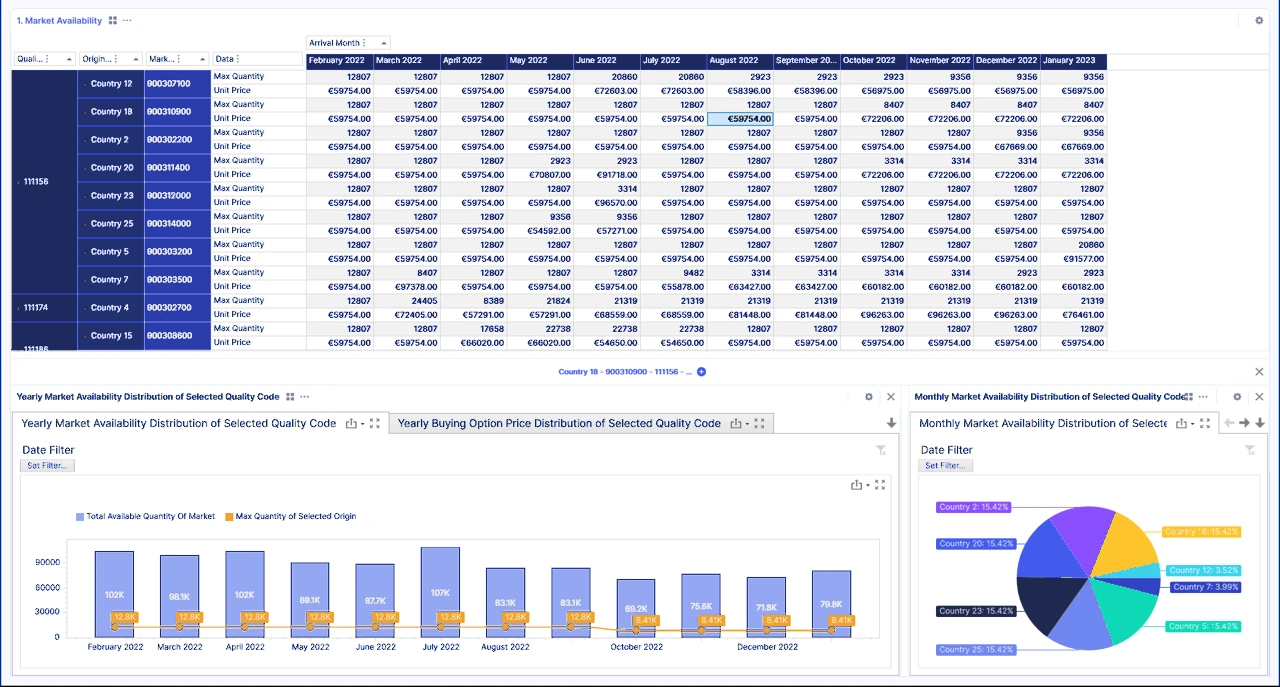
For one global coffee manufacturer, the challenge went beyond choosing the right recipe. Coffee moved between origins, inventory hubs and roasting facilities, while demand and supply conditions kept shifting. Planners needed to know whether to transfer available beans, purchase more, or adjust blends without creating problems elsewhere.
With ICRON Procurement Planning and Blending Optimization, the manufacturer brought sourcing, roasting, blending and inventory decisions into a shared planning environment. According to the published customer story, the approach helped improve demand satisfaction, reduce procurement-related costs and inventory inefficiencies, and make scenario comparisons faster and clearer.
How ICRON Supports Smarter Coffee Blending Decisions
ICRON helps coffee manufacturers connect procurement planning, blending optimization, and operational decision-making.
Its optimization capabilities support the evaluation of alternative ingredient combinations while accounting for quality specifications, material availability, costs, and operational constraints. With scenario planning, manufacturers can assess the implications of changing prices, sourcing conditions, and production requirements before selecting a course of action.
ICRON’s approach to AI-native decision execution brings AI-supported analysis together with mathematical optimization and governed decision processes. Rather than treating procurement, blending, and production as separate planning activities, ICRON helps manufacturers evaluate their interdependencies and make coordinated decisions.
This is particularly important when market conditions change quickly and manufacturers need to balance margin protection with consistent product quality.
Better Margins Start With Better Decisions
No manufacturer can eliminate commodity volatility. But teams can decide how to respond: which ingredients to buy, where to use existing stock and which feasible blend best serves the business. Better margin decisions come from seeing those choices together.
The objective is not to find the cheapest ingredient. It is to identify the best feasible decision for the entire coffee manufacturing operation.
Frequently Asked Questions
What is coffee blending optimization?
Coffee blending optimization uses mathematical models to identify ingredient combinations that meet defined quality, availability, and operational requirements while minimizing costs or achieving other business objectives.
How can coffee manufacturers protect margins when green coffee prices increase?
Manufacturers can use scenario planning and blending optimization to compare alternative origins, ingredient proportions, inventory allocations, and purchasing decisions while maintaining required quality standards.
Can AI optimize coffee blends?
AI can support data analysis, scenario exploration, and decision workflows. Mathematical optimization generates sourcing and blending decisions that balance defined business objectives while satisfying material, quality, inventory and production constraints.
What is the difference between coffee blending optimization and scenario planning?
Blending optimization identifies suitable ingredient combinations under defined conditions. Scenario planning compares how those decisions perform when factors such as prices, availability, demand, or production capacity change.
Why should procurement and coffee blending decisions be planned together?
Procurement decisions affect which ingredients are available and at what cost, while blending requirements determine how those ingredients can be used. Planning them together helps manufacturers avoid locally attractive decisions that create higher costs or operational problems elsewhere.