






 Guides

Coffee blending optimization is the process of selecting and combining available coffees to meet a defined product profile, while green coffee quality, origin, lot characteristics, availability, inventory, procurement, roasting, production, and cost constraints are evaluated together.
Coffee is sourced through a global agricultural network, and the characteristics of each lot can change by origin, crop, variety, processing method, supplier, storage, and season. Manufacturers therefore need a structured way to maintain a recognizable finished product without assuming that the same materials will always be available at the same quality or price. If you are new to the subject, start with the broader guide to blending optimization, which covers the principles that also apply in tea and tobacco.
Key Takeaways
- Consistency is achieved by protecting the finished-product requirements, not by repeating the same green coffee composition.
- The characteristics of each lot can change by origin, crop, variety, processing method, supplier, storage, and season.
- Green coffee inventory represents both supply and optionality. Its value depends on which products it can support, where it is located, and when it is available.
- Some products are blended before roasting and others after, so the planning model should reflect the actual process rather than assume one universal sequence.
- The operational value of a green coffee purchase depends on more than its unit price.
What is coffee blending optimization?
Coffee blending optimization translates product requirements and sourcing conditions into a decision model. It evaluates available and potential green coffee lots, their attributes, their cost, and the rules that govern how they may be used.
The model can support decisions at different levels, from selecting a feasible blend for a product and period to coordinating procurement, inventory, transfers, roasting, and production across multiple hubs or markets. This is the decision environment ICRON Procurement Planning and Blending Optimization for Tea & Coffee is built for.
Why coffee blending is complex
- Coffee is naturally variable. Crop conditions, origin, variety, processing method, storage, and lot differences influence physical and sensory characteristics.
- Finished-product profiles must remain recognizable. A brand or product may require consistency even when individual components change.
- Green coffee markets and supply conditions move. Price, availability, lead time, contracts, and logistics can change independently of quality.
- Inventory is distributed across time and location. The right coffee may exist in the network but not at the right hub, release status, or time.
- Roasting and production matter. A blend that appears feasible from a green coffee perspective may affect roasting, yield, capacity, or production requirements.
- Portfolio decisions are connected. Allocating a lot to one product changes the options available for other products and future periods.
How origin, crop, lot, and processing method affect decisions
Coffee origin is an important descriptor, but it is not enough on its own to determine how a coffee will perform in a blend. Crop, lot, variety, processing method, physical condition, moisture, storage, and sensory evaluation can all influence its value for a particular product.
Optimization allows companies to represent the level of detail that matters to their portfolio. It can distinguish between lots from the same origin, preserve rules for approved sources, and evaluate substitutions based on actual contribution rather than broad category assumptions.
Which coffee attributes can be used?
The model should reflect the manufacturer’s established quality and procurement processes. Coffee evaluation may include physical, sensory, commercial, and operational information.
- Physical and green coffee information such as moisture, density, screen or grade data, defect information, and other internally used measures.
- Sensory information such as aroma, flavor, acidity, body, texture, aftertaste, or internally defined descriptive and quality assessments.
- Origin, country, region, supplier, crop, variety, processing method, certification, and contract information.
- Inventory and logistics information including quantity, location, release status, age, expected receipt, and transfer availability.
- Roasting and production information such as product eligibility, roast or process requirements, yield, capacity, batch size, and timing.
Industry sensory methods continue to evolve. The optimization model should use the organization’s approved assessment framework and preserve the distinction between descriptive attributes, quality evaluation, and commercial value.
Connecting green coffee procurement and blending
The operational value of a green coffee purchase depends on more than its unit price. A lot may be attractive because it supports several products, protects a constrained quality requirement, reduces dependence on another source, or improves future flexibility.
- Evaluate prospective purchases against product demand and blend requirements.
- Compare supplier and origin options based on quality contribution and total cost.
- Test contract volumes against existing inventory and future portfolio needs.
- Understand whether a substitution is feasible before changing the sourcing plan.
- Identify which attributes, lots, or origins are likely to become constraints.
- Coordinate procurement decisions across hubs, factories, and markets.
Our note on cloud-based procurement and optimal blending covers how replenishment planning and blend generation are handled in the same model.
Maintaining a consistent coffee profile
Consistency is achieved by protecting the finished-product requirements, not necessarily by repeating the same green coffee composition. When one component changes, the model can evaluate how the rest of the blend must adjust.
This is particularly valuable when sensory, physical, and commercial requirements must be considered together. A combination may appear acceptable on average but fail a specific attribute, origin rule, or production constraint. Optimization checks these requirements simultaneously.
Connecting blending with roasting and production
Coffee operations differ in where and how blending is performed. Some products may be blended before roasting, others after roasting, and some operating models use a combination of approaches. The planning model should reflect the actual process rather than assume one universal sequence.
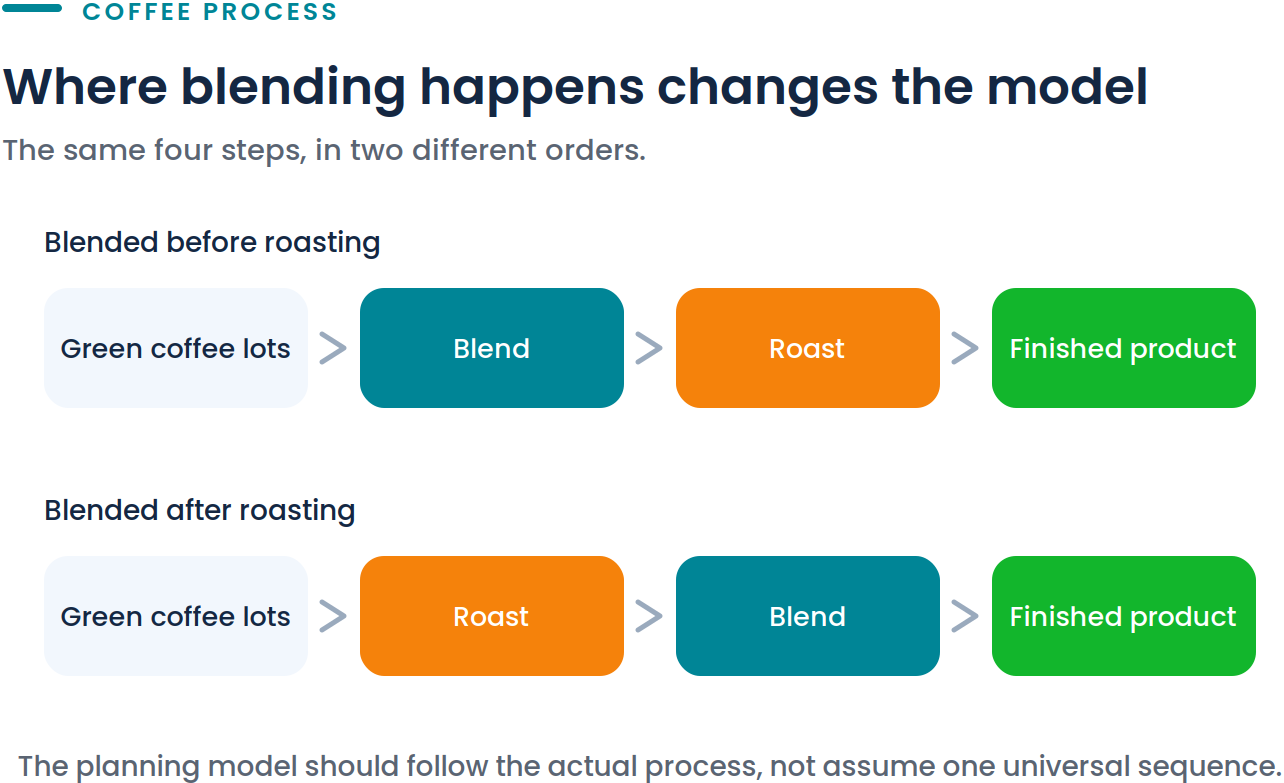
Some roasters blend green coffee before roasting, others blend after. The choice changes which materials are held in inventory, how yield is calculated, and what the planning model has to represent.
Relevant constraints may include roast or production eligibility, batch sizes, line or roaster capacity, yield, timing, transfer requirements, and product-specific rules. Connecting these factors with blend selection helps prevent recommendations that are theoretically acceptable but difficult to execute.
Managing inventory across origins, hubs, and time
Green coffee inventory represents both supply and optionality. Its value depends on which products it can support, where it is located, when it is available, and what alternatives exist.
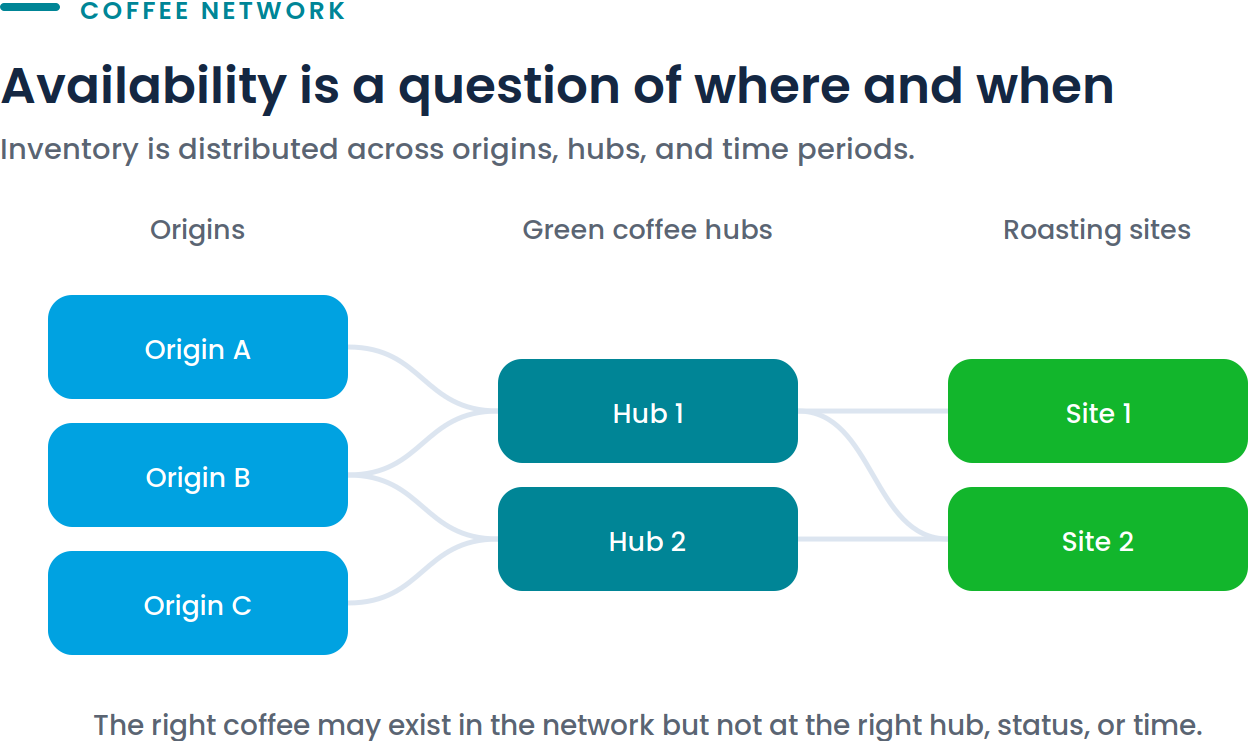
Green coffee is bought at origin, held at hubs, and consumed at roasting sites, often in different countries. Availability is therefore a question of location, release status, and timing, not just of total quantity on hand.
- Allocate constrained lots to the products that need them most.
- Use flexible coffees where they create the greatest portfolio value.
- Avoid consuming substitute materials too early.
- Evaluate transfers between hubs against logistics cost and service impact.
- Coordinate expected receipts with production and demand timing.
- Consider inventory age and internal usage policies where relevant.
Scenario planning for coffee supply, quality, and price changes
- A key origin or supplier becomes less available.
- A received lot has a different sensory or physical profile than expected.
- Green coffee prices change before contract or purchase decisions are finalized.
- Demand shifts across products, pack formats, or markets.
- A transfer, shipment, or release is delayed.
- The organization wants to reduce concentration in one origin or supplier.
- Roasting or production capacity becomes constrained.
Scenario planning helps teams compare practical responses, identify critical materials, and understand the consequences for cost, quality, inventory, service, and operations.
Balancing quality, cost, service, and risk
Coffee blending decisions rarely have one objective. Procurement may seek favorable cost and supply conditions, sensory teams protect product profile, operations need feasible production, and supply chain teams must protect service and inventory.
A multi-objective model makes these trade-offs explicit. Teams can define hard constraints that must never be violated, preferred targets that can be balanced, and scenarios that show the cost or risk of different choices.
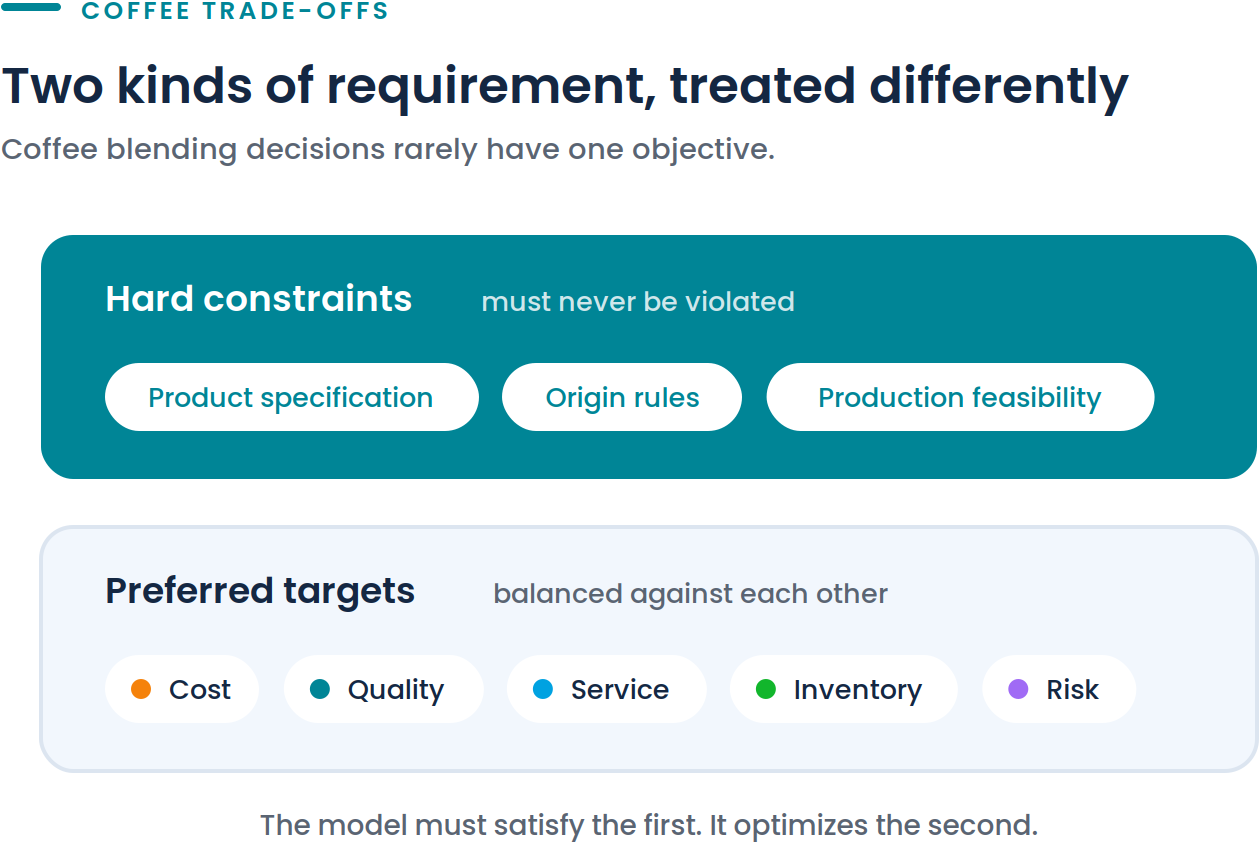
Product specifications, origin rules, and production feasibility are absolute; cost, quality, service, inventory, and risk are competing priorities. Separating the two is what allows a model to optimize without ever producing something that cannot be made.
What data is required for coffee blending optimization?
- Demand and product data. Product requirements, volumes, markets, timing, and service priorities.
- Green coffee data. Lot, origin, crop, supplier, processing method, physical data, sensory assessments, and approved uses.
- Inventory and logistics data. Quantity, hub, release status, age, receipts, transfers, and transportation conditions.
- Procurement data. Prices, contracts, supplier availability, lead times, commitments, and minimum quantities.
- Roasting and production data. Eligibility, yield, capacity, batch rules, timing, and process constraints.
- Cost and policy data. Material, logistics, handling, inventory, conversion, shortage, sourcing, and risk rules.
Customer story. A global coffee manufacturer implemented ICRON across a multi-origin network spanning sourcing, roasting, blending, and inventory decisions, replacing fragmented planning and manual workarounds with structured, scenario-based decision support.
How AI-Native Decision Execution supports coffee blending
ICRON Procurement Planning and Blending Optimization for Tea & Coffee, powered by the ICRON AI-Native Decision Execution Hub, provides one environment for evaluating green coffee sourcing, blend feasibility, inventory, transfer, roasting, and production decisions. A short overview of the Tea and Coffee solution is also available.
Optimization handles the decision complexity. AI-supported workflows help planners investigate changes and alternatives. Governance keeps assumptions, recommendations, and approvals visible. This allows teams to move from analysis to an executable plan without losing the operational context behind the decision.
Key Terms Used in This Guide
- Green coffee. Unroasted coffee, the material that is purchased, stored, transferred, and evaluated in most planning models.
- Lot. A quantity of green coffee with its own origin, crop, processing method, physical data, sensory assessment, location, and approved use.
- Processing method. The post-harvest route, recorded as a material attribute alongside origin, variety, crop, and supplier.
- Sensory assessment. The organization’s approved descriptive and quality evaluation, used together with physical, commercial, and operational data.
- Hub. A sourcing or inventory location in the network, where quantity, release status, and transfer availability are tracked.
- Pre-roast and post-roast blending. Two operating models for where blending occurs in the process, each with different material, yield, inventory, and product rules.
Frequently Asked Questions
What is coffee blending optimization?
Coffee blending optimization uses a structured decision model to select green coffee or roasted coffee combinations that meet product requirements while considering quality, origin, lot characteristics, cost, availability, inventory, roasting, and production constraints.
Is coffee blending optimization only for specialty coffee?
No. It can support any coffee manufacturing environment where multiple materials, quality requirements, supply options, and operational constraints must be coordinated. The attributes and decision rules should reflect the company’s own products and quality system.
What is the difference between a coffee blend recipe and an optimized blend?
A recipe describes an approved composition. An optimized blend protects the approved finished-product requirements while allowing the material composition to adjust within those boundaries as availability, lot characteristics, and price change. The two can be used together.
Does coffee blending optimization replace sensory expertise?
No. The organization’s approved assessment framework defines what an acceptable profile is, and the model works within it. Its contribution is to evaluate green coffee, inventory, roasting, production, and cost constraints simultaneously rather than one attribute at a time.
Can the model use cupping or sensory data?
Yes. It can use the organization’s approved descriptive, quality, or sensory assessments together with physical, commercial, and operational data.
Can it distinguish between lots from the same origin?
Yes. Lot-level properties can be represented when differences affect product quality, feasibility, cost, or allocation decisions.
Can it support both pre-roast and post-roast blending?
Yes, provided the model is configured around the company’s actual process. The relevant material, yield, roasting, inventory, and product rules will differ by operating model.
How are green coffee purchase and contract conditions represented?
Price, supplier availability, lead time, minimum quantities, commitments, and transportation conditions can each be represented as attributes of a supply option. Purchase options are then compared on quality contribution and total cost rather than on unit price alone.
How does it support green coffee procurement?
It evaluates purchase and contract options against forecasted product requirements, existing inventory, expected receipts, quality contribution, and operational constraints.
Can it coordinate multiple sourcing hubs and factories?
Yes. It can represent inventories, transfers, receipts, production locations, and market requirements across a multi-site network.
What level of green coffee data is needed to begin?
The model should reflect the manufacturer’s established quality and procurement processes. Product requirements, the physical and sensory values already in use, and reliable inventory, hub, release status, and expected receipt information are usually the inputs that determine whether the model is useful.
How does it help maintain a consistent product profile?
The model protects approved product requirements while adjusting the material composition as availability and lot characteristics change. It evaluates the complete set of relevant constraints rather than one attribute at a time.

Turn Complex Coffee Blend Trade-Offs Into Executable Decisions
See how ICRON connects green coffee sourcing, quality, inventory, roasting, and production constraints within one optimization and execution environment.