


 Blogs


Chocolate manufacturers face a difficult balancing act: volatile ingredient markets, concentrated seasonal demand, complex production constraints and constant pressure on margins. Connected supply chain planning helps teams weigh these trade-offs and turn forecasts into production and inventory decisions that reflect actual constraints.
When cocoa costs change, every planning decision matters
Imagine Easter orders arriving just as cocoa purchasing costs change and a packaging line reaches capacity. Should a manufacturer prioritize its highest-margin products, protect customer commitments or build additional seasonal inventory? The answer depends on more than the forecast. It depends on how procurement, production, inventory and service decisions interact.
Why is chocolate supply chain planning challenging?
Chocolate supply chain planning coordinates ingredient supply, demand, production, inventory and distribution while accounting for material costs, product specifications, manufacturing capacity and delivery commitments. For confectionery producers, seasonal peaks, multiple SKUs, shared equipment, allergen-related changeovers and temperature-sensitive storage add further complexity.
Market conditions can shift significantly. In its August 2026 statistical update, the International Cocoa Organization (ICCO) reported an 8.5% increase in global cocoa production and a 3.3% decline in global cocoa grindings for the 2024/25 cocoa year. These are revised figures for that season, not final 2025/26 results, and illustrate why supply and demand assumptions need regular review.
Four planning priorities for chocolate manufacturers
1Connect ingredient costs with production and margin decisions
A change in cocoa, cocoa butter, sugar or milk powder costs affects products differently. Integrated supply and production planning helps determine product mixes and material allocations that balance contribution margins and customer commitments within available supplies and capacity.
2Prepare for seasonal demand without excess inventory
Easter, Christmas, Valentine’s Day and promotional campaigns create short sales windows. Demand planning helps anticipate peaks, while inventory and capacity optimization determine how much to build, when to produce and how to avoid costly leftover seasonal stock.
3Allocate constrained ingredients across competing products
When supply is tight, not every order can be prioritized equally. Mathematical planning models can allocate limited ingredients across products while balancing customer commitments, contribution margins, available inventory and approved product specifications. The resulting priorities must also follow quality and commercial rules.
4Build production schedules that work on the factory floor
Mixing, refining, conching, tempering, molding, cooling and packaging compete for shared resources. Constraint-based production scheduling considers batch sizes, equipment availability, cleaning and changeovers, helping teams translate supply plans into executable production sequences.
Three practical ways AI can support decisions
The following examples are illustrative scenarios, not customer case studies or claims of achieved results.
A cocoa cost increase changes product economics
Updated cocoa and ingredient prices can feed an AI-supported planning workflow in which mathematical models generate revised production volumes and material allocations using available inventory, capacity and customer commitments. Planners can then assess the effects on margin and service before acting.
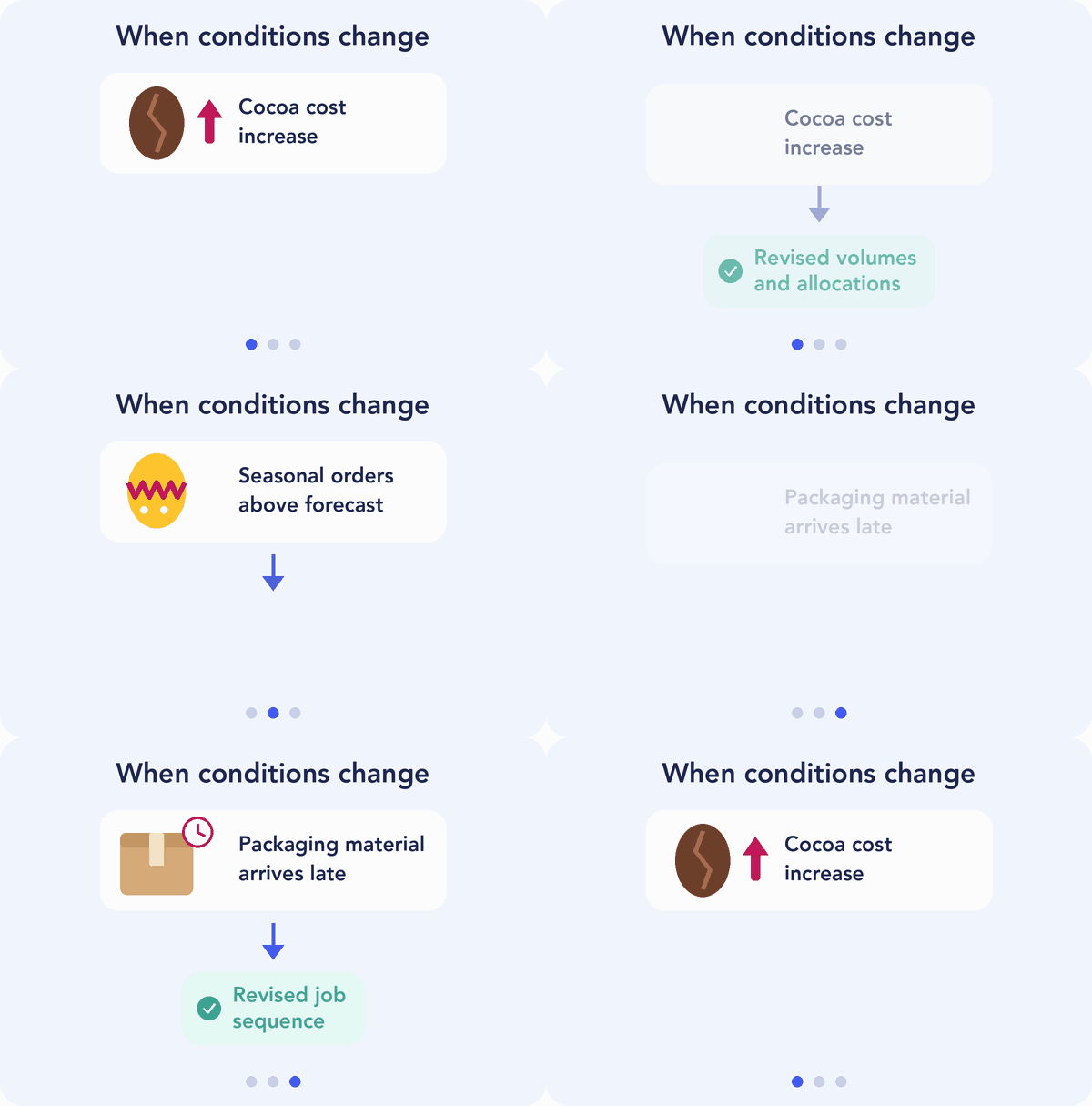
Seasonal orders arrive above forecast
Scenario planning evaluates additional shifts, inventory reallocation and revised production sequences, showing which options can serve demand without creating disproportionate post-season stock risk.
A key packaging material arrives late
With updated packaging delivery dates, constraint-aware scheduling can generate revised job sequences and resource assignments around material readiness and customer priorities. Teams can then assess the effect on delivery commitments before making changes.
How ICRON supports chocolate supply chain planning
ICRON brings Demand Planning, Production & Capacity Planning, Inventory Optimization and Production Scheduling together within its AI-Native Decision Execution Hub. Rather than treating each plan in isolation, this connected approach links seasonal forecasts to inventory and ingredient allocations, production volumes and factory schedules, helping teams weigh service and profitability together.
For chocolate and confectionery manufacturers, this means connecting seasonal forecasts to inventory targets, production decisions and factory schedules built around resource and material constraints. The objective is not just to predict change, but to make better, executable decisions when conditions change.
Frequently asked questions
What is chocolate supply chain planning?
It is the coordinated planning of ingredients, demand, production, inventory and distribution under cost, quality, capacity and customer-service constraints.
How can AI improve chocolate production planning?
AI-supported forecasting can inform mathematical planning models that generate material allocations and production plans. Scenario analysis and scheduling then help teams understand the operational and commercial consequences before execution.
Why is production scheduling important in chocolate manufacturing?
Chocolate operations share processing and packaging resources. Scheduling helps account for batch sizes, changeovers, equipment constraints and delivery priorities.
Which ICRON solutions are most relevant?
Demand Planning, Production & Capacity Planning, Inventory Optimization and Production Scheduling, connected through the AI-Native Decision Execution Hub.