


 Blogs


Milk does not wait for the next planning cycle. When deliveries exceed expectations, a retailer changes an order, or a filling line stops, dairy manufacturers must decide what to produce, where to allocate milk, and how to keep production moving without compromising freshness.
Dairy supply chain planning connects milk supply, demand, production, inventory, and distribution while accounting for perishability, material composition, and plant constraints. AI and advanced optimization can help manufacturers make these decisions together rather than in isolation.
Why dairy supply chain planning is different
Raw milk is highly perishable, and its volume and composition can vary with seasonality and other factors. Manufacturers must balance this variability against changing demand for products with different processing requirements, shelf lives, and margins.
The challenge extends beyond matching supply with demand. Shared tanks, processing equipment, filling lines, cleaning-in-place (CIP) cycles, and limited intermediate storage can interrupt material flow even when nominal capacity is available. A product mix that looks profitable on paper may still fail to meet the plant’s timing and resource requirements.
How is AI used in dairy supply chain planning?
The following hypothetical scenarios illustrate three practical applications of AI and optimization in dairy operations.
1. Finding the best use of available milk
Imagine a plant receiving more milk than planned while orders for yogurt soften and demand for cheese increases. Producing additional yogurt may increase expiry risk, while diverting milk to cheese could create a capacity bottleneck. AI-supported demand forecasts can inform mathematical planning models that determine how much milk and its components to allocate across products, accounting for co-products, processing capacity, demand and contribution margins.
2. Protecting freshness without sacrificing service
Consider a retailer reducing its order for a fresh product after production has been scheduled. By combining forecasts, inventory age, and customer-specific remaining shelf-life requirements, planning systems can flag stock at risk and evaluate changes to production volumes or allocation. The goal is to avoid unnecessary production while meeting delivery commitments.
3. Responding to disruptions on the plant floor
A filling line stops while upstream production is running. Moving an order to another line may not work if a tank or transfer route is occupied or cleaning is due. Constraint-aware scheduling can generate revised sequences and resource assignments around material flow, cleaning and downstream capacity, showing delivery and waste implications before release.
Keep dairy production moving with AI-driven flow scheduling
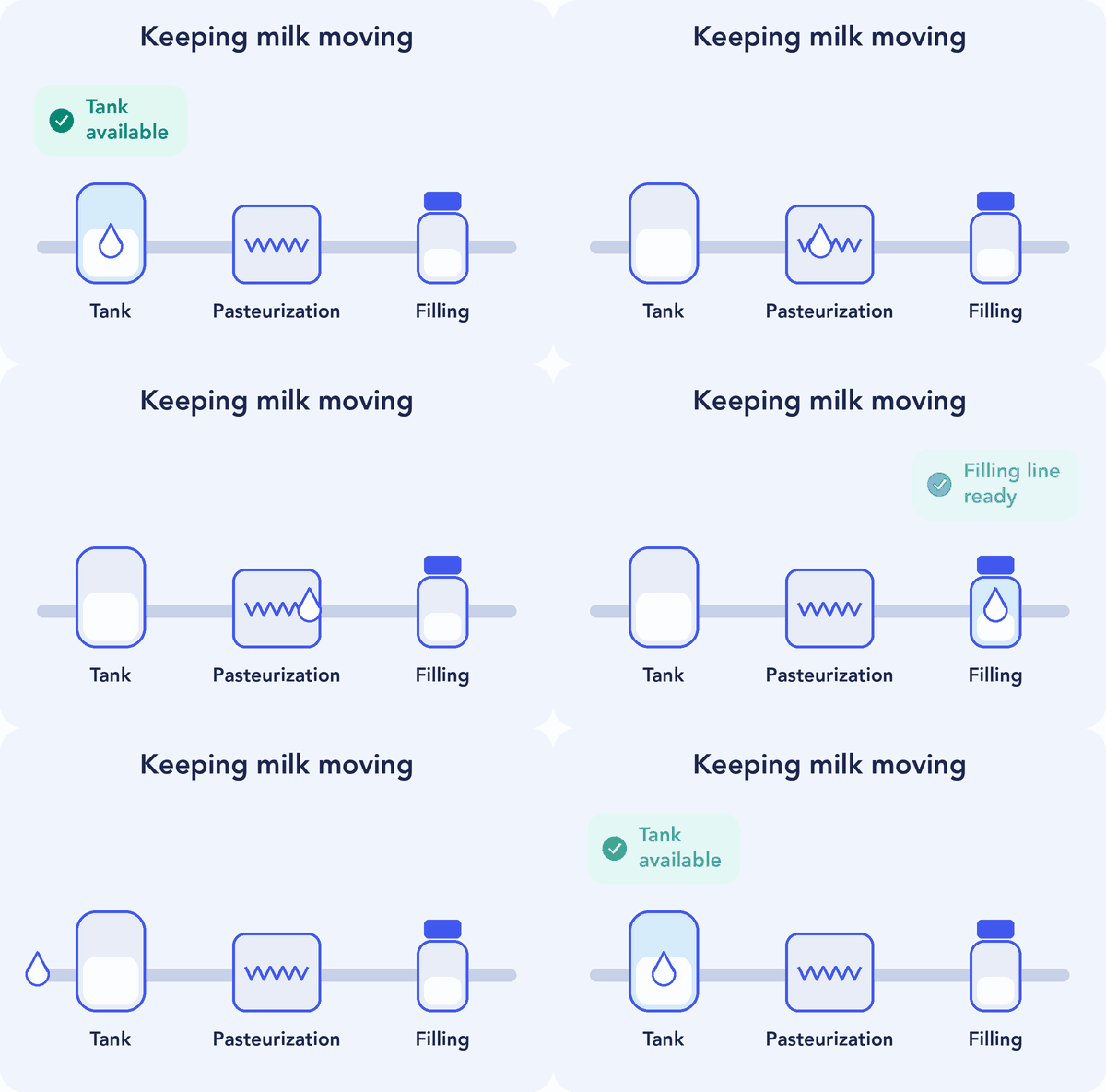
A schedule based only on orders and equipment availability misses a critical part of dairy production: the movement of materials between operations. Milk reception, pasteurization, fermentation, intermediate storage, filling, and packaging must be coordinated wherever these stages apply.
A free processing line does not guarantee that production can start: the right material, tank, transfer route, and downstream capacity must also be available at the right time. Flow scheduling addresses these dependencies, including cleaning cycles and product changeovers.
How ICRON supports dairy manufacturers
ICRON’s AI-driven Flow Scheduling for Dairy Plants is designed to address the unique production scheduling challenges of dairy manufacturers. It helps planners synchronize material flows, tank allocation, processing and filling operations, and cleaning requirements in schedules that reflect plant capacity and material-flow dependencies.
With ICRON’s AI-Native Decision Execution Hub, advanced optimization and digital twin technology support the evaluation of alternative schedules and their operational implications. When conditions change, planners can compare feasible options and make informed decisions based on the constraints of their production environment.
By connecting planning with the realities of the plant floor, dairy manufacturers can work toward better resource utilization, reduced waste, and more reliable production. The objective is not simply to produce more, but to create more value from every drop of milk.
Frequently asked questions
What is milk allocation optimization?
Milk allocation optimization determines how available milk and its components can be distributed across products to balance demand, capacity, composition, and profitability.
How does a digital twin support dairy production planning?
A digital twin models relevant production resources and constraints so planners can test changes in material flows, equipment availability, and production schedules before implementation.
Can AI help reduce dairy supply chain waste?
Yes. Forecasting and optimization can help identify excess inventory risks, account for remaining shelf life, and evaluate production adjustments before products expire.