


 Blogs

Imagine a manufacturer producing two nutritional blends. Both can use the same approved ingredient, but only a limited quantity is available at a discounted price.
The team assigns it to Product A. Product A’s cost falls. A clear win: until Product B must use a much more expensive alternative.
The cheapest option wins. Until it doesn’t.
When multiple products compete for the same ingredients, the best decision for one recipe may not be the best decision for the whole operation. This is the challenge behind raw material allocation optimization.


A simple allocation example
Suppose the discounted supply can be assigned to only one product. Both products are eligible to use it, but the potential savings differ:
| Option | Product A | Product B |
|---|---|---|
| Savings if discounted material is allocated | €400 | €900 |
| Possible allocation | Eligible | Eligible |
Illustrative hypothetical example; assumes all other costs and constraints are equal.
Allocating the ingredient to Product B generates €500 more savings than allocating it to Product A. The arithmetic is straightforward. Actual decisions are not: manufacturers also face specification limits, available stock, future deliveries, batch sizes and capacity constraints.
What is raw material allocation optimization?
Raw material allocation optimization determines how available materials should be distributed across competing products, orders or sites to meet business objectives while respecting defined constraints.
Rather than treating each formulation in isolation, it evaluates the consequences of using limited resources across the wider production plan.
- Which product benefits most from a scarce ingredient?
- Should available stock be used now or reserved for future demand?
- Could another approved blend reduce total cost?
- How might allocation choices affect customer orders?
Why real-world allocation is harder than the example
The €400-versus-€900 comparison assumes that the discounted material can be used interchangeably and that nothing else changes. Real ingredient manufacturing rarely offers that simplicity. A raw-material option may satisfy one customer’s product specifications but not another’s. A blend may have a minimum inclusion rate, while a production line may require fixed batch sizes. A delivery due tomorrow may be more urgent than an order due next month.
That means allocation is not just about choosing the product with the highest apparent saving. The allocation must satisfy applicable material eligibility, product specifications, inventory availability and operational constraints while balancing cost, timing and service priorities. An apparently low-cost option may be infeasible because it breaches formulation requirements, or commercially undesirable because it puts a customer commitment at risk.
A practical way to evaluate competing uses
When a material is scarce, a structured comparison helps teams avoid local decisions that create network-wide problems:
- Identify the constraint: Which material, supplier, expected delivery or availability limit is restricting production?
- Map eligible demand: Which approved products can use the material, and in what quantities?
- Compare alternatives: What other materials, suppliers or blend proportions are allowed?
- Measure the trade-offs: Compare total cost, service risk, inventory exposure and production feasibility.
- Revisit the decision: Update the allocation when demand, supply or prices change.
This approach is especially relevant to manufacturers of nutritional premixes, seasoning blends and specialty ingredients, where several finished products may draw from a shared pool of qualified raw materials.
Why purchasing and allocation belong together
Allocation decisions can also reveal a better purchasing decision. If a scarce ingredient is reserved for the product that benefits most, the team may need to source an approved substitute for another blend: or adjust a future purchase quantity. Conversely, an incoming shipment may change which allocation makes sense.
This is why connected procurement and blending decisions matter. A material should be evaluated not only by what it costs, but by what using it prevents or enables elsewhere.
| Step | Question for the planner |
|---|---|
| Check eligibility | Which approved blends can use this material option? |
| Compare scenarios | What changes if demand shifts or stock is reallocated? |
| Optimize | Which feasible plan best meets cost and service priorities? |
| Review and approve | Are the assumptions and trade-offs acceptable? |
Illustrative decision workflow, not a product UI screenshot.
Food-safety controls, applicable allergen and labeling requirements, and any required supplier approval or verification remain the manufacturer's responsibility. Optimization can account for defined material-eligibility and process constraints, but it does not replace these controls. For regulatory context, see the FDA preventive controls for human food.
How ICRON helps planners make the bigger decision
The two-product example is simple, but the same problem can involve hundreds of ingredients, dozens of recipes and several production sites. A material that looks plentiful at one plant may be urgently needed at another. A cheaper blend might also consume capacity needed for a priority customer order.
ICRON Procurement Planning and Blending Optimization brings these connected decisions into one optimization approach. Planners can evaluate eligible blend combinations, material availability, sourcing choices and allocation across products and planning periods, while accounting for defined quality and operational constraints.
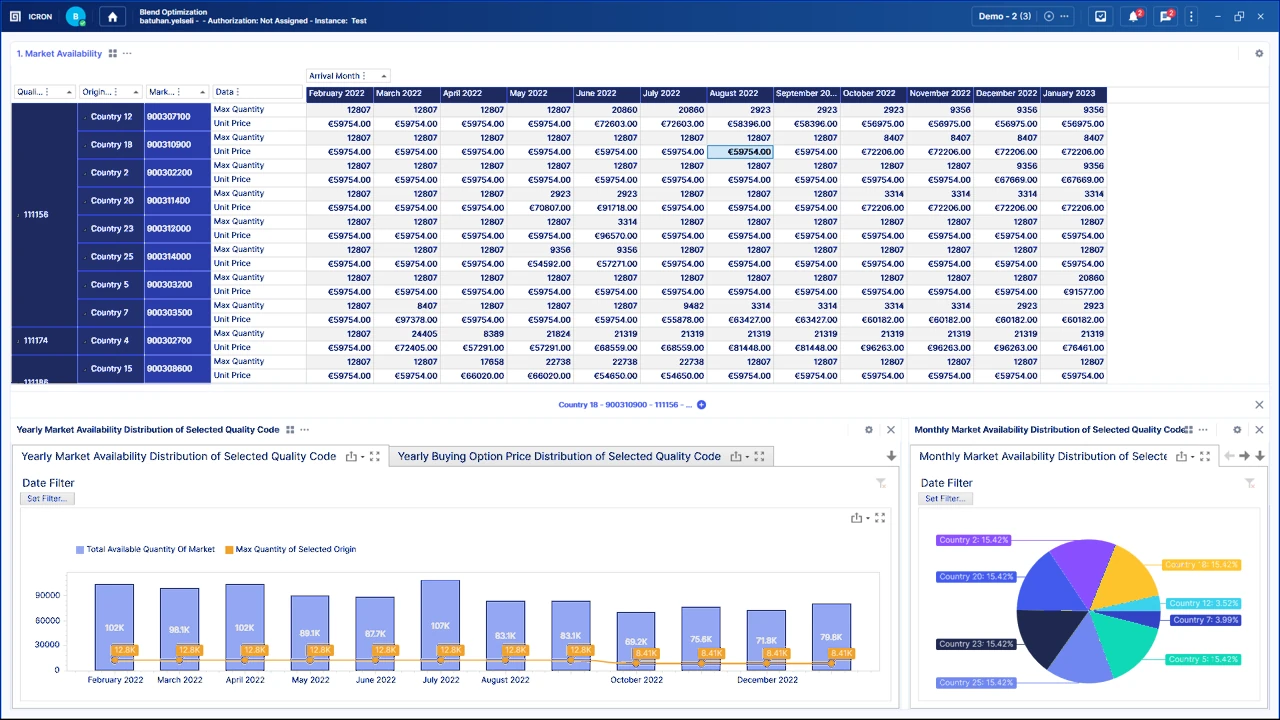
Use scenario planning to test the consequences
Suppose demand for Product B rises unexpectedly. Instead of simply moving more of the discounted ingredient to that product, the team can compare scenarios: keep the original allocation, rebalance the material, or use an approved alternative blend. Each scenario can be assessed for cost, feasibility and its effect on other commitments.
Each scenario assessed for cost feasibility other commitments
Discounted ingredientApproved alternative blend
Where AI and agentic AI fit
In this case, optimization compares eligible allocation and blending choices under quality, capacity and inventory constraints. AI helps teams explore the trade-offs. Agentic AI can coordinate approved steps, such as preparing a new scenario when demand changes and sending the result for planner review. ICRON’s AI-Native Decision Execution Hub brings these capabilities into a governed decision process.
Where configured, agents can also respond to requests or operational updates from planners, other agents or connected enterprise systems, gather relevant information, modify scenarios, initiate or rerun optimization, and execute permitted planning actions within defined authority. Decisions requiring approval can be escalated through the appropriate workflows.
This does not mean an AI agent should decide which ingredient goes into a product without oversight. Approved specifications and business rules remain central, and planners retain control over decisions that require authorization.
So the question changes from
Which recipe is cheapest?
How should we use the materials we have to deliver the best overall result?

Facing competing demands for the same ingredients?
See how procurement, blending and allocation decisions are planned together in ICRON.
Frequently asked questions
What is the difference between blending optimization and raw material allocation optimization?
Blending optimization determines feasible material combinations for a product. Raw material allocation optimization evaluates how limited materials should be distributed across competing requirements. The two can be optimized together.
Why can the cheapest ingredient increase total production costs?
A cheaper ingredient may be scarce, require different approved blend proportions or create higher costs elsewhere. The best choice depends on its impact across all affected products and operations.