






 Guides

Blending optimization is the structured process of determining which raw materials to use, in what quantities, and from which available stocks or supply options, so that the resulting blend meets quality, cost, availability, and operational requirements at the same time.
This matters in industries where raw materials are naturally variable, specifications are expressed as acceptable ranges, and many different material combinations may appear technically possible. The lowest-cost material is not always usable. The highest-quality blend is not always operationally feasible. A practical decision must work across procurement, inventory, formulation, production, and customer requirements. The same principles apply in tea, coffee, and tobacco, with different vocabulary in each.
Key Takeaways
- A recipe describes what a product should contain. A blending decision determines what can actually be produced under current conditions.
- Two lots with the same commercial description may differ enough to change which blends are feasible, which is why material data is often required at lot level.
- Quality, availability, cost, inventory, and production constraints are evaluated together rather than in sequence.
- Procurement determines which future blending options will exist, so the two decisions are more effective when they are optimized together.
- The value depends on the industry, portfolio, data quality, and planning horizon, and should not be reduced to a single cost-saving claim.
What is blending optimization?
Blending optimization converts product requirements and operating conditions into a decision model. The model evaluates available raw materials and determines the combinations that satisfy required limits while supporting business objectives such as reducing cost, protecting quality, using inventory effectively, or limiting supply risk.
Depending on the industry, a blend may need to comply with sensory, physical, chemical, regulatory, performance, or processing specifications. Materials may differ by lot, origin, supplier, crop, grade, age, composition, price, or location. Blending optimization helps planning teams evaluate these differences consistently and at a scale that is difficult to manage through spreadsheets and fixed rules. This is the decision environment ICRON Procurement Planning and Blending Optimization is built for.
Why blending is more complex than recipe management
A recipe describes what a product should contain. A blending decision determines what can actually be produced under current conditions. Those are not always the same thing.
- Raw material properties change. Two lots with the same commercial description may have different quality or performance characteristics.
- Availability changes. A preferred material may be delayed, restricted, committed to another product, or available only at a different location.
- Prices and contract conditions change. The most attractive sourcing option may depend on volume commitments, timing, transportation, or supplier terms.
- Inventory has operational value. Using one material today can reduce the options available for future demand.
- Production creates additional constraints. A blend may be mathematically valid but unsuitable for a specific line, batch size, sequence, or processing condition.
- Quality is usually multidimensional. A combination may meet one target while violating another.
For these reasons, blending decisions should be evaluated as part of a wider operational system, not as a stand-alone formulation exercise.
Recipe management compared with blending optimization:
- Decision scope. Recipe management: One formulation at a time. Blending optimization: Products, periods, and sites together.
- Material variability. Recipe management: Fixed ratios against a nominal spec. Blending optimization: Actual lot-level values.
- Procurement. Recipe management: Evaluated separately. Blending optimization: Evaluated with blend feasibility.
- Output. Recipe management: An approved composition. Blending optimization: An executable decision.
How blending optimization works
The exact model depends on the industry and operating environment, but a typical blending optimization process follows a consistent sequence.
- Define the demand or production requirement. The model starts with the products, volumes, locations, and time periods that must be supplied.
- Represent raw material availability. Available inventory, open procurement options, expected receipts, transfers, and supplier limits are included.
- Capture material characteristics. Relevant quality, sensory, physical, chemical, regulatory, or performance values are assigned at the appropriate level, often by lot, grade, origin, or supplier.
- Set product and process constraints. Minimums, maximums, ratios, inclusion rules, exclusions, capacity limits, batch rules, and other operational requirements are defined. -. Choose the business objective. The model may minimize total cost, reduce risk, protect quality, use aging inventory, improve service, or balance several objectives.
- Generate feasible alternatives. Optimization evaluates large numbers of possible combinations and returns options that satisfy the defined constraints.
- Compare scenarios and trade-offs. Planners can test changes in price, availability, demand, quality, sourcing, or policy before committing to a decision. Our note on cloud-based procurement and optimal blending covers how dynamic recipe generation and what-if comparison work in practice.
- Release an execution-ready decision. The selected plan can be governed, approved, and connected with procurement, inventory, production, and scheduling processes.
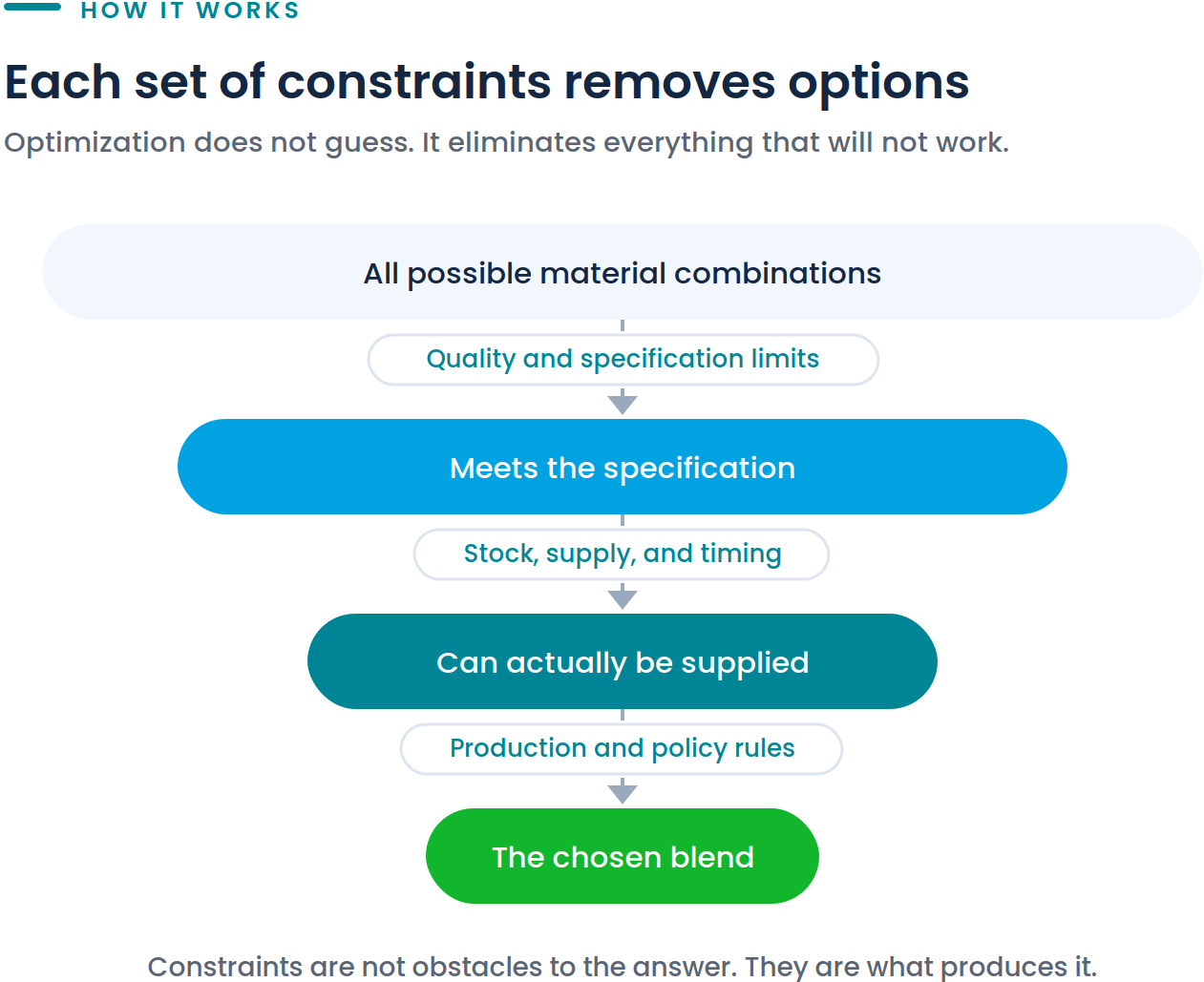
Quality limits, supply availability, and production rules are not applied one after another; a blend has to satisfy all of them at once. What makes the decision difficult is that a combination can pass one set of requirements and fail another.
What data is used in blending optimization?
Blending optimization depends on reliable data, but it does not require every company to use the same data model. The relevant inputs are determined by the product, process, and decision horizon.
- Demand and product data. Required products, volumes, dates, locations, service priorities, and product specifications.
- Raw material master data. Material type, grade, origin, supplier, approved uses, substitutions, and units of measure.
- Lot-level or batch-level quality data. Sensory, physical, chemical, regulatory, or performance attributes.
- Inventory data. Quantity, location, status, age, shelf life where relevant, reserved stock, and expected receipts.
- Procurement data. Prices, supplier availability, contracts, lead times, minimum order quantities, commitments, and transportation conditions.
- Production data. Batch sizes, line eligibility, yields, capacities, sequence rules, processing limits, and timing.
- Cost and policy data. Material, transport, handling, conversion, inventory, shortage, and other relevant cost elements, plus internal sourcing or risk policies.
Data quality should be treated as part of the operating model. Missing or uncertain values can be handled through approved defaults, ranges, confidence rules, or scenario comparisons, but they should remain visible to planners.
What constraints must a blend satisfy?
Constraints define what is acceptable and feasible. They protect product requirements and keep recommendations grounded in operational reality.
- Specification constraints. Minimum and maximum values for the attributes that define the finished product.
- Composition constraints. Required, optional, prohibited, or limited ingredients and material groups.
- Quality and sensory constraints. Acceptable ranges defined by the company’s own quality framework.
- Supply constraints. Available stock, expected receipts, supplier capacity, contracts, and allocation limits.
- Inventory constraints. Material status, age, shelf life where relevant, location, release status, and prioritization rules.
- Operational constraints. Batch sizes, equipment compatibility, process limits, yields, and production timing.
- Commercial and policy constraints. Approved suppliers, origin policies, concentration limits, sourcing diversification, or customer-specific rules.
How raw material variability changes blend decisions
Raw material variability is one of the main reasons fixed formulations become difficult to maintain. Materials can vary because of agricultural conditions, extraction or processing methods, supplier differences, storage, age, or natural composition. The same nominal material may therefore perform differently from one lot to another.
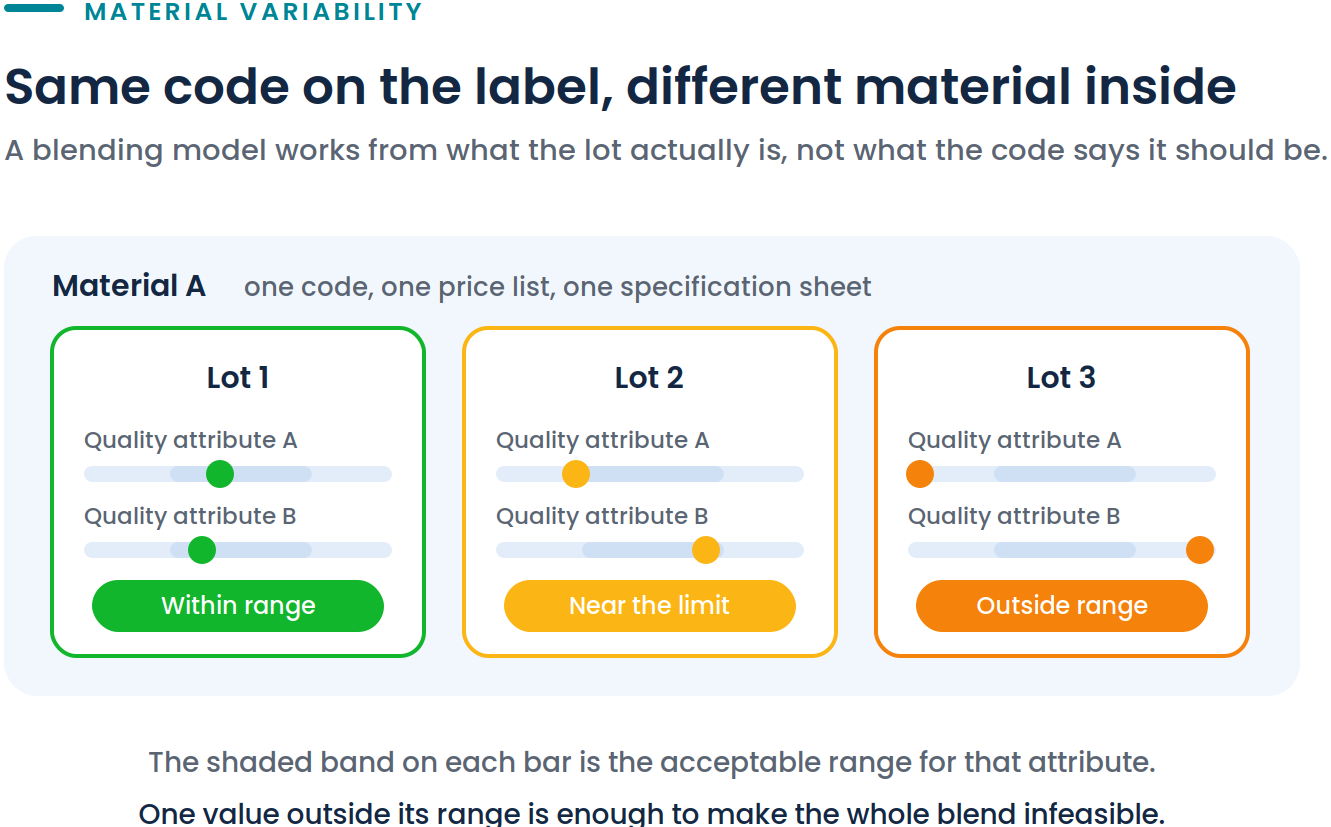
A material code describes what was purchased, not how a specific lot will behave. Where a lot's measured values fall against the specification determines whether it can be used at all, which is why blending decisions are made from lot data rather than averages.
Blending optimization accounts for this variability directly. Instead of assuming that all units of a material are interchangeable, the model can use the available quality information at the level required by the business. This allows planners to protect finished-product requirements while making better use of the materials that are actually available.
Why procurement and blending decisions should be connected
Procurement determines which future blending options will exist. Blending determines the real value of a procurement option. Planning them separately can create low-cost purchases that are difficult to use, technically attractive blends that depend on unavailable materials, or inventory positions that restrict future production.
- Evaluate material price and blend contribution together.
- Understand whether supplier or origin changes affect formulation feasibility.
- Test contract volumes against expected demand and quality requirements.
- Identify where additional purchases create flexibility and where they create excess.
- Consider current inventory before committing to new supply.
- Compare total landed and operational cost rather than unit price alone.
This is especially important for long procurement lead times, seasonal materials, constrained origins, or products with narrow quality ranges.
How scenario planning supports blending
A single optimized answer is not enough when market and operating conditions can change. Scenario planning helps teams understand how robust a decision is and which alternatives remain available.
- What happens if a supplier delivers less than expected?
- How would a price increase affect the preferred blend?
- Can the product still be supplied if one origin or grade is unavailable?
- What is the effect of a quality shift in a major lot?
- How much additional inventory is needed to protect service?
- Which materials become critical under a demand increase?
- Can aging or excess inventory be used without compromising specifications?
Scenario comparison also improves cross-functional alignment. Procurement, quality, planning, and production teams can discuss the same assumptions and see the operational consequences of each option.
Connecting blending with inventory and production planning
A blend recommendation becomes valuable only when it can be produced at the required time and location. Inventory availability, material release status, transfers, production capacity, batch size, and sequencing can all influence the final decision.
Integrated blending optimization can therefore support decisions such as where to consume a material, when to transfer it, which product should receive a constrained lot, whether an alternative formulation is needed, and how the selected blend affects production plans. This reduces the gap between a technically feasible formulation and an executable operating plan.
What business value can blending optimization create?
The value of blending optimization depends on the industry, product portfolio, data quality, constraints, and planning horizon. It should not be reduced to a single cost-saving claim.
- More consistent product quality despite changing raw materials.
- Better alignment between material purchasing and actual formulation needs.
- Faster evaluation of complex sourcing and blend alternatives.
- Lower exposure to unusable, excess, or poorly allocated inventory.
- Clearer trade-offs between cost, quality, service, risk, and sustainability objectives.
- Improved use of available materials across products, sites, and time periods.
- More transparent and governed decisions across procurement, quality, planning, and production.
Lipton Teas and Infusions replaced static recipes with optimization and scenario-based planning across its global sourcing network: 96% demand satisfaction, a 30% reduction in procurement costs, a 5% reduction in worldwide inventory, and run times cut from 180 to 15 minutes. A global coffee manufacturer applied the same approach across sourcing, roasting, blending, and inventory decisions.
Which industries use blending optimization?
Blending optimization is relevant wherever variable materials must be combined to meet defined product or process requirements. Common applications include tea, coffee, tobacco, chemicals, food ingredients, animal feed, mining and minerals, fuels, and other process manufacturing environments. Short overviews are available for chemical manufacturing and tea and coffee production.
The business logic is similar, but the terminology and constraints are not. A tea quality profile, a coffee sensory assessment, a tobacco leaf specification, and a chemical formulation should not be represented as if they were the same process. Effective software must reflect the language, data, and rules of the industry in which it is used.
What to evaluate in blending optimization software
- Constraint depth. Can the model represent the real quality, sourcing, inventory, and production rules used by the business?
- Lot-level visibility. Can it distinguish between materials that share a code but differ in properties, origin, age, or status?
- Procurement integration. Can it evaluate purchase options and blend feasibility together?
- Scenario capability. Can planners compare alternatives without rebuilding spreadsheets or models?
- Multi-objective optimization. Can teams balance cost, quality, service, risk, inventory, and other objectives transparently?
- Explainability and governance. Can users understand why an option was recommended, review assumptions, and control approvals?
- Operational integration. Can selected decisions connect with enterprise data, procurement, inventory, production, and scheduling processes?
- Adaptability. Can the solution reflect company-specific products, constraints, workflows, and decision horizons without forcing a generic template?
How the ICRON AI-Native Decision Execution Hub supports blending
ICRON Procurement Planning and Blending Optimization is powered by the ICRON AI-Native Decision Execution Hub. It brings optimization, AI-supported workflows, governance, risk awareness, and operational constraints into one decision environment. The chemical manufacturing page shows how the same model is adapted to a regulated industry.
For blending decisions, this means teams can evaluate procurement, material, inventory, quality, and production trade-offs together, compare alternatives as conditions change, understand the reasoning behind recommendations, and move approved decisions closer to execution. The purpose is not to replace domain expertise. It is to give experts a faster, more consistent, and more transparent way to work with complex decision spaces.
Key Terms Used in This Guide
- Constraint. A requirement the blend must satisfy. Constraints protect product requirements and keep recommendations grounded in operational reality.
- Feasible blend. A combination that satisfies every constraint. A model may identify several feasible options rather than a single answer.
- Specification constraint. Minimum and maximum values for the attributes that define the finished product.
- Lot-level data. Material information held for an individual lot or batch, used when differences within one material code affect feasibility or value.
- Multi-objective optimization. Balancing cost, quality, service, risk, and inventory objectives together rather than optimizing one in isolation.
- Execution-ready decision. A selected plan that can be governed, approved, and connected with procurement, inventory, production, and scheduling processes.
Frequently Asked Questions
Is blending optimization the same as recipe management?
No. Recipe management stores and controls approved formulations. Blending optimization evaluates available materials, specifications, costs, inventory, and operational constraints to determine which feasible formulation should be used under current or future conditions. The two capabilities complement each other, and most manufacturers need both.
Does blending optimization always produce one best blend?
Not necessarily. A model may generate several feasible alternatives with different cost, quality, inventory, or risk profiles. Scenario comparison allows planners to select the option that best reflects current priorities.
Can blending optimization use lot-level quality data?
Yes. When lot-level differences affect feasibility or value, the model can represent attributes at lot, batch, grade, crop, origin, supplier, or another relevant level.
Can it account for fixed recipes?
Yes. Fixed recipes, approved alternatives, minimum and maximum inclusion rates, and flexible quality boundaries can all be modeled together. The appropriate structure depends on the product and the company’s operating rules.
Why are spreadsheets often insufficient for complex blending?
Spreadsheets can support small or stable decisions, but they become difficult to maintain when there are many materials, products, periods, quality attributes, sites, and interdependent constraints. They also make scenario comparison, governance, and cross-functional consistency harder.
Can blending optimization support sustainability objectives?
Yes, where the parameters are measurable and the decision rules are agreed. Carbon-related factors, transportation distance, material utilization, waste, and supplier-related factors can be included alongside quality, cost, service, and feasibility rather than treated as isolated claims.
How often should a blending plan be updated?
It depends on how often demand, availability, quality, price, and production conditions change. Longer-horizon sourcing and procurement plans are often reviewed monthly or seasonally, while operational blend and allocation decisions may need to be refreshed much more frequently.
How is blending optimization different from procurement planning?
Procurement planning determines what should be sourced, from whom, in what quantity, and when. Blending optimization determines how available and potential materials can be combined to meet product requirements. In variable-material industries, the two decisions are closely connected and are often more effective when optimized together.

Turn Complex Blend Trade-Offs Into Executable Decisions
See how ICRON connects procurement, quality, inventory, formulation, and production constraints within one optimization and execution environment.