






 Guides

CMO/CDMO production planning is the process of coordinating customer orders, materials, manufacturing capacity, equipment, resources and production timing across contract manufacturing operations.
The defining challenge is that multiple customer programs may depend on the same constrained resources.
The planning problem is therefore not simply when can this order be produced?
It is: Which combination of customer requirements can be fulfilled, using which materials and resources, at what time, and with what effect on the rest of the production portfolio?
Key Takeaways
- Multiple customer programs compete for shared capacity, materials, and production time.
- Available capacity and usable capacity are not always the same.
- Batch sizes, campaigns, cleaning, changeovers, and maintenance affect feasibility.
- Allocating resources to one customer can affect commitments to others.
- Planning balances customer service, manufacturing efficiency, and operational feasibility.
What Is CMO/CDMO Production Planning?
Contract Manufacturing Organizations and Contract Development and Manufacturing Organizations manufacture products or perform development and manufacturing activities on behalf of other organizations.
From a planning perspective, this creates an operating environment in which customer demand, manufacturing feasibility and commercial commitments are tightly linked.
CMO/CDMO production planning can coordinate:
- customer orders and forecasts
- requested delivery dates
- materials and APIs
- customer-supplied materials
- shared manufacturing capacity
- equipment and production-route eligibility
- batches and campaigns
- cleaning and changeovers
- maintenance
- labor and specialist resources
- quality and release timing
- customer and business priorities
The result should be a plan that shows not only what the organization would like to manufacture, but what can realistically be manufactured and delivered.
Why CMO/CDMO Production Planning Is Difficult
A conventional manufacturer primarily coordinates its own product portfolio.
A CMO/CDMO may be coordinating many products belonging to multiple customers, each with different forecasts, production requirements, priorities and contractual expectations.
Those requirements compete for a shared manufacturing environment.
A suite may be required by two different customer programs during the same period. A critical material may be available for only part of demand. A long campaign may improve throughput but delay another customer. An unplanned quality hold may remove expected supply from the plan.
Even apparently available capacity can be misleading.
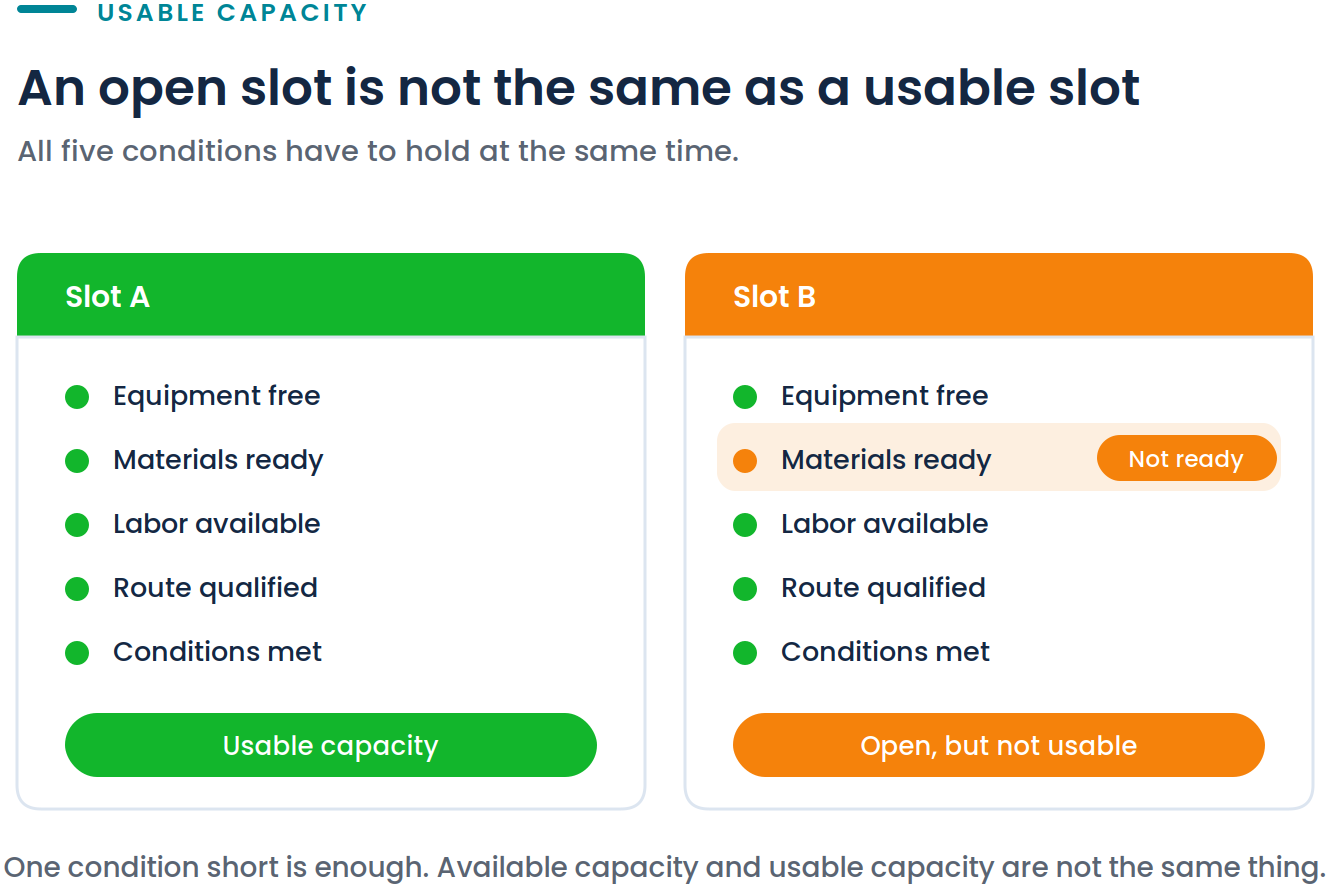
Equipment, materials, labor, a qualified route, and the right operating conditions all have to coincide for a slot to be usable. Capacity that looks open on a schedule is frequently not capacity at all.
A production slot is only genuinely useful when the required equipment, materials, labor, product route and operating conditions are available at the same time.
For this reason, available capacity and usable capacity are not always the same thing.
What Needs to Be Considered in CMO/CDMO Planning?
Customer demand is the starting point, but it is only one part of the decision.
The planning environment also needs to understand which manufacturing resources are eligible for each product, how much capacity is available, whether required materials will be ready, and how production sequencing affects throughput.
Batch sizes and campaign structures matter because demand cannot always be converted into production in arbitrary quantities.
Cleaning, setup and changeover requirements can also consume significant time between products.
Maintenance creates additional restrictions on resource availability.
Quality and release timing may affect when materials, intermediates or finished products become usable.
Finally, customer commitments and business priorities may determine how scarce resources are allocated when all requirements cannot be met simultaneously.
These factors need to be represented together. Otherwise, a plan may appear feasible in aggregate while failing at the detailed production level.
How Does CMO/CDMO Production Planning Work?
| Planning step | What happens |
|---|---|
| 1. Consolidate customer requirements | Orders, forecasts, requested dates and customer priorities are translated into manufacturing requirements. |
| 2. Determine manufacturing feasibility | The model evaluates suitable resources, production routes and available capacity. |
| 3. Establish material readiness | Inventory, expected receipts, procurement and customer-supplied materials are checked against production requirements. |
| 4. Allocate constrained resources | Scarce capacity or materials are assigned according to feasible alternatives and business priorities. |
| 5. Build batches and campaigns | Demand is converted into executable production quantities and grouped where campaign logic applies. |
| 6. Sequence production | Batches are positioned against resources, cleaning, changeovers, maintenance and timing constraints. |
| 7. Evaluate customer commitments | The resulting production plan is checked against requested dates and downstream requirements. |
| 8. Replan as conditions change | Delays, shortages, priority changes or equipment disruption trigger reevaluation of the plan. |
Each step narrows the plan against a different kind of limit: what customers need, what the site can physically run, what materials exist, and what has already been promised elsewhere. The order matters less than the fact that a decision taken at any step changes what remains possible at the others, which is why the sequence ends by returning to the beginning.
This sequence connects strategic and operational questions.
Capacity planning may reveal whether enough manufacturing capability exists overall, but detailed scheduling determines whether that capacity can actually be used in the required sequence.
Material planning may show sufficient stock in aggregate, but allocation determines which customer programs can use it.
Multi-Client Production Planning
Multi-client production planning is one of the most distinctive parts of a CMO/CDMO environment.
When demand exceeds a constrained resource, the decision cannot be made using urgency alone.
Suppose three customer programs require the same production suite.
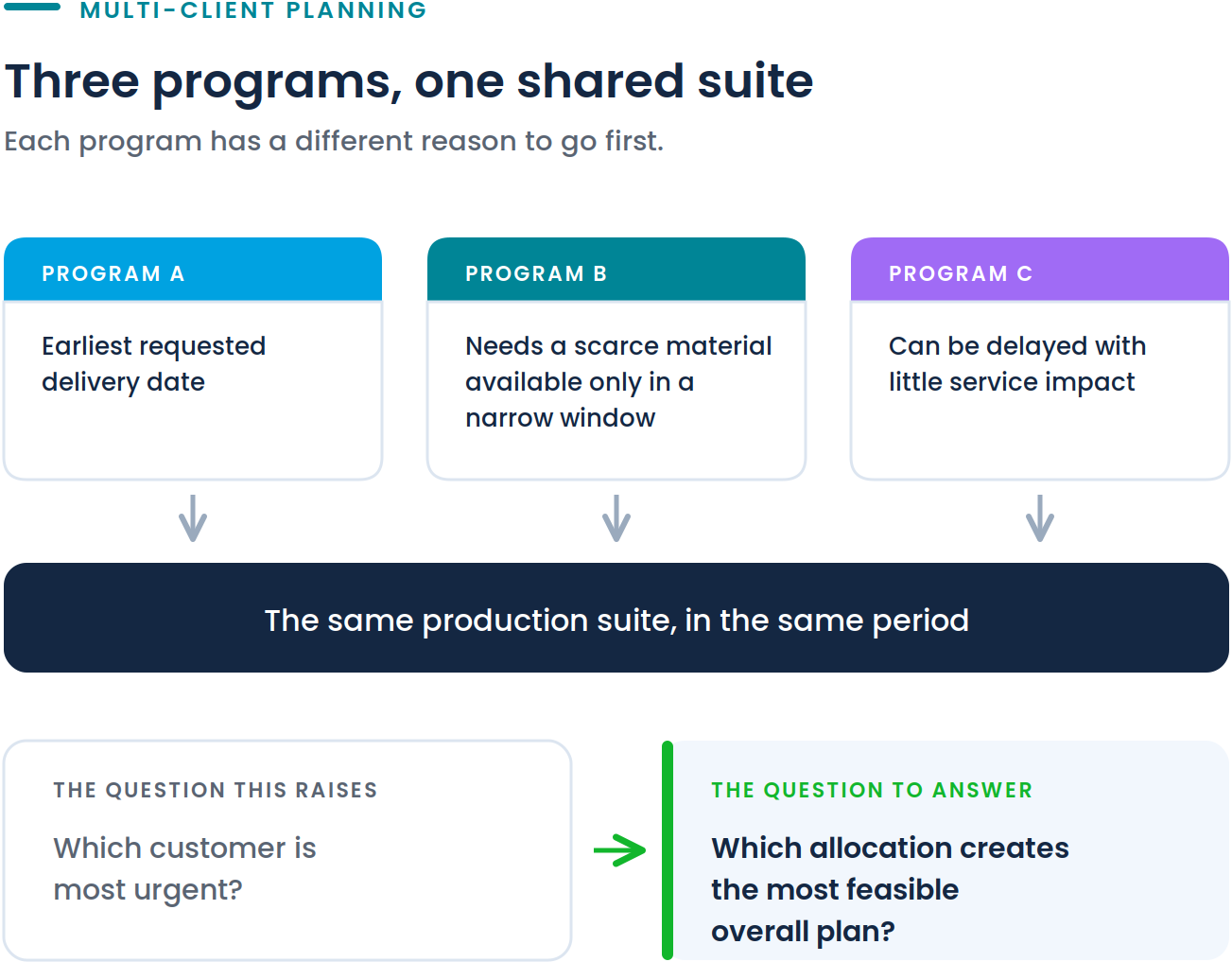
Contract manufacturers serve customers whose priorities are independent of each other but whose products share the same equipment. The useful question is not whose order matters most, but which allocation leaves the largest number of commitments achievable.
One has an earlier requested delivery date. Another requires a scarce material that is available only during a narrow window. A third can be manufactured now or delayed with relatively little service impact.
The correct decision depends on the combined effect of the three alternatives.
Planning therefore needs to consider customer requirements, capacity, material readiness, manufacturing feasibility and downstream consequences together.
This allows the organization to move from “Which customer is most urgent?” to “Which allocation of resources creates the most feasible overall production plan while respecting defined customer and business priorities?”
How Capacity, Materials and Scheduling Interact
CMO/CDMO production planning can be understood as a connected decision chain:
A decision at any stage can change the remainder of the chain.
Allocating a production suite to one customer removes capacity from others.
Allocating a scarce material to one batch can make another batch infeasible.
Increasing campaign length may improve utilization but delay other customer requirements.
Accepting a new order may appear feasible in the current month but create a capacity bottleneck several periods later.
This is why order promising, capacity planning and detailed production scheduling should not be treated as completely separate exercises.
Planning for Change and Disruption
| Scenario | Planning impact | Decision to evaluate |
|---|---|---|
| A new customer order is proposed | Existing production may need to share future capacity with additional demand. | Whether the order can be accepted without jeopardizing existing commitments. |
| A customer increases its forecast | Capacity and material requirements rise. | Additional production, capacity reservation, alternative timing or customer negotiation. |
| Two customers need the same resource | Shared capacity becomes constrained. | Priority, alternative resources, sequence and delivery consequences. |
| A critical API or component is delayed | Planned batches may no longer be material-feasible. | Reallocation, production resequencing or alternative supply. |
| A quality hold lasts longer than expected | Material or product availability is postponed. | Schedule changes, inventory protection and customer impact. |
| Equipment becomes unavailable | Usable manufacturing capacity falls. | Alternative equipment, campaign changes, outsourcing or revised timing. |
| A campaign runs longer than planned | Subsequent production slots move. | Resequencing and customer commitment changes. |
| Maintenance timing changes | Resource availability shifts. | Alternative schedules and impact on future production. |
The purpose of scenario planning is not to produce a single emergency answer. It is to show the effect of each alternative across the wider customer portfolio.
Balancing Customer Service and Manufacturing Efficiency
Customer service versus utilization. Very high equipment utilization can reduce the flexibility needed to absorb changes in customer demand or production conditions.
Campaign efficiency versus responsiveness. Long campaigns can reduce cleaning and changeover losses but increase waiting time for other products.
Capacity reservation versus new business. Reserving capacity for forecasted customer demand protects future commitments but may reduce the ability to accept additional opportunities.
Inventory versus production risk. Additional inventory can protect customer delivery dates but increases working capital and, for shelf-life-sensitive products, expiry exposure.
Individual customer priority versus portfolio performance. Protecting one order may create significant downstream consequences for other customers.
The best production plan therefore depends on the objectives the organization chooses to prioritize and the constraints it cannot violate.
What Data Is Required for CMO/CDMO Production Planning?
- Customer data. Orders, forecasts, requested dates, service expectations and priority rules.
- Product data. Bills of material, batch sizes, production routes and processing requirements.
- Capacity data. Equipment, lines, suites, vessels, bioreactors, labor and specialist resource availability.
- Scheduling data. Processing times, sequences, cleaning, setup, changeovers and maintenance.
- Material data. Inventory, expected receipts, APIs, components, customer-provided materials and procurement lead times.
- Quality-related planning data. Release status, holds, qualified routes and other restrictions that affect feasibility.
- Inventory data. Raw materials, work in process, intermediates and finished product.
- Cost data. Production, overtime, changeover, inventory and other relevant planning costs.
- Business rules. Customer priorities, allocation policies, frozen periods and other planning constraints.
The level of detail should match the decisions being made. A long-term capacity model does not require the same granularity as a detailed batch schedule.
How Optimization and AI Support CMO/CDMO Planning
The number of possible combinations of customers, orders, production resources, materials and sequences can become extremely large.
Mathematical optimization evaluates feasible combinations against defined objectives and constraints.
This can help planners determine:
- which customer orders are feasible
- where future bottlenecks occur
- how capacity should be allocated
- which materials are constraining production
- how batches and campaigns should be sequenced
- which customer commitments are at risk
- what changes when new demand is introduced
AI-supported workflows can make this decision environment easier to investigate by helping users explore exceptions, compare scenarios and understand what changed.
The important distinction is that an AI-generated recommendation is not automatically an executable production plan.
The final decision still needs to respect materials, qualified resources, capacity, sequencing, operating policies and other manufacturing constraints.
Powered by the ICRON AI-Native Decision Execution Hub, ICRON combines optimization, AI-supported workflows and governance so CMO/CDMO planning decisions can move from analysis toward coordinated execution.
CMO/CDMO planning in practice
A global pharmaceutical manufacturer using ICRON incorporated external contract manufacturers into its wider supply chain planning environment.
The organization connected long-term capacity decisions with mid-term optimization and scenario analysis, allowing external manufacturing dependencies to be evaluated alongside internal production, inventory and supply-side risk.
The principle is equally important for CMO/CDMO operators themselves: customer commitments cannot be separated from the capacity, materials and production decisions required to fulfill them.
Frequently Asked Questions
What is CMO/CDMO production planning?
CMO/CDMO production planning coordinates customer orders, materials, manufacturing capacity, batches and production schedules across contract manufacturing operations.
What is the difference between a CMO and a CDMO?
A CMO primarily provides manufacturing services, while a CDMO may support both development and manufacturing activities. From a production-planning perspective, both may need to coordinate multiple customer programs against shared manufacturing resources.
What is multi-client production planning?
Multi-client production planning coordinates manufacturing requirements from several customers against common capacity, equipment, materials and time.
How does a CDMO decide which customer order to produce first?
The decision can consider requested dates, customer priority, material availability, production feasibility, scarce capacity and the effect of the choice on other customer requirements.
How can a CDMO determine whether it can accept a new order?
The new requirement can be tested against existing commitments, suitable manufacturing resources, material availability, batch requirements and future capacity before a commitment is made.
What happens when two customers need the same manufacturing capacity?
The planning model can evaluate alternative sequences, resource assignments and priorities and show how each option affects delivery and the wider production portfolio.
What is CDMO capacity planning?
CDMO capacity planning evaluates future demand against resources such as suites, lines, equipment, bioreactors and labor to identify future shortages, available capacity and investment or outsourcing requirements.
How are scarce materials allocated across customer orders?
Allocation can consider customer requirements, delivery commitments, production feasibility, available alternatives and the downstream effect of using the material for one program instead of another.
What is the difference between production planning and production scheduling?
Production planning determines what should be produced, in what quantity and during which period. Scheduling assigns specific batches to specific resources and times.
How does campaign planning affect CDMO production?
Campaign planning groups compatible production to reduce cleaning and changeover losses. Longer campaigns may improve efficiency but can reduce flexibility for other customer requirements.
What happens if a batch or material remains on quality hold?
Expected availability can be delayed, requiring the planner to reassess production sequences, alternative supply, inventory and customer commitments.
Can optimization support customer order promising?
Yes. A prospective customer requirement can be evaluated against future capacity, materials and existing commitments before confirming whether the requested date is feasible.
Where does AI add value in CMO/CDMO production planning?
AI can help investigate exceptions, explore scenarios and interact with complex planning information, while optimization evaluates feasible production alternatives against defined manufacturing constraints.

Coordinate Customer Commitments With Executable Production
CMO/CDMO manufacturing requires more than filling available production slots. Customer demand, materials, capacity, batches, campaigns and delivery commitments need to remain synchronized as conditions change. See how ICRON helps CMO/CDMO and life sciences teams coordinate these decisions within one planning and execution environment.