






 Guides

Life sciences supply chain planning is the process of coordinating demand, supply, inventory, production, capacity, procurement and distribution across pharmaceutical, biotechnology and medical device operations while accounting for shelf life, quality, regulatory requirements, product availability and operational constraints.
The objective is not simply to create a balanced supply plan. A plan also needs to remain feasible when it reaches manufacturing, inventory, quality, external suppliers and distribution.
That distinction is important in life sciences. Inventory may physically exist but still be awaiting release. Production capacity may appear available but not be qualified for a particular product. A batch may satisfy one market but not another. A product may be available today but have insufficient remaining shelf life to support future demand.
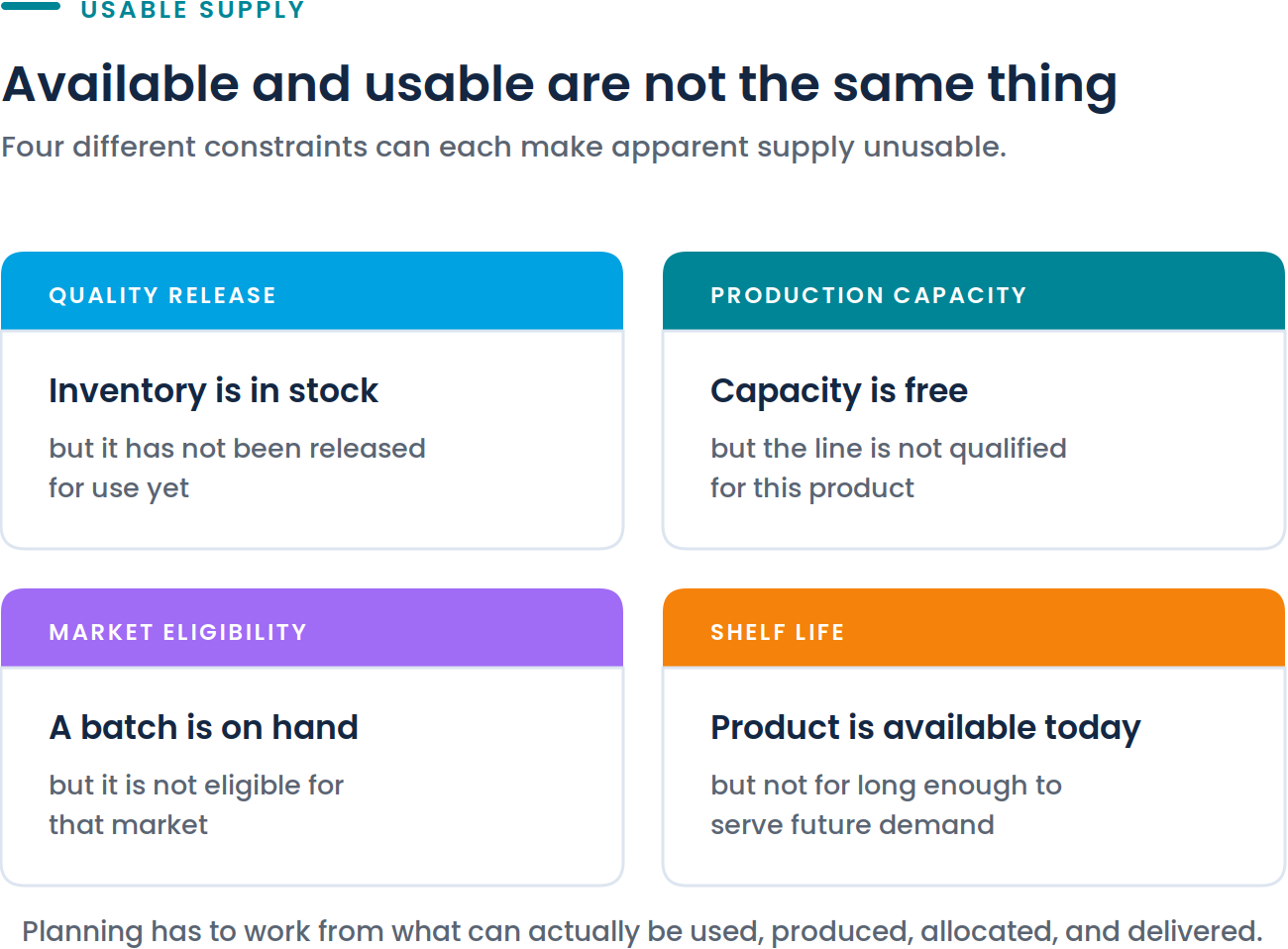
Quality release, line qualification, market registration, and shelf life each restrict supply in a different way. A plan built on recorded quantities alone will commit to volumes the organization cannot actually deliver.
Life sciences planning therefore needs to understand not only how much demand and supply exists, but what can actually be used, produced, allocated and delivered under real operating conditions.
Key Takeaways
- Life sciences supply chain planning connects demand, supply, inventory, production, capacity, procurement, and distribution rather than planning each function independently.
- Shelf life, expiry, quality release, product-market eligibility, and qualified production routes can determine whether apparent supply is actually usable.
- Pharmaceutical, biotechnology, and medical device manufacturers share many planning challenges, but the importance of individual constraints differs by operating environment.
- Internal manufacturing, external CMO/CDMO capacity, materials, and inventory need to be considered together because a change in one area can affect the entire supply plan.
- The objective is not only an accurate plan, but a feasible plan that can adapt to changing demand, supply, production, and operational conditions.
What Is Life Sciences Supply Chain Planning?
Life sciences supply chain planning connects decisions that are often managed across different functions and planning horizons.
These include forecasting future demand, determining production requirements, allocating materials and capacity, positioning inventory, coordinating internal and external manufacturing, and deciding how products should move through the network.
- demand planning
- supply planning
- production and capacity planning
- batch and campaign scheduling
- inventory planning and optimization
- procurement and material allocation
- CMO/CDMO production planning
- sales and operations planning
- supply chain network design
- distribution planning
- scenario planning and risk analysis
Pharmaceutical, biotechnology and medical device manufacturers share many of these planning requirements, but the importance of individual constraints differs.
Pharmaceutical planning may place particular emphasis on expiry, market-specific requirements, batch production and launch readiness. Biotech operations may have scarce specialist capacity, complex production stages, variable yields and extensive quality checks. Medical device manufacturers may need to coordinate long product lifecycles, configurations, supplier dependencies and service requirements for a growing installed base.
The planning model therefore needs to reflect the operating reality of the organization rather than apply one generic life sciences template.
Why Life Sciences Supply Chain Planning Is Difficult
Life sciences supply chains combine demanding service requirements with manufacturing, quality and regulatory constraints that are closely interconnected.
A delayed API can affect production. A delayed batch can affect inventory. An inventory shortage can change market allocation. A quality hold can make apparently available stock unusable. A shift in demand can create a shortage in one market and excess inventory in another.
Long lead times can make these effects difficult to correct quickly.
At the same time, increasing inventory everywhere is rarely a satisfactory solution. Additional stock can protect supply but also increase working capital, expiry exposure, storage requirements and the risk of positioning product where it is not ultimately needed.
The planning challenge is therefore to understand these dependencies early enough to make coordinated decisions rather than solving each problem after it appears.
Important Variables and Constraints in Life Sciences Planning
| Planning factor | Why it matters |
|---|---|
| Demand and product availability | Demand can vary by product, market, customer or program while continuity of supply remains important. |
| Shelf life and expiry | Remaining shelf life affects how much to produce, where inventory can be positioned and which demand it can serve. |
| Quality and release status | Physical inventory or completed production may not yet be available for downstream use. |
| Manufacturing capacity | Equipment, lines, suites, bioreactors, labor, maintenance and production routes limit what can be manufactured. |
| Materials and supplier dependencies | APIs, components and specialized materials may have long lead times, limited alternatives or approved-source restrictions. |
| CMO/CDMO capacity | External production introduces additional dependencies across capacity, materials, timing and customer commitments. |
| Batch and campaign requirements | Batch sizes, cleaning, changeovers and sequencing affect manufacturing feasibility and efficiency. |
| Cold-chain requirements | Temperature-sensitive products may depend on constrained storage, transportation and handling capacity. |
| Product-market eligibility | A product, batch, site or configuration may not be eligible for every destination. |
| Business and regulatory rules | Planning decisions must respect the operating policies and requirements relevant to the organization and product. |
The important point is that these constraints rarely operate independently.
For example, a plant may have capacity to produce more of a product, but doing so may not solve a future shortage if the required API is unavailable or if the resulting inventory would expire before it can be consumed.
How Does Life Sciences Supply Chain Planning Work?
A connected planning process begins by establishing expected demand across products, markets and time periods. That demand is then compared with available inventory, expected production, supplier receipts, external manufacturing and other sources of supply.
The next step is not simply to calculate the difference between demand and supply. The planning model needs to determine which supply is actually usable and which production alternatives are feasible.
Shelf life, material availability, manufacturing routes, capacity, quality status, market eligibility and business rules can all change the answer.
The organization can then evaluate alternative production quantities, inventory positions, material allocations, sourcing options and distribution decisions.
The selected plan should coordinate these choices rather than optimize one function at the expense of another.
Planning is also continuous. When demand, supply or operating conditions change, the consequences need to be reassessed and the plan adjusted.
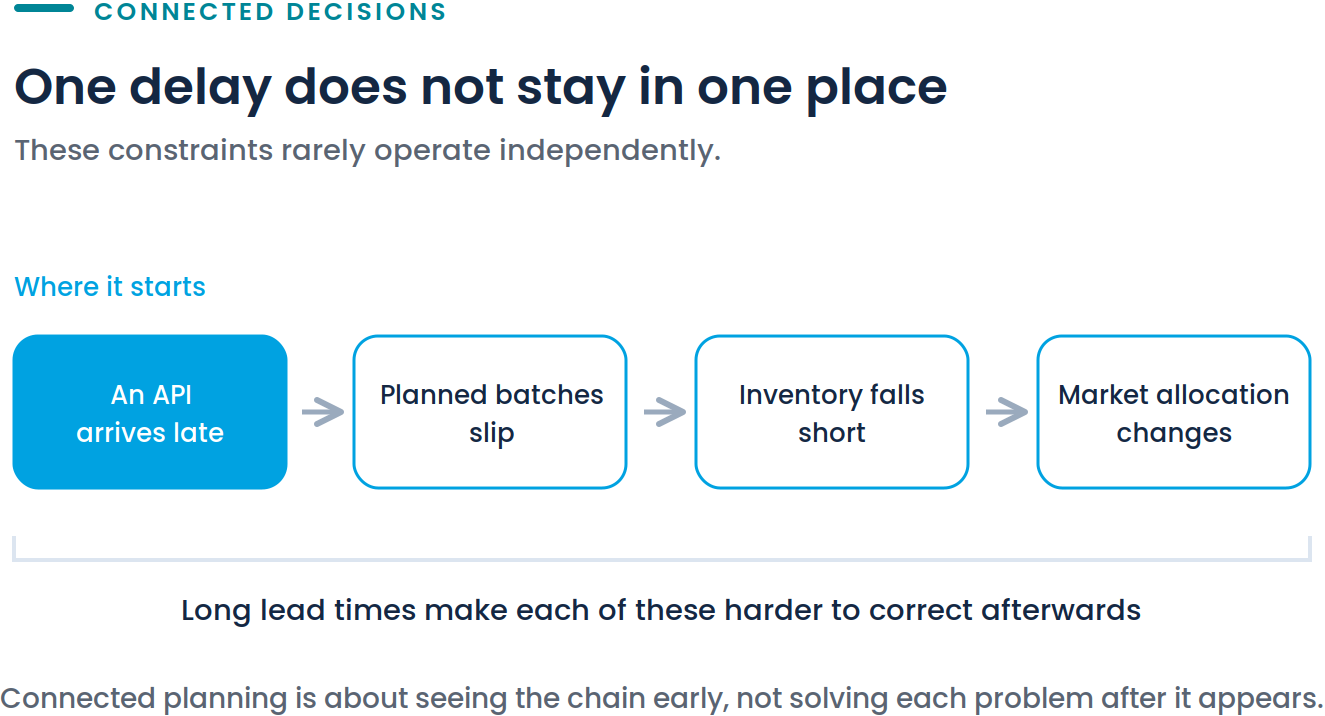
Life sciences supply chains have long lead times and limited substitution options, so a single late material rarely stays contained. By the time the effect reaches market allocation, the original problem is usually too old to correct.
How Related Life Sciences Decisions Interact
Life sciences planning becomes particularly valuable when decisions that are usually separated can be evaluated together.
A production decision changes future inventory. An inventory decision changes expiry exposure. A capacity decision can affect which customer, product or market can be supplied. A material allocation decision may protect one product while constraining another. A CMO/CDMO delay can increase the need for internal production, inventory protection or alternative sourcing. A network decision can change where safety stock should be positioned.
The best decision in one function is therefore not necessarily the best decision for the wider supply chain.
Consider inventory as an example. Increasing inventory may appear to improve service. But if the product has limited remaining shelf life, or if the inventory is positioned far from the market that eventually needs it, the additional stock may provide much less protection than expected.
Connected planning makes those downstream effects visible before the decision is executed.
Planning for Supply Chain Disruption
Scenario planning allows life sciences teams to compare alternative responses before committing to them.
Rather than treating disruption as a collection of hypothetical questions, the planning model can assess how a change propagates through demand, materials, manufacturing, inventory and distribution.
| Scenario | Potential impact | What planning can evaluate |
|---|---|---|
| Demand changes unexpectedly | Inventory or capacity may become misaligned with market requirements. | Production changes, allocation, inventory transfers and future capacity requirements. |
| An API or critical component is delayed | Planned batches may not be feasible and supply commitments may be affected. | Alternative materials, allocation priorities, sourcing options and production resequencing. |
| A batch remains on quality hold | Expected supply becomes unavailable later than planned. | Usable inventory, substitute supply, market allocation and schedule changes. |
| Production yield is below plan | Less usable output is available to satisfy demand. | Inventory protection, additional production and allocation choices. |
| Critical equipment becomes unavailable | Manufacturing capacity is reduced. | Alternative resources, sequence changes, external capacity and delivery impact. |
| A CMO/CDMO production slot moves | External supply may arrive later than expected. | Internal or external alternatives, inventory protection and revised commitments. |
| A launch date changes | Inventory and capacity may be available too early or too late. | Production timing, inventory build, materials and capacity allocation. |
| Inventory approaches expiry | Stock may become unusable before forecast demand consumes it. | Transfers, production changes, allocation and replenishment timing. |
| Supplier or geographic exposure increases | Supply continuity may become more vulnerable to disruption. | Alternative sourcing, inventory buffers and network scenarios. |
The value of a scenario is not simply the calculated outcome. It is the ability to understand why that outcome changes and which constraints are driving the decision.
Balancing Availability, Inventory, Capacity and Cost
Life sciences planning rarely has one objective.
Organizations may need to maintain product availability while controlling inventory, expiry, procurement cost, manufacturing cost and working capital.
They may also need to balance utilization and responsiveness.
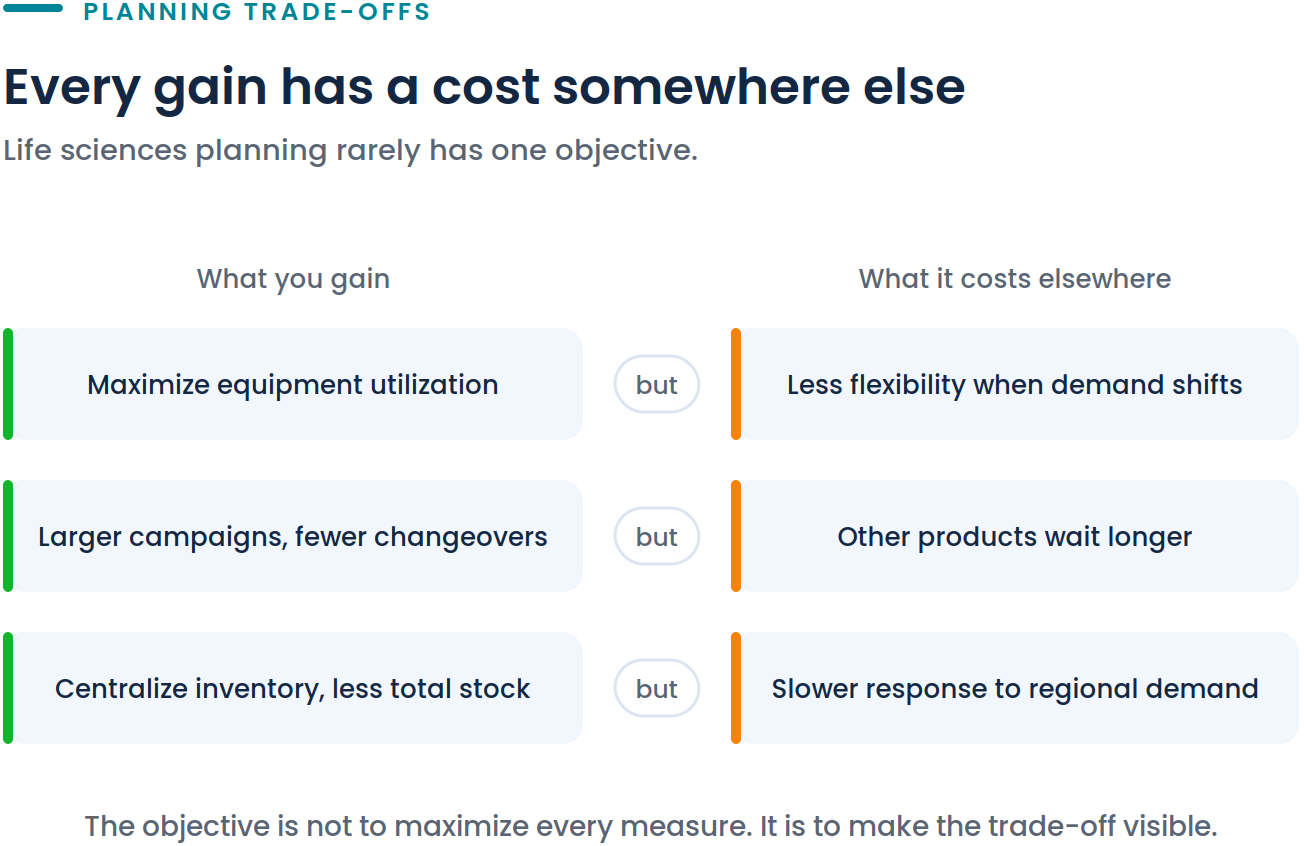
Utilization, campaign size, and inventory centralization all improve one measure while weakening another. Planning cannot remove these tensions, but it can show what each choice costs before the decision is made.
A production plan that maximizes equipment utilization may leave too little flexibility to respond to changing demand. A large campaign may reduce cleaning and changeover losses but delay other products. A highly centralized inventory strategy may reduce total stock but provide slower protection when regional demand changes.
The objective is therefore not to maximize every KPI simultaneously. It is to make trade-offs explicit and evaluate which alternatives best support the priorities of the organization.
What Data Is Required for Life Sciences Supply Chain Planning?
- Demand data. Forecasts, customer orders, market requirements, tenders, launches and service targets.
- Product and material data. Bills of material, APIs, components, packaging, approved alternatives and sourcing relationships.
- Inventory data. Quantity, location, batch or lot, expiry date, remaining shelf life, release status and reservations.
- Manufacturing data. Sites, equipment, routes, batch sizes, yields, processing times, changeovers, cleaning, maintenance and resource requirements.
- Capacity data. Internal manufacturing capacity, external manufacturing capacity, labor and specialist resources.
- Procurement data. Suppliers, lead times, availability, contracts, minimum quantities, sourcing policies and commitments.
- Distribution data. Warehouses, markets, transportation lead times, transfer options and cold-chain requirements.
- Planning and business rules. Product-market eligibility, priorities, inventory policies, production restrictions and governance requirements.
More data is not automatically better. The model should use the level of detail that materially changes feasibility, cost, service or risk.
How Optimization and AI Support Life Sciences Planning
Life sciences planning can involve thousands or millions of interacting choices across products, materials, resources, locations and periods.
Advanced optimization evaluates feasible alternatives against the objectives and constraints defined by the organization.
This is different from simply identifying patterns or generating recommendations. Optimization determines whether alternatives can actually satisfy requirements such as capacity, materials, shelf life, production routes and business rules simultaneously.
AI-native capabilities can complement this by helping planners investigate exceptions, explore scenarios, understand changes and interact with complex planning information more easily.
Governance remains important. Organizations need visibility into assumptions, recommendations, approvals, overrides and the rules governing decisions.
Powered by the ICRON AI-Native Decision Execution Hub, ICRON connects optimization, governed AI and decision workflows so planning decisions can move closer to coordinated execution while human review remains available where judgment and accountability are required.
A global pharmaceutical manufacturer used ICRON supply chain network design and multi-echelon inventory optimization to address long production lead times, regulatory requirements and uncertain demand for new products.
The organization connected long-term capacity planning with mid-term optimization, incorporated external contract manufacturers into the planning environment and used what-if analysis to understand supply-side risk and disruption.
The example demonstrates why resilience does not come from one inventory, capacity or sourcing decision. It comes from understanding how those decisions work together. Bayer has also discussed the use of ICRON to support more connected and responsive supply chain planning.
Frequently Asked Questions
What is life sciences supply chain planning?
Life sciences supply chain planning coordinates demand, supply, inventory, production, capacity, procurement and distribution across pharmaceutical, biotechnology and medical device operations while accounting for industry-specific operational requirements.
How is pharmaceutical supply chain planning different from traditional manufacturing planning?
Pharmaceutical planning may need to consider factors such as shelf life, expiry, batch status, quality release, market eligibility, approved manufacturing routes, long lead times and external manufacturing alongside traditional capacity and material constraints.
Why is supply chain planning important in life sciences?
Planning helps organizations coordinate product availability, materials, inventory and manufacturing before constraints result in shortages, excess inventory, expiry or operational disruption.
When does shelf life actually drive the plan?
Shelf life becomes a planning driver when it influences how much should be produced, where inventory should be held, when replenishment should occur or which demand a batch can realistically satisfy.
What makes cold-chain planning more difficult?
Temperature-controlled products may depend on constrained storage and transportation while remaining shelf life continues to decrease. Inventory, distribution timing and cold-chain capacity therefore need to be considered together.
What role do CMO/CDMOs play in life sciences supply chain planning?
CMO/CDMO production adds external capacity, material and timing dependencies. These need to be synchronized with internal production, inventory and customer or market requirements.
What happens if an API or critical component arrives late?
The effect depends on available inventory, alternative sources, production priorities and downstream demand. Scenario planning can compare options such as reallocating materials, changing production sequences or protecting priority demand.
How does multi-echelon inventory optimization decide where inventory should sit?
It considers inventory across multiple tiers simultaneously and evaluates how stock at plants, distribution centers and markets contributes to service, risk and overall inventory requirements.
How does scenario planning support life sciences supply chains?
Scenario planning allows teams to change assumptions about demand, supply, capacity, production or inventory and compare the resulting impact before making a decision.
Where does AI add value in life sciences supply chain planning?
AI can support analysis, exception investigation and scenario exploration. Combined with optimization and defined planning rules, it can help planners evaluate alternatives more quickly while keeping decisions grounded in operational feasibility.
Does AI replace the planner?
Not necessarily. Organizations can determine where decisions may be automated and where approval, review, override or escalation is required.
What systems can life sciences planning software integrate with?
Planning systems can use information from ERP, manufacturing, inventory, procurement and other operational systems and return plans or decisions into established execution processes.

Build Life Sciences Plans That Remain Executable
Life sciences organizations need to protect product availability while managing inventory, materials, manufacturing, capacity and risk under real operating conditions. See how ICRON connects these decisions across pharmaceutical, biotechnology and medical device supply chains.