






 Guides

Multi-echelon inventory optimization is the process of determining how much inventory should be held and where it should be positioned across multiple stages of a supply chain rather than optimizing each plant, warehouse or market independently.
In life sciences, the problem is more complex because inventory may also need to be evaluated according to shelf life, expiry, batch or lot status, quality release, cold-chain requirements, market eligibility and long replenishment lead times.
The objective is therefore not simply to reduce stock. It is to position usable inventory where it provides the greatest protection to future demand without creating unnecessary excess, expiry or cost.
Key Takeaways
- Inventory is optimized across the network rather than location by location.
- Shelf life, expiry, release status, and eligibility affect usable inventory.
- Upstream inventory can protect multiple downstream locations.
- Inventory positioning can also support supply chain resilience.
- The objective is to protect availability without unnecessary excess or expiry.
What Is Multi-Echelon Inventory Optimization for Life Sciences?
A life sciences supply network may contain several inventory tiers:
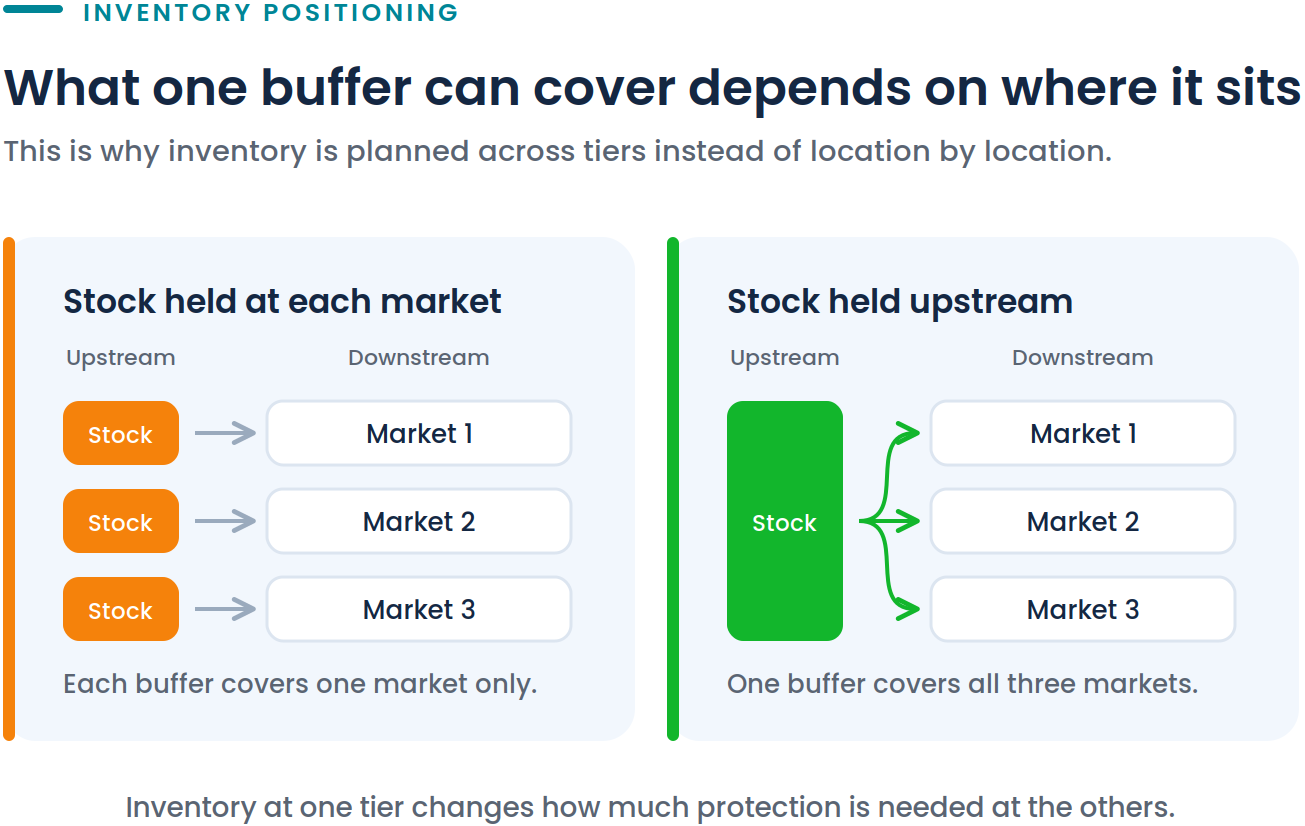
Inventory held close to a market responds quickly but protects only that market. Inventory held upstream covers demand variation across several locations at once, which is why total stock and stock position are separate decisions.
Inventory at one tier changes the amount of protection required elsewhere.
If every site independently calculates safety stock, the network can accumulate redundant buffers.
If every location independently reduces inventory, shortages can increase.
Multi-echelon inventory optimization evaluates these locations as one connected network.
It considers how upstream inventory can protect several downstream locations, where local buffers are genuinely required, and how uncertainty propagates through replenishment lead times.
In pharmaceutical and biotechnology supply chains, the model may also need to determine whether inventory will still have sufficient remaining shelf life by the time it reaches the demand it is intended to serve.
Why Life Sciences Inventory Optimization Is Difficult
Inventory performs several roles at once.
It protects against demand variation, production disruption, supplier delays and replenishment uncertainty.
But inventory also creates risk.
It consumes working capital. It may require expensive controlled storage. It can become obsolete. And for products with limited shelf life, excess inventory may expire before it is used.
This creates an important distinction between inventory quantity and usable inventory.
Two distribution centers may each hold the same number of units.
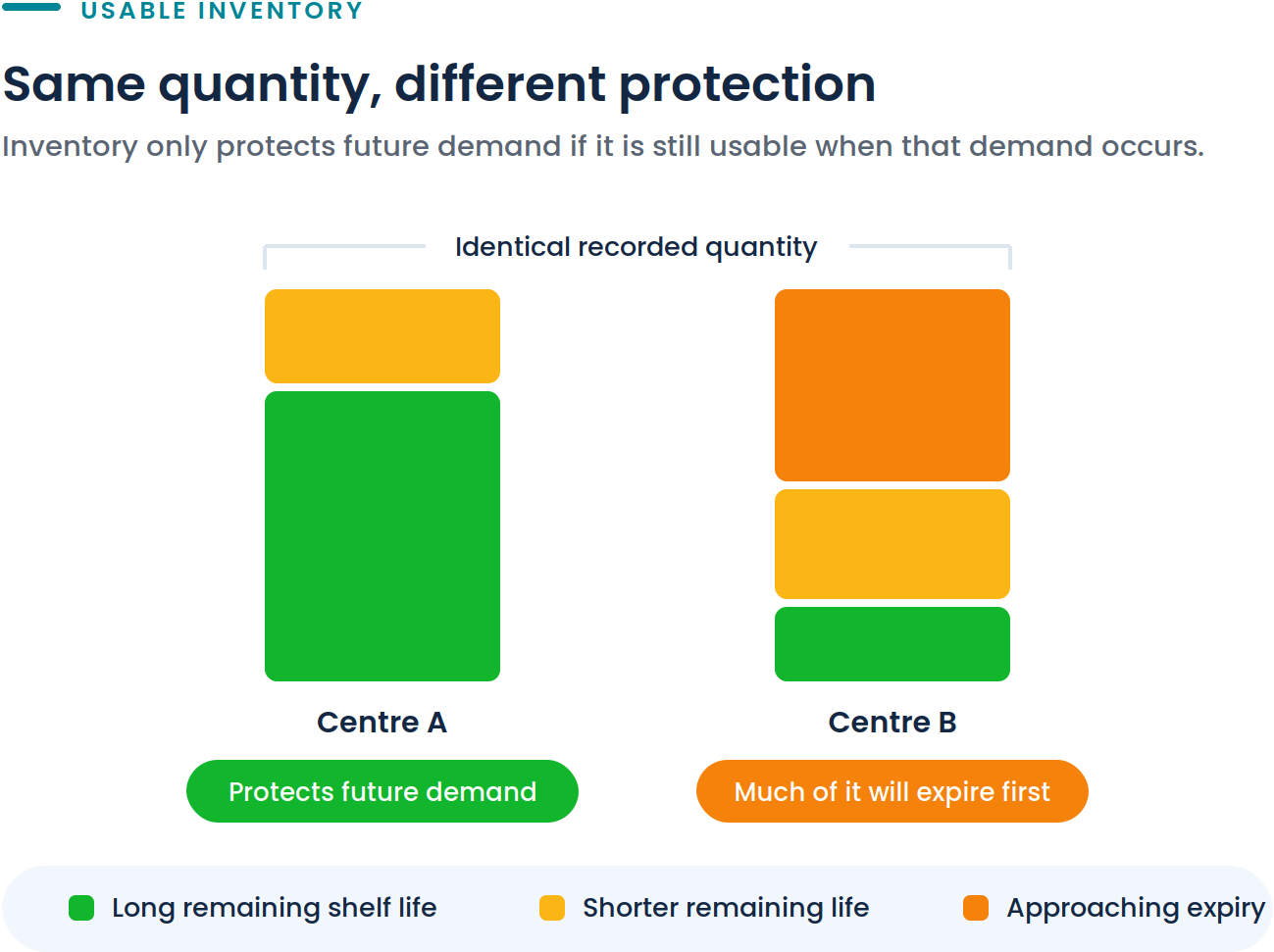
Two locations can report identical inventory and offer very different protection. In life sciences, remaining shelf life determines whether stock will still be usable when the demand it was held for actually arrives.
One may hold recently released stock with substantial remaining shelf life. The other may hold stock approaching expiry.
Their inventory balances look identical, but their ability to protect future demand is very different.
This is why life sciences inventory planning needs to understand where stock sits, when it becomes available, how long it remains usable and what future demand it can actually serve.
Inventory positioning is also increasingly shaped by resilience objectives, not only service and cost. Where an organization wants to reduce its exposure to a single supplier, site or geography, inventory becomes one of the levers for absorbing that risk alongside sourcing and network structure. The question is not only how much protection is needed, but where in the network that protection should sit so it remains usable if a particular source or lane is disrupted.
Important Factors in Life Sciences Inventory Optimization
| Planning factor | Inventory implication |
|---|---|
| Demand and variability | More uncertain demand generally requires greater protection, but the buffer does not necessarily need to sit at the final market. |
| Service targets | Different products, markets or customers may require different levels of availability. |
| Replenishment lead time | Long or variable lead times increase exposure to supply disruption. |
| Supply variability | Production reliability, supplier performance and CMO/CDMO dependencies affect required inventory protection. |
| Shelf life and expiry | Inventory only provides future protection if it remains usable when demand occurs. |
| Quality and release status | Physical stock may not yet be available for allocation or distribution. |
| Batch and lot characteristics | Lot-level expiry or eligibility can change which demand the inventory can serve. |
| Product-market eligibility | Inventory available globally may not be usable in the market experiencing the shortage. |
| Cold-chain capacity | Additional inventory may require constrained and costly temperature-controlled storage and transport. |
| Network structure | Plants, warehouses, markets and transfer lead times determine where buffers provide the greatest value. |
These factors explain why pharmaceutical inventory optimization cannot be reduced to applying a safety-stock formula separately at each location.
How Does Multi-Echelon Inventory Optimization Work?
The process begins by mapping the inventory network: plants, distribution centers, markets, replenishment relationships and transfer options.
Demand and demand variability are then represented by product, market and period.
The model also considers replenishment lead times and supply variability. These may include production lead times, supplier lead times, external manufacturing and transportation.
Service objectives define the level of availability the inventory strategy is intended to support.
Life sciences-specific rules can then be added where relevant, including shelf life, expiry, quality release, FEFO, cold-chain requirements and market eligibility.
Optimization evaluates where inventory should be positioned across the different echelons rather than calculating every location independently.
The resulting inventory targets can then be tested against alternative scenarios such as increased demand, longer lead times or a production disruption.
As demand, supply and product characteristics change, inventory policies can be recalculated.
Shelf Life and Expiry-Aware Inventory Planning
Shelf life changes the meaning of inventory availability.
Traditional inventory planning may ask: How much inventory do we have?
Expiry-aware planning must also ask: How much inventory will still be usable when it is needed?
A batch with six months of remaining shelf life and a batch with six weeks of remaining shelf life cannot necessarily provide the same future service protection.
Their usefulness depends on forecast demand, location, transfer lead times and relevant market requirements.
Expiry-aware inventory planning can therefore consider:
- remaining shelf life
- forecast demand before expiry
- inventory location
- transfer time
- replenishment timing
- FEFO policies
- expected production
- market eligibility
This allows the organization to identify inventory that appears available in aggregate but is unlikely to support future demand effectively.
How Inventory Decisions Interact with Production and Supply
Inventory requirements depend heavily on the behavior of the rest of the supply chain.
Reliable, responsive production may reduce the need for downstream buffers.
Long or uncertain manufacturing lead times may increase them.
A CMO/CDMO delay can increase the value of inventory already positioned in the network.
A supplier dependency may justify additional upstream protection.
A change in campaign frequency can alter replenishment quantities and timing.
A supply chain network redesign can change the best location for safety stock.
A new product launch may initially require a different inventory policy from a mature product with stable demand.
For this reason, multi-echelon inventory optimization becomes more valuable when inventory can be evaluated in the context of production, sourcing, capacity and network decisions.
Planning for Inventory and Supply Scenarios
| Scenario | What changes | What inventory planning can evaluate |
|---|---|---|
| Demand increases in one market | Existing local stock may be insufficient. | Transfers, revised inventory targets, replenishment and production requirements. |
| A production batch is delayed | Expected replenishment arrives later. | Shortage exposure, use of upstream inventory and alternative supply. |
| A supplier or API delay extends lead time | The network must operate longer before replenishment arrives. | Additional buffers, allocation priorities and sourcing alternatives. |
| Inventory approaches expiry | Recorded inventory may provide less future service than expected. | Transfers, allocation, production reductions and replenishment timing. |
| A CMO/CDMO shipment moves | External supply timing changes. | Inventory protection at affected echelons and impact on service. |
| Supplier reliability deteriorates | Replenishment uncertainty increases. | Revised safety stocks and placement of resilience inventory. |
| A new product launches | Demand history may be limited and uncertainty may be high. | Initial inventory positioning and alternative launch assumptions. |
| Service targets increase for a critical product | More protection may be required. | Where additional inventory provides the greatest service benefit. |
| The supply network changes | Lead times and replenishment relationships change. | New optimal inventory targets across the redesigned network. |
Scenario analysis is particularly important because an inventory policy that works under normal assumptions may perform very differently when lead times, supply reliability or demand volatility change.
Balancing Availability, Expiry, Inventory and Resilience
Availability versus inventory. More inventory can protect against uncertainty but increases working capital and storage requirements.
Availability versus expiry. Additional stock only improves future service if it remains usable. For short-life products, excess inventory can create waste without materially reducing shortage risk.
Centralization versus responsiveness. Central inventory can pool variability across several markets, but inventory positioned closer to demand may respond faster when conditions change.
Efficiency versus resilience. A very lean network can perform efficiently in normal conditions while remaining vulnerable to longer disruptions.
Cold-chain availability versus cost. Additional biologics or temperature-sensitive inventory can improve availability but may consume expensive constrained storage and distribution capacity.
Global inventory versus local usability. Inventory may exist elsewhere in the network but still be unavailable to a particular market because of timing, eligibility or remaining shelf life.
Optimization allows these trade-offs to be quantified rather than managed through independent local targets.
What Data Is Required for Multi-Echelon Inventory Optimization?
- Network data. Plants, warehouses, markets, lanes, transfer options and replenishment relationships.
- Demand data. Forecasts, orders, demand history and variability.
- Inventory data. Quantity, location, batch or lot, reservations, release status and expected receipts.
- Shelf-life data. Expiry dates, remaining usable life and relevant planning rules.
- Lead-time data. Production, supplier, transportation, release and transfer lead times.
- Service data. Target availability or service levels by product, market or customer.
- Supply data. Production plans, supplier performance and external manufacturing commitments.
- Cost data. Holding, transfer, transportation, shortage and disposal costs where relevant.
- Policy data. FEFO, inventory priorities, minimum requirements, sourcing policies and allocation rules.
The objective is not to collect every available field. It is to represent the factors that materially affect availability, risk and inventory positioning.
How Optimization and AI Support Life Sciences Inventory Decisions
Multi-echelon inventory optimization uses mathematical models to evaluate inventory across the network as a connected system.
Rather than asking every warehouse to protect itself independently, the model evaluates where inventory can most effectively absorb uncertainty.
Optimization can help determine:
- target inventory by location
- safety-stock positioning
- potential shortage exposure
- excess inventory and expiry risk
- transfer opportunities
- the impact of changing service targets
- the effect of longer lead times or supply disruption
Scenario analysis allows planners to test how the inventory strategy performs under alternative assumptions.
AI-supported workflows can then help users investigate exceptions, understand why a target changed and navigate alternative scenarios.
The objective is not for AI to set inventory policies without context. Inventory recommendations should remain grounded in service objectives, demand, lead times, product characteristics and supply constraints.
Powered by the ICRON AI-Native Decision Execution Hub, ICRON connects inventory optimization with wider production, capacity, network and supply decisions.
Multi-echelon inventory optimization in practice
A global pharmaceutical manufacturer used ICRON supply chain network design and multi-echelon inventory optimization to strengthen resilience across a complex supply network.
The organization connected long-term capacity planning with mid-term inventory optimization, incorporated external contract manufacturers and used what-if analysis to evaluate disruption and supply-side risk.
The example demonstrates why inventory optimization becomes more powerful when it is connected to network, capacity and external manufacturing decisions rather than treated as an isolated safety-stock calculation.
Frequently Asked Questions
What is multi-echelon inventory optimization?
Multi-echelon inventory optimization determines how much inventory should be held and where it should be positioned across multiple stages of a supply network while accounting for how inventory at each tier affects the rest of the network.
What is multi-echelon inventory optimization in pharmaceuticals?
In pharmaceuticals, the approach can additionally account for shelf life, expiry, quality release, batch or lot status, market eligibility, long lead times and other life sciences planning constraints.
What is the difference between multi-echelon inventory optimization and safety-stock optimization?
A safety-stock calculation may focus on an individual product and location. Multi-echelon optimization considers how inventory buffers interact across several levels of the supply network.
How does shelf life affect safety stock?
Additional safety stock only protects future demand if the inventory remains usable long enough to serve that demand. Shelf life can therefore limit the benefit of simply increasing stock.
How can pharmaceutical companies reduce inventory without increasing shortages?
The objective is not to reduce every location equally. Multi-echelon optimization can identify where inventory provides little additional protection and where buffers are genuinely needed to maintain service.
How can inventory optimization reduce expiry and write-offs?
It can identify where inventory is likely to outlive forecast demand and evaluate alternative allocation, transfer, replenishment or production decisions.
What is FEFO inventory planning?
FEFO, or First Expiry, First Out, prioritizes inventory with the earliest expiry for use or distribution where appropriate.
How does multi-echelon inventory optimization help prevent shortages?
It considers demand uncertainty, replenishment lead times and supply risk across the network and determines where inventory buffers provide the greatest protection.
What happens if inventory in one market is approaching expiry while another market faces a shortage?
Where product eligibility, timing and business rules allow, the model can evaluate transferring or reallocating inventory and compare that option with new production or replenishment.
Can multi-echelon inventory optimization include cold-chain inventory?
Yes. Cold-storage capacity, transport requirements, cost and shelf life can be represented where they affect inventory decisions.
How does CMO/CDMO manufacturing affect inventory targets?
External manufacturing lead times, capacity commitments and reliability can change the amount and location of inventory required to protect downstream demand.
How do supply chain network design and multi-echelon inventory optimization work together?
Network design determines the structure of the supply chain. Multi-echelon inventory optimization determines where inventory should be positioned within that structure. Changing sites, lanes or flows can therefore change the optimal inventory strategy.
Can AI determine pharmaceutical safety-stock levels?
AI can support investigation and scenario analysis, while optimization models calculate inventory strategies against defined demand, service, lead-time and product constraints.

Position Inventory Where It Protects Supply
Life sciences organizations need more than lower inventory. They need inventory that remains usable, is positioned where it protects future demand and supports continuity of supply without creating unnecessary expiry or cost. See how ICRON connects inventory decisions with production, capacity, supply and network planning.