






 Guides

Tobacco blending optimization is the process of selecting and combining available cured leaf tobaccos and other approved materials to meet defined product specifications, while leaf type, grade, crop, origin, supplier, quality, inventory age, availability, procurement, production, and cost constraints are evaluated together.
The decision is complex because leaf is an agricultural material and the value of each stock depends on more than quantity. Different lots contribute differently to the finished blend, and using a lot today changes the options available for future demand. This guide addresses industrial leaf planning for manufacturers and leaf merchants. If you are new to the subject, start with the broader guide to blending optimization, which covers the principles that also apply in tea and coffee.
Key Takeaways
- Tobacco inventory is long-lived and heterogeneous, so age, crop, location, status, and future usability can materially affect the value of a stock.
- Using a lot today changes the options available for future demand, which makes allocation a portfolio decision rather than a product-by-product one.
- Product specifications are multidimensional, so a blend may need to meet several composition and quality requirements at the same time.
- Age is represented as an operating characteristic rather than a rule. The model does not assume that older inventory should always be used first.
- Procurement lead times and crop cycles are long, so today’s sourcing decisions shape the materials available for future blends.
What is tobacco blending optimization?
Tobacco blending optimization converts product specifications, leaf characteristics, inventory, procurement options, and operational rules into a structured decision model. It identifies feasible combinations and allocations across products, periods, and locations.
The model can support short-term blend decisions, tactical leaf allocation, procurement planning, inventory prioritization, and longer-horizon scenario analysis. The scope should match the organization’s operating model and decision responsibilities. This is the decision environment ICRON Procurement Planning and Blending Optimization is built for.
Why tobacco blending is complex
- Leaf characteristics vary. Type, grade, crop, origin, supplier, curing, season, and storage can affect chemical, physical, and sensory properties.
- Product specifications are multidimensional. A blend may need to meet several composition and quality requirements simultaneously.
- Inventory is long-lived and heterogeneous. Age, crop, location, status, and future usability can materially affect the value of a stock.
- Procurement lead times and crop cycles matter. Today’s sourcing decisions shape the materials available for future blends.
- Portfolio decisions are connected. Allocating a leaf grade or origin to one product can create shortages or cost pressure elsewhere.
- Production feasibility must be protected. Material preparation, batch rules, line eligibility, timing, and other operating constraints can affect execution.
How leaf type, grade, crop, origin, and supplier affect decisions
The tobacco industry preserves distinctions among leaf types and grades because these materials make different contributions to the finished product. Crop, origin, supplier, curing, and storage can create additional variation within those categories.
Optimization allows these distinctions to be represented at the level required by the business. It can protect rules for approved materials and sources, distinguish lots with different characteristics, and evaluate how substitutions affect the full blend rather than a single attribute.
Which tobacco attributes can be modeled?
The relevant attributes depend on the company’s products, quality system, regulatory environment, and internal specifications. A model may include physical, chemical, sensory, commercial, and operational data.
- Leaf type, grade, stalk position or internal classification, crop, origin, supplier, and curing-related information.
- Chemical or analytical characteristics used in the company’s blend specifications, such as nicotine, sugars, nitrogen, moisture, or other approved measures.
- Physical and sensory assessments used by the company to evaluate leaf and finished blends.
- Inventory information such as quantity, age, crop, location, status, release, reservations, and expected receipts.
- Commercial information such as price, contract, supplier capacity, lead time, and minimum purchase conditions.
- Production information such as preparation requirements, material eligibility, batch rules, capacity, yield, and timing.
These examples should not be treated as a universal specification. Each implementation must reflect the company’s approved quality parameters and product requirements.
Connecting leaf procurement and blending decisions
Leaf procurement decisions determine the future range of feasible blends. A purchase that appears favorable on price may create limited value if the material can be used in only a narrow part of the portfolio. Conversely, a higher-cost material may protect several products or reduce dependence on a constrained grade.
- Evaluate prospective purchases against future blend and demand requirements.
- Compare grades, origins, suppliers, and crops based on contribution to the product portfolio.
- Test contract volumes against current stocks and inventory age.
- Identify quality attributes or leaf categories that may become constrained.
- Assess substitution options before changing sourcing commitments.
- Understand how procurement decisions affect future flexibility, inventory, and production.
Our note on cloud-based procurement and optimal blending covers how replenishment planning and blend generation are handled in the same model.
Managing tobacco inventory and aging
Tobacco inventory decisions often span multiple crops and planning periods. Age can be an important operational characteristic, but the meaning of age and the rules for using older or newer stocks depend on the company’s product and quality policies.
A blending model can include age, crop, status, and prioritization rules without assuming that older inventory should always be used first. It can identify where aging stocks remain suitable, where they should be reserved, and where consuming them would create quality or future supply risk.
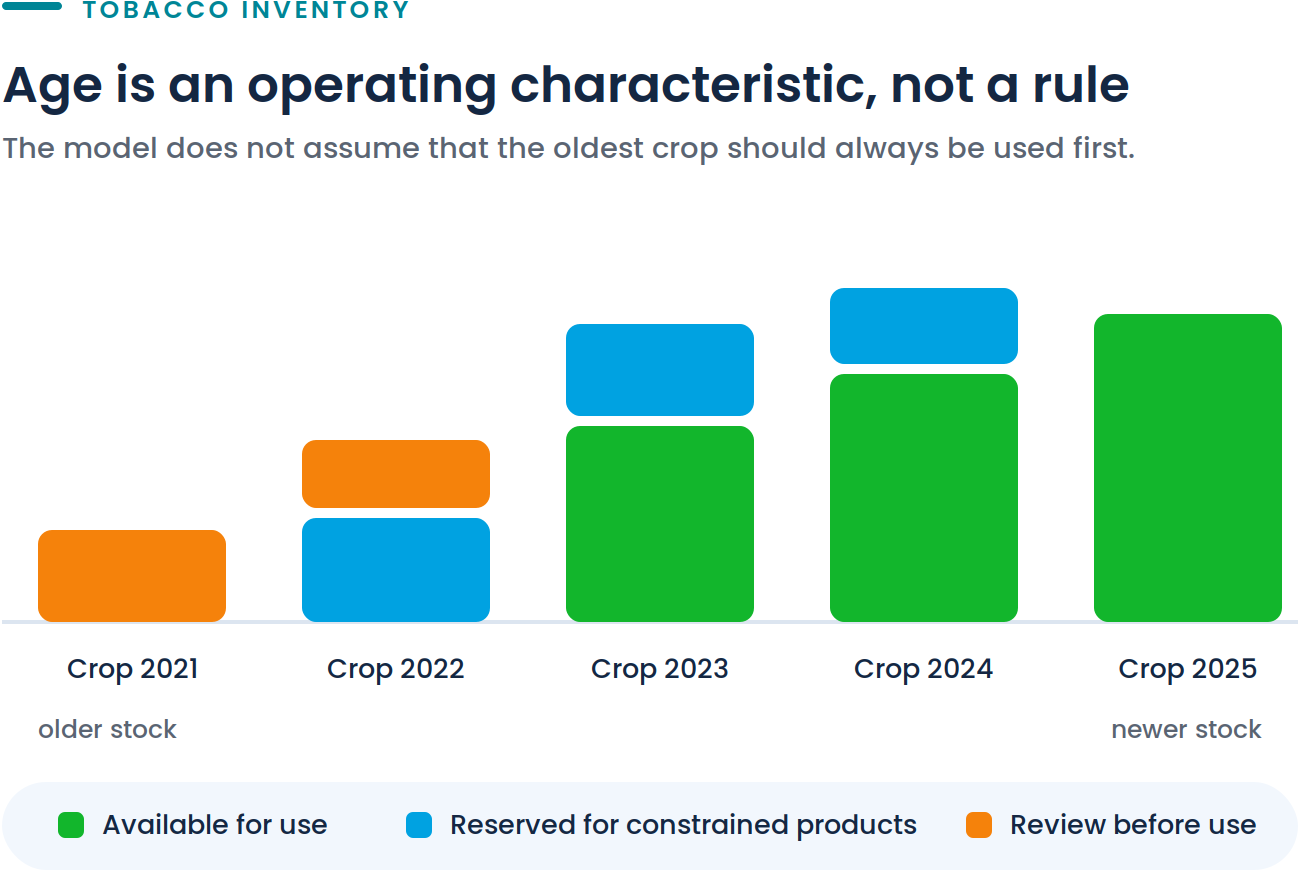
Leaf inventory is held across several crop years, and its usability depends on quality, product requirements, and internal policy rather than age alone. Some older stock remains suitable while some newer stock is reserved for products that have no alternative.
- Prioritize stocks according to approved age and usage policies.
- Protect scarce leaf categories for products with limited substitution options.
- Avoid leaving inventory stranded because of allocation decisions made earlier.
- Coordinate inventory across warehouses, preparation sites, and factories.
- Show how today’s blend changes future inventory coverage and procurement needs.
Maintaining blend consistency under changing conditions
A tobacco blend may need to remain within approved physical, chemical, sensory, and composition requirements even when the available crops, grades, origins, or suppliers change.
Optimization evaluates these requirements simultaneously. It can adjust the material composition while protecting hard limits and company rules. It can also provide alternative blends so experts can compare cost, quality, inventory use, and sourcing risk before selecting a plan.
Connecting tobacco blending with demand and production
A blend decision should reflect what must be produced, where, and when. Demand changes can alter the required balance of leaf stocks across products. Production constraints can determine whether a technically acceptable material combination is executable.
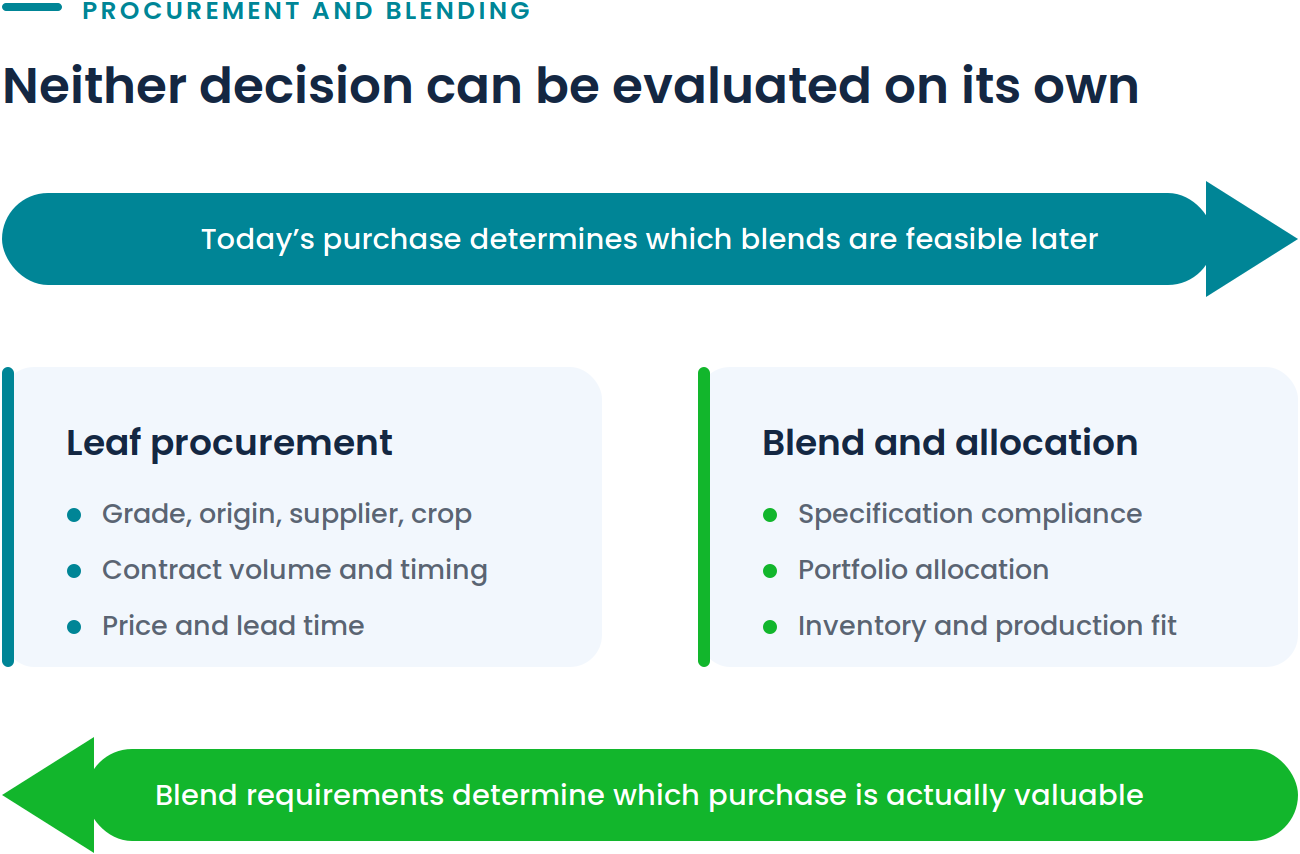
Leaf is bought long before the blends that will consume it are finalized. A purchase shapes which products remain feasible for years, and blend requirements are what reveal whether that purchase was worth making.
- Allocate constrained leaf across products and periods according to demand priorities.
- Coordinate blend decisions with preparation, manufacturing, and capacity requirements.
- Represent batch sizes, material eligibility, yield, timing, and other process rules.
- Evaluate how product-mix changes affect leaf consumption and future coverage.
- Connect selected blends with inventory, procurement, production planning, and scheduling.
Scenario planning for tobacco supply and demand changes
- A crop or supplier delivers less volume than expected.
- A leaf lot has a different quality profile after receipt or evaluation.
- Demand changes across products or markets.
- A key grade, origin, or leaf type becomes constrained.
- The business needs to reduce reliance on one source.
- Inventory age or stock balance creates a future exposure.
- Production capacity, timing, or material preparation becomes constrained.
- A procurement price or contract condition changes.
Scenario planning allows the organization to test these changes before they become urgent. It also reveals which assumptions and materials drive the result, helping teams prepare alternatives and escalation rules.
Balancing cost reduction with quality and service risk
A lower-cost blend can create downstream risk if it consumes flexible stocks, increases dependence on a constrained material, or reduces the ability to supply future demand. Cost therefore needs to be evaluated across the portfolio and planning horizon.
Tobacco blending optimization can minimize or control cost while protecting quality, inventory, sourcing, and service constraints. Where several feasible options exist, planners can compare the trade-offs and choose the one that reflects current business priorities.
What data is required for tobacco blending optimization?
- Product and demand data. Finished-product specifications, composition rules, volumes, markets, periods, and service priorities.
- Leaf data. Type, grade, crop, origin, supplier, quality, chemical, physical, sensory, and approved-use information.
- Inventory data. Quantity, age, crop, warehouse, status, release, reservations, and expected receipts.
- Procurement data. Prices, supplier availability, contracts, lead times, commitments, and minimum quantities.
- Production data. Preparation and manufacturing eligibility, capacity, batch rules, yields, timing, and process constraints.
- Cost and policy data. Material, logistics, handling, storage, processing, shortage, sourcing, and risk policies.
How AI-Native Decision Execution supports tobacco blending
ICRON Procurement Planning and Blending Optimization, powered by the ICRON AI-Native Decision Execution Hub, connects leaf sourcing, inventory, quality, blend, demand, and production decisions in one governed environment. Related reading: 5 Ways AI-Native Decision Execution Improves Tobacco Blending.
Optimization evaluates large decision spaces and identifies feasible alternatives. AI-supported workflows help experts investigate changes, risks, and scenarios. Governance keeps assumptions, recommendations, and approvals visible. The selected decision can then be connected with procurement and operational planning rather than remaining a stand-alone blend calculation.
Key Terms Used in This Guide
- Cured leaf. Tobacco that has completed curing and is available to be graded, stored, and used in blending.
- Leaf type and grade. Classifications describing how a material is expected to contribute to the finished product. Material within one grade may still differ, which is why lot-level information is used.
- Stalk position or internal classification. The company’s own classification of leaf, recorded as a material attribute alongside crop, origin, supplier, and curing information.
- Crop. The season a leaf was grown and cured, used together with age and status to govern how and when a stock may be consumed.
- Inventory age. An operating characteristic of a stock, applied through the company’s approved usage and prioritization policies rather than as an automatic rule.
- Allocation. The decision of which product, period, or location a given leaf stock should be used in.
Frequently Asked Questions
What is tobacco blending optimization?
Tobacco blending optimization uses a structured decision model to select and allocate cured leaf tobaccos and other approved materials while satisfying product, quality, inventory, procurement, production, and cost constraints.
Why is tobacco blending difficult?
Leaf materials vary by type, grade, crop, origin, supplier, curing, age, and quality. Product specifications are multidimensional, and the use of one stock affects future portfolio options.
Does the model assume older leaf should be used first?
No. Age, crop, status, and prioritization rules are represented, but the usage policy belongs to the company. The model can identify where aging stocks remain suitable, where they should be reserved, and where consuming them would create quality or future supply risk.
Can the model use chemical and quality data?
Yes. It can use the company’s approved chemical, physical, sensory, and classification data together with commercial and operational inputs.
Can it manage inventory age and multiple crops?
Yes. Crop, age, status, location, and usage policies can be modeled so that inventory is allocated according to product feasibility and business rules.
How is a constrained leaf grade allocated when several products need it?
Allocation is evaluated across the portfolio and planning horizon rather than product by product. The model can prioritize products with limited substitution options and show how each allocation affects future inventory coverage and procurement needs.
How does it support leaf procurement planning?
It evaluates purchase and contract options against future blend requirements, current stocks, expected demand, material contribution, and supply constraints.
Can it evaluate substitutions between grades or origins?
Yes, where substitutions are approved. The model can test their effect on the complete blend, cost, inventory, and future supply rather than treating materials as automatically interchangeable.
How does it connect with production planning?
The model can include preparation, manufacturing, capacity, batch, yield, timing, and eligibility constraints, then pass the selected blend and material requirements into downstream planning processes.
What level of leaf data is needed to begin?
The relevant attributes depend on the company’s products, quality system, regulatory environment, and internal specifications. Approved specification limits, the leaf classifications already in use, and reliable inventory quantity, age, crop, and status information are usually the determining inputs.
How often should a leaf blend and allocation plan be reviewed?
This depends on how frequently demand, availability, quality, price, and production conditions change. Longer-horizon procurement and inventory decisions may be reviewed by crop or season, while blend and allocation decisions are often refreshed more frequently.
Can it support multi-site tobacco operations?
Yes. It can represent multiple inventories, warehouses, preparation locations, factories, suppliers, and markets, subject to the organization’s data and decision scope.

Turn Complex Leaf Blend Trade-Offs Into Executable Decisions
See how ICRON connects leaf sourcing, quality, inventory, allocation, and production constraints within one optimization and execution environment.