






 Guides
Tea blending optimization is the process of selecting and combining available tea materials to meet defined product quality requirements, while cost, supply, inventory, and operational constraints are evaluated at the same time.
A finished tea product must remain recognizable and consistent even when the materials used to produce it change. That makes tea blending a continuous decision process rather than a one-time recipe exercise. If you are new to the subject, start with the broader guide to blending optimization, which covers the principles that also apply in coffee and tobacco.
Key Takeaways
- Consistency does not mean using the same raw material mix in every period. It means keeping the finished product within its approved profile while the inputs change.
- Tea characteristics can change by origin, garden, season, harvest, grade, supplier, processing method, and lot, which makes blending a continuous decision rather than a one-time recipe exercise.
- The relevant quality attributes should come from the manufacturer’s own quality and tasting framework rather than an assumed external standard.
- Tea procurement creates the material portfolio from which future blends will be built, so a purchase cannot be evaluated by price, origin, or volume alone.
- Lipton Teas and Infusions reported 96% demand satisfaction, a 30% reduction in procurement costs, and a 5% reduction in worldwide inventory levels using this approach.
What is tea blending optimization?
Tea blending optimization translates the company’s quality framework and operating rules into a structured decision model. The model evaluates which teas can be used, how much of each should be included, where materials should be allocated, and whether additional supply is required.
The result is a feasible blend and material plan that respects required product characteristics and the realities of procurement, inventory, and production. Depending on the company, decisions may be made for a single blend, a portfolio of products, a factory, a market, or a global sourcing network. This is the decision environment ICRON Procurement Planning and Blending Optimization for Tea & Coffee is built for.
Why tea blending is difficult
- Tea quality varies naturally. Origin, growing conditions, harvest timing, processing, and storage can influence the physical, chemical, and sensory characteristics of tea.
- Finished products require consistency. Consumers and customers expect a recognizable profile even when the underlying raw materials change.
- Supply is seasonal and geographically distributed. Availability and price can shift across origins, grades, suppliers, and crop periods.
- Materials are not fully interchangeable. A lower-cost tea may not provide the same contribution to color, aroma, body, brightness, or other product requirements.
- Inventory decisions affect future options. Using a valuable lot in one product can make another product more difficult or costly to supply later.
- Procurement decisions have long consequences. Contracts and purchases made before the full demand picture is known can shape blend feasibility for months.
How tea quality varies by origin and harvest
Tea quality is influenced by the plant material, growing environment, plucking standard, season, manufacturing process, and storage conditions. This variability is not a planning exception. It is a normal characteristic of the industry.
For planning purposes, the important question is not whether one origin or season is universally better than another. It is how each available lot contributes to the requirements of a specific finished product. A tea that is unsuitable for one blend may be valuable in another.
Optimization allows these differences to be represented explicitly, so planners do not have to rely on broad averages or assume that all material within a commercial grade will behave in the same way.
Which tea attributes can be used in blending decisions?
The relevant attributes should come from the manufacturer’s own quality and tasting framework. They may include sensory, physical, and chemical characteristics, but the exact list varies by tea type, product, market, and internal methodology.
- Sensory characteristics such as aroma, body, brightness, color, astringency, strength, or other internally defined profile measures.
- Physical characteristics such as grade, particle size distribution, bulk density, or moisture.
- Chemical or analytical values used by the company to support quality and process control.
- Origin, garden, supplier, crop, season, manufacturing method, and certification information.
- Operational status such as location, release status, age, availability date, and approved product use.
These values should not be treated as universal industry standards unless the company has adopted a specific external standard. In most implementations, the optimization model reflects the organization’s established product specifications and quality language.
Why tea formulations need to adapt within quality boundaries
Tea products may have approved recipes, preferred compositions, or established sourcing patterns. However, the exact material mix often needs to adapt when availability, quality, price, or demand changes.
Blending optimization can represent both fixed and flexible rules. It can protect required ingredients and inclusion limits while allowing the model to choose among acceptable alternatives. This is more accurate than saying there are no recipes. The real requirement is controlled flexibility within approved product and quality boundaries.
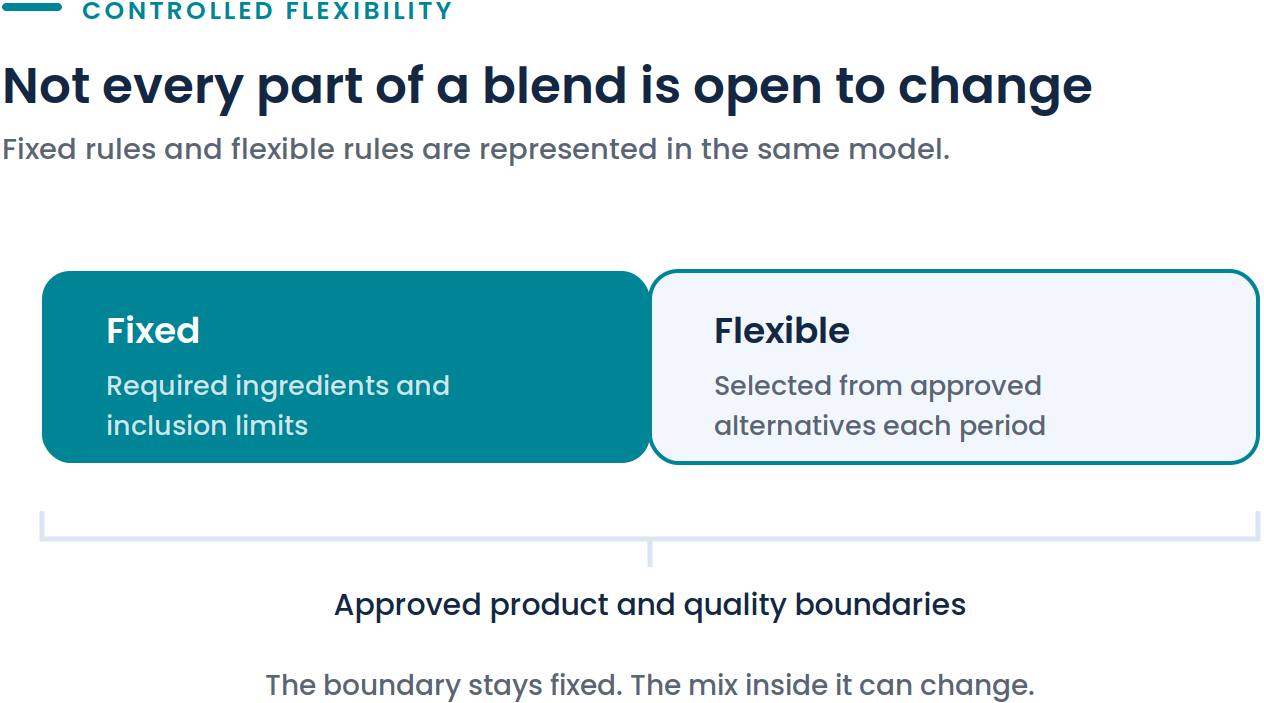
Blending flexibility is bounded, not unlimited. Required ingredients and inclusion limits are protected while the rest of the composition adjusts, which is how a product stays within its approved quality boundaries as inputs change.
Connecting tea procurement and blending decisions
Tea procurement creates the material portfolio from which future blends will be built. A purchase decision therefore cannot be evaluated only by price, origin, or volume. Its value also depends on where the tea can be used, how it supports product requirements, and what other materials it may replace.
- Evaluate purchase options against forecasted blend requirements.
- Understand whether lower-cost supply creates enough quality contribution and formulation flexibility.
- Compare contract commitments with existing inventory and expected demand.
- Test the effect of origin, grade, supplier, or harvest changes before finalizing purchases.
- Identify constrained attributes or materials that could limit future production.
- Avoid buying volume that appears attractive commercially but is difficult to consume across the portfolio.
Our note on cloud-based procurement and optimal blending covers how replenishment planning and blend generation are handled in the same model.
Maintaining consistent tea quality
Consistency does not mean using the same raw material mix in every period. It means keeping the finished product within its approved profile while the inputs change.
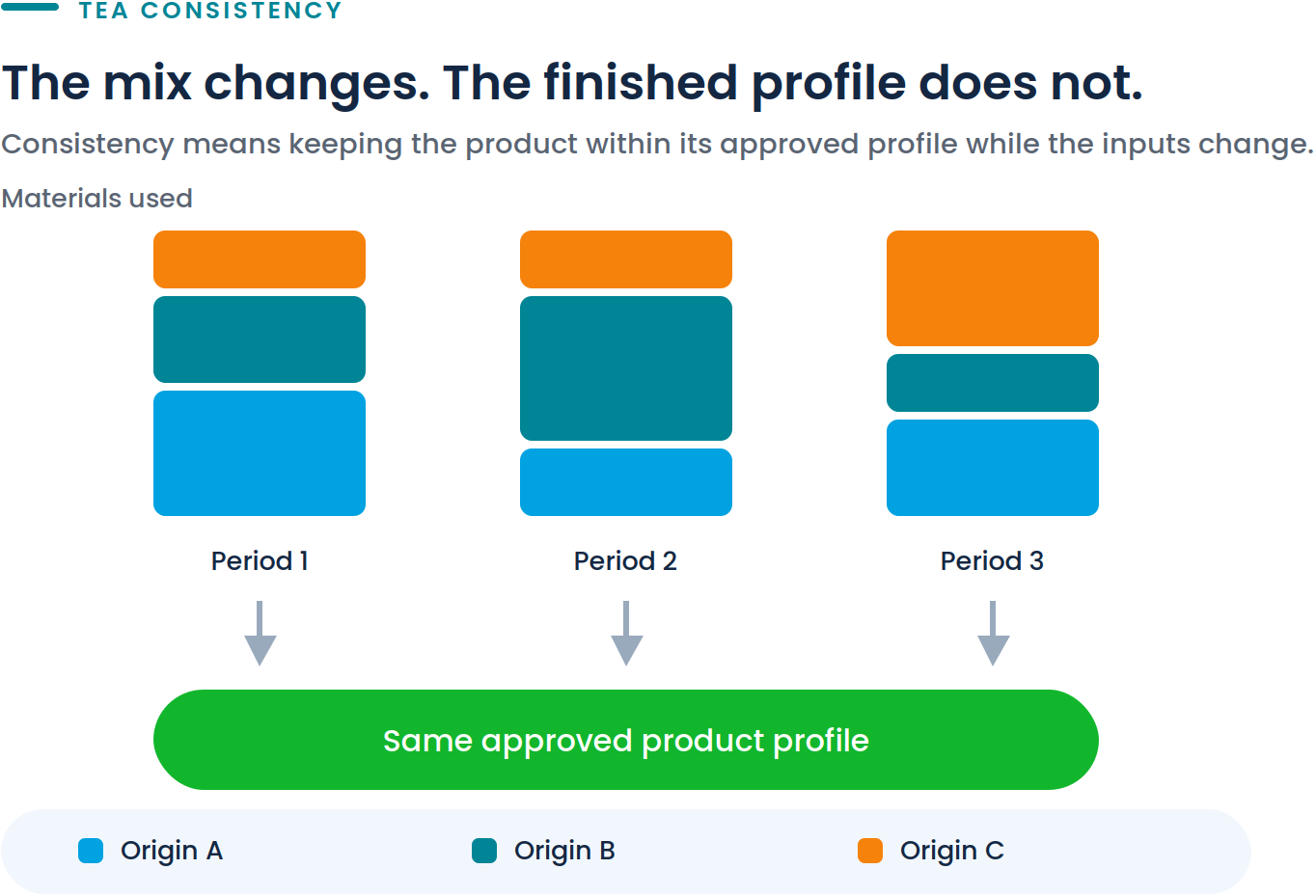
Consistency in tea is a property of the finished product, not of the recipe. As availability and quality shift between periods, the material mix has to change in order to keep the product where it has always been.
An optimization model can evaluate all relevant attributes simultaneously and prevent a cost improvement in one area from creating an unacceptable change elsewhere. It can also show planners which quality limits are driving the decision, which lots are critical, and where additional flexibility may exist.
Tea inventory allocation and material usage
Tea inventory is not only a quantity. Each lot has a location, age, status, quality profile, approved use, and opportunity value. Allocation decisions should consider the full portfolio rather than selecting materials product by product.
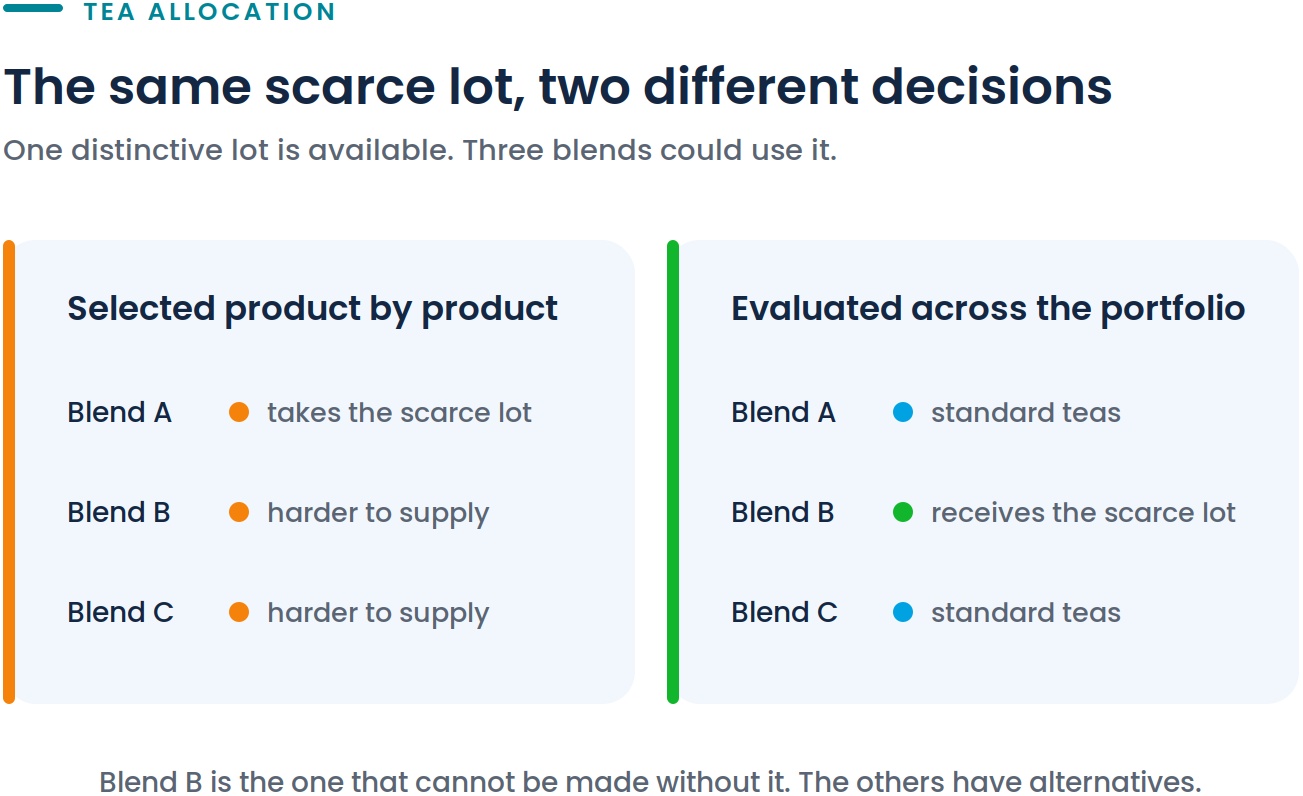
A distinctive lot is usually worth more to one blend than to another. Deciding across the portfolio, rather than filling orders as they arrive, is what keeps the scarce material with the product that genuinely needs it.
- Reserve scarce or distinctive lots for products that need them most.
- Use aging or slow-moving inventory where it remains quality-compliant.
- Avoid consuming flexible materials too early when they may be needed for future demand.
- Coordinate transfers between hubs or factories when the value exceeds the logistics cost.
- Understand the future effect of today’s blend on inventory balance and procurement needs.
Scenario planning for tea supply and market changes
- A key origin is less available than expected.
- A major lot is released with a different quality profile.
- Demand shifts between products or markets.
- A supplier price or contract condition changes.
- A transfer between sourcing or production hubs is delayed.
- A policy limits dependence on a supplier, country, or origin.
- The business wants to prioritize existing inventory before making additional purchases.
The value of a scenario is not the hypothetical number itself. It is the ability to compare assumptions, expose constraints, and see how procurement, quality, inventory, and service outcomes change together.
Balancing tea quality, cost, and sourcing risk
The lowest-cost blend may be too dependent on one material, origin, or supplier. The most conservative blend may protect quality but create unnecessary cost or inventory. Tea blending optimization allows the organization to define which trade-offs are acceptable and make them visible.
The model can combine cost objectives with quality limits, inventory policies, supplier rules, and sourcing diversification requirements. Where priorities conflict, planners can compare alternatives rather than relying on a single opaque answer.
What data is required for tea blending optimization?
- Product requirements. Finished tea specifications, approved composition rules, product-market requirements, and demand by period and location.
- Tea quality data. Lot, grade, origin, season, supplier, sensory, physical, and analytical values used by the company.
- Inventory data. Quantity, location, release status, age, reservations, expected receipts, and transfer options.
- Procurement data. Supplier availability, price, contracts, lead times, minimum quantities, commitments, and sourcing policies.
- Production data. Factory eligibility, batch sizes, yields, line or process constraints, and timing.
- Cost data. Material, transportation, transfer, handling, storage, conversion, and shortage costs where relevant.
The model should be designed around the level of detail that materially changes decisions. More data is not automatically better. The objective is to use the data that explains quality contribution, feasibility, cost, and risk.
Lipton Teas and Infusions modeled sourcing constraints, ingredient variability, and blending requirements across multiple regions with ICRON, replacing static recipes with optimization and scenario-based planning: 96% demand satisfaction, a 30% reduction in procurement costs, a 5% reduction in worldwide inventory levels, and optimization run times reduced from 180 minutes to 15 minutes.
How AI-Native Decision Execution supports tea blending
ICRON Procurement Planning and Blending Optimization for Tea & Coffee, powered by the ICRON AI-Native Decision Execution Hub, connects sourcing, inventory, quality, and blend decisions within one governed environment. A short overview of the Tea and Coffee solution is also available.
Optimization evaluates feasible alternatives across complex constraints. AI-supported workflows can help users explore scenarios and understand changes. Governance keeps assumptions, approvals, and decision logic visible. The selected plan can then move closer to procurement and operational execution instead of remaining a disconnected analysis.
Key Terms Used in This Guide
- Garden. A specific tea source, recorded as a material attribute alongside origin, supplier, crop, and season.
- Grade. A commercial classification recorded as a material attribute. Material within one grade may still behave differently, which is why lot-level values are used.
- Lot. A quantity of tea with its own quality profile, location, age, status, and approved use.
- Approved quality boundaries. The finished-product limits within which the material mix may be adjusted, allowing controlled flexibility rather than a fixed recipe.
- Allocation. The decision of which product, period, or location a given tea should be used in.
- Release status. The operational status that determines whether a material is available for use.
Frequently Asked Questions
What is the difference between tea blending and tea blending optimization?
Tea blending is the process of combining teas to produce a required finished product. Tea blending optimization uses a structured mathematical model to select feasible combinations while considering quality, cost, inventory, procurement, and operational constraints.
Does tea blending optimization replace the tasting panel?
No. The company’s quality and tasting framework defines what an acceptable finished profile is, and the model works within those approved boundaries. Its contribution is to evaluate a much larger set of material combinations consistently, and to show which quality limits are driving a given recommendation.
Can the model use tasting-panel or sensory data?
Yes, provided the data is defined consistently enough for planning. The model can use the company’s own sensory scores, categories, limits, or approved quality bands together with physical and analytical data.
Does tea blending optimization require fixed quality scores?
No. Quality can be represented through exact targets, acceptable ranges, categorical rules, preferred values, penalties, or a combination of methods. The structure should match the way the company governs product quality.
Can it manage different origins, grades, crops, and suppliers?
Yes. These characteristics can be represented as material attributes and linked with availability, price, policy, and quality rules.
How does the model handle a tea that is unsuitable for one blend but valuable in another?
This is treated as an allocation decision rather than a quality judgment. Because the model evaluates the portfolio rather than one product at a time, it can reserve scarce or distinctive lots for the products that need them and use more flexible teas elsewhere.
How does it help maintain taste consistency?
The model evaluates the relevant finished-product requirements simultaneously and selects material combinations that remain within approved quality boundaries. It also shows how changes in one material affect the overall blend.
Can it prioritize aging or excess tea inventory?
Yes. Inventory age, status, location, and prioritization rules can be included, provided that quality and product constraints remain satisfied.
How does it support tea procurement planning?
It evaluates prospective purchases against future blend requirements, existing inventory, supplier conditions, and expected demand. This helps procurement teams understand the operational value of each sourcing option.
What level of tea data is needed to begin?
The model should be designed around the level of detail that materially changes decisions. In practice, finished-product requirements, the quality values the company already uses, and reliable inventory quantity, location, age, and status are the inputs that determine whether the model is useful.
How often should a tea blend and sourcing plan be reviewed?
This depends on how frequently availability, quality, price, and demand change. Longer-horizon sourcing decisions may be reviewed seasonally, while blend and allocation decisions often need to be refreshed more frequently.
Can it support a global tea sourcing network?
Yes. A model can represent multiple origins, suppliers, inventories, hubs, factories, markets, and transfer options. The appropriate scope depends on the decisions the organization wants to coordinate.

Turn Complex Tea Blend Trade-Offs Into Executable Decisions
See how ICRON connects tea sourcing, quality, inventory, formulation, and production constraints within one optimization and execution environment.