






 Blogs
Blogs

Intro
Supply chains today operate in increasingly complex and volatile environments. Companies must continuously evaluate where to produce, how to source materials, and how products should flow through global distribution networks. Decisions about facility locations, production allocation, and transportation structures have a long-term impact on cost, service levels, and resilience.
Supply chain network design software helps organizations analyze and optimize these structural decisions. Network design tools and platforms allow companies to simulate alternative supply chain configurations, evaluate trade-offs across multiple scenarios, and identify the most effective network structure for changing business conditions. This guide explains how network design software works, what capabilities platforms provide, and when companies should use these tools to support strategic supply chain decisions.
To understand why network design has become a critical competitive capability, see:
Optimizing Supply Chain Network Design: The Key to Competitive Advantage 
At a Glance
Supply chain network design software is a supply chain management and analytics suite, powered by mathematical optimization environment used to evaluate, redesign and continuously improve structural supply chain configuration.
It supports long-term decisions such as:
- Facility location and consolidation
- Capacity allocation and expansion
- Production and distribution flow design
- Customer assignment strategy
- Carbon-constrained structural optimization
Unlike spreadsheet-based studies, network design software applies comprehensive and advanced mixed-integer optimization techniques and structured scenario modeling to evaluate thousands of potential configurations.
In volatile environments, continuous network design transforms structural modeling from a one-time study into an ongoing governance capability.
Quick Definition
Supply chain network design software is a supply chain management and analytics suite, powered with mathematical modeling and optimization platform that determines optimal facility locations, capacities and material flows across a multi-echelon supply chain under defined cost, service and structural constraints.
Why Companies Use Supply Chain Network Design Software
Global supply chains operate under persistent volatility:
- Demand uncertainty
- Geopolitical disruption
- Capacity imbalance
- Carbon regulation pressure
- Cost variability
Traditional one-time network studies are no longer sufficient. Structural evaluation increasingly becomes a recurring discipline rather than a periodic project.
If you suspect structural misalignment, review:
8 Warning Signs Your Supply Chain Network Needs Redesign
Core Capabilities of Supply Chain Network Design Platforms
Supply chain network design platforms provide advanced analytical capabilities that allow organizations to evaluate complex supply chain structures. Unlike traditional planning tools, these platforms use optimization models and scenario simulations to analyze how different network configurations affect cost, service levels, and resilience.
Key capabilities of network design software include:
- Scenario modeling: Evaluate alternative supply chain structures by testing different facility locations, sourcing strategies, and distribution flows.
- Optimization engines: Identify the most efficient network configuration based on cost, service level, and capacity constraints.
- Multi-echelon network modeling: Analyze supply chains across multiple layers, including suppliers, manufacturing plants, distribution centers, and customer locations.
- Capacity and operational constraints: Incorporate real-world constraints such as production capacity, transportation limitations, and lead times.
- Sustainability analysis: Evaluate the environmental impact of network structures, including transportation emissions and carbon footprint.
These capabilities allow organizations to move beyond static supply chain models and continuously evaluate how structural decisions perform under changing market conditions.
Supply Chain Network Design Software Vendors
Several specialized software vendors provide supply chain network design software and tools that allow organizations to model supply chain structures, simulate alternative scenarios, and evaluate trade-offs across cost, service levels, and resilience.
Common capabilities provided by network design platforms include optimization modeling, scenario analysis, capacity constraints, and multi-echelon supply chain modeling. While different vendors offer varying levels of functionality, most network design tools aim to support strategic supply chain decisions such as facility location planning, sourcing strategies, and distribution network configuration.
Examples of supply chain network design platforms include solutions developed by companies such as ICRON, AIMMS, Coupa (formerly LLamasoft), Sophus Technology, Blue Yonder, OMP, The AnyLogic Company and Optilogic, and other advanced supply chain analytics providers.
**The vendors mentioned above are provided as examples of supply chain network design platforms used in the market. This list is not exhaustive and does not represent a formal comparison or endorsement.
These platforms are typically used by large organizations seeking to evaluate global or structurally complex supply chain structures and optimize long-term network decisions.
For a broader overview of supply chain network design tools and platform capabilities, see:
Supply Chain Network Design Software: Vendors, Tools and Platform Capabilities
Network Design Software vs Spreadsheets and Traditional Analysis Tools
Some organizations attempt to evaluate supply chain network decisions using spreadsheets or basic analytical tools. While spreadsheets may support simple analyses, they quickly become difficult to manage as supply chains grow in size and complexity.
Why Spreadsheets Are Not Suitable for Network Design
Network design software provides several advantages over traditional planning tools:
| Spreadsheets and Basic Analysis Network Design Software | |
|---|---|
| Limited scenario | Evaluate multiple scenarios simultaneously |
| Manual calculations | Advanced optimization algorithms |
| Difficult to manage large datasets | Designed for large-scale supply chain networks |
| Static analysis | Dynamic modeling of supply chain changes |
As supply chains become more complex and globally distributed, specialized network design platforms allow organizations to evaluate structural decisions more accurately and efficiently.
When Companies Should Use Network Design Tools
Companies typically use supply chain network design tools when evaluating tactical and strategic decisions, from sourcing strategies to investment decisions or major structural changes. These tools help decision-makers understand how alternative network configurations impact costs, service levels, and operational efficiency.
Common situations where organizations use network design software include:
- Expanding into new markets or regions
- Opening or closing manufacturing plants or distribution centers
- Evaluating sourcing strategy changes
- Responding to transportation cost increases or disruptions
- Assessing the impact of mergers and acquisitions
- Supply chain footprint rationalization
- Nearshoring or reshoring initiatives
- Evaluating carbon-constrained supply chain structures
By modeling different structural scenarios, companies can make more informed decisions and design supply chain networks that remain efficient and resilient over the long term.
What Is Supply Chain Network Design?
One of the main functions of supply chain network design is the structured optimization of facility locations, capacities and material flows across an end-to-end supply chain.
Strategic supply chain network design evaluates long-term facility footprint, production allocation and distribution flows using optimization models.
It addresses long-term structural questions:
- How many facilities should operate
- Where those facilities should be located
- What each facility should produce or store
- How customers should be allocated
- How products should move through the network
Operational excellence cannot compensate for structural misalignment.
Common pitfalls are explored here:
Top 7 Supply Chain Network Design Mistakes to Avoid
What Is Supply Chain Network Design Software?
Supply chain network design software enables organizations to:
- Represent the current network configuration
- Build alternative structural scenarios
- Optimize facility and flow decisions
- Evaluate cost–service–resilience trade-offs
- Compare scenarios in a repeatable and auditable way
The output is mathematically grounded decision support rather than spreadsheet-based estimation.
Figure 1 – Strategic Architecture of Network Design Software
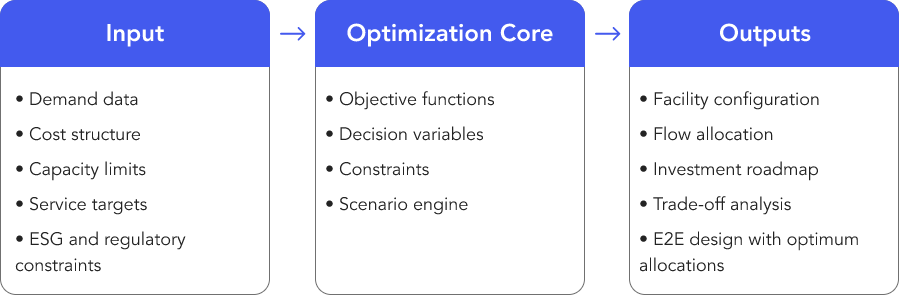
Illustrative example of a structural modeling layer integrated with an optimization engine and scenario management framework.
Strategic, Tactical and Operational Horizons
Network design primarily operates at strategic and tactical horizons.
Strategic horizon (long-term):
- Facility location decisions
- Capacity investments
Tactical horizon (mid-term):
- Capacity balancing
- Flow restructuring
Structural design defines the boundary conditions for downstream planning.
Network design decisions define capacity boundaries and supply chain configuration that operational planning processes must follow. In many organizations, these insights directly inform Sales and Operations Planning (S&OP) cycles and long-term supply–demand alignment.
Further reading:
Elevating S&OP: Transforming Operations Strategically
Deterministic vs Stochastic Network Design
Deterministic models assume fixed inputs.
Stochastic modeling evaluates structural performance under variability such as:
- Demand volatility
- Supply disruptions
- Cost fluctuations
For deeper insight:
From Static Assumptions to Scenario-Based Network Design
Multi-Objective Trade-Off Analysis
Structural decisions often require balancing cost, service, resilience and sustainability. Efficient frontier analysis reveals non-dominated solution sets rather than a single answer.
Figure 2 – Multi-Objective Cost and Service Trade-Off
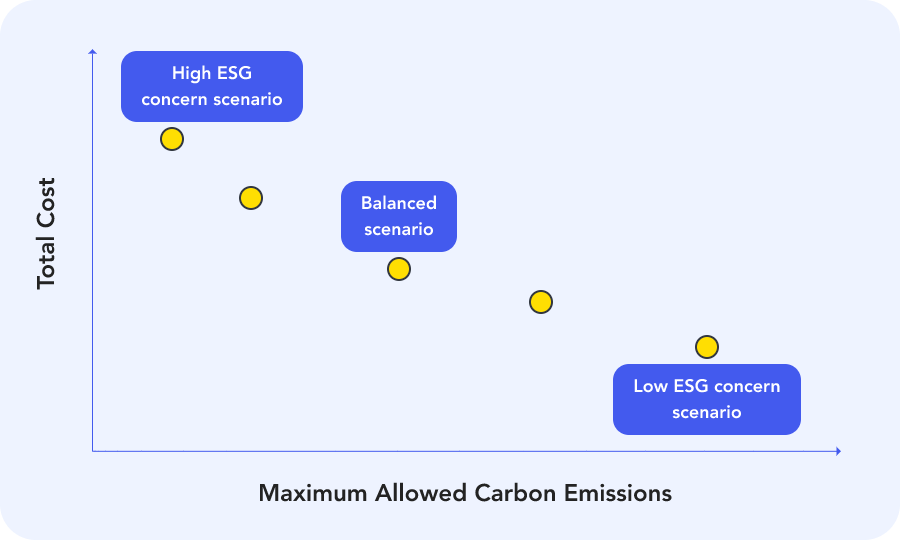
Scenario-based analysis reveals how ESG priorities impact total cost, enabling data-driven supply chain design decisions.
Continuous Network Design
Volatility requires ongoing structural evaluation supported by continuous supply chain network design optimization.
Continuous network design includes:
- Persistent baseline models
- Continuous data integration
- Scenario comparison libraries
- Governance framework
Continuous network design capabilities are increasingly embedded within advanced supply chain planning platforms such as the ICRON platform, enabling organizations to integrate structural network evaluation with ongoing planning processes.
Further reading:
What Is Continuous Optimization in Supply Chain Network Design?
Explore Continuous Network Design Capabilities
If your organization is moving from static network studies to continuous structural evaluation, learn how continuous network design supports ongoing scenario analysis and strategic decision-making.
Learn more about Continuous Network Design
Categories of Supply Chain Network Design Software
Supply chain network design software solutions generally fall into three structural categories.
1. Standalone Network Design Tools
These tools focus primarily on strategic facility location modeling and flow optimization.
They are often used for periodic structural studies and may require manual integration with other planning systems.
Best suited for organizations conducting occasional network redesign projects.
2. Integrated Supply Chain Planning Platforms
These platforms embed network design capabilities within broader supply chain planning environments.
Platforms such as ICRON integrate network design with supply chain planning processes including Sales and Operations Planning (S&OP), capacity planning and production scheduling, allowing organizations to align structural network decisions with ongoing operational planning cycles.
Supply chain planning platforms connect structural modeling with:
This approach enables continuous network design rather than isolated studies.
3. General Optimization Environments
Mathematical modeling platforms that allow custom optimization development.
They provide high flexibility but require significant internal modeling expertise and governance discipline.
Often used in organizations with advanced operations research teams.
How Category Choice Impacts Network Design Maturity
Choosing between standalone tools, integrated platforms or general optimization environments depends on:
- Modeling maturity
- Integration requirements
- Governance capability
- Frequency of structural evaluation
Network design software is not just an analytical tool. It defines how structural decisions are institutionalized.
How to Choose Supply Chain Network Design Software
When evaluating solutions, assess:
- Modeling depth and flexibility
- Stochastic and multi-objective capability
- Scenario scalability
- Integration with planning systems
- Carbon modeling support
- Governance and version control
These factors help organizations identify solutions that best align with their analytical requirements and decision-making processes.
Governance and Organizational Readiness
Effective network design requires:
- Defined ownership
- Data discipline
- Cross-functional alignment
- Executive sponsorship
Mature organizations treat supply chain network design software as a strategic structural optimization capability rather than a one-time analytical exercise.
ICRON’s Approach to Network Design
ICRON approaches supply chain network design as a continuous structural capability rather than a periodic study.
The focus is not only on facility location optimization, but on embedding structural modeling within broader decision cycles.
ICRON’s network design capability connects:
- Strategic footprint modeling
- Sales and operations alignment
- Capacity and production planning
- Risk-aware scenario evaluation
- Carbon-constrained optimization
By integrating structural optimization with downstream and upstream planning layers, network design becomes part of an ongoing decision architecture rather than an isolated analytical exercise.
This enables organizations to align structural network decisions with operational planning and long-term supply chain strategy.
Explore ICRON Supply Chain Network DesignKey Takeaways
- Supply chain network design software helps organizations evaluate facility locations, capacity allocation and distribution flows across complex supply chain structures.
- Advanced network design platforms use mathematical optimization and scenario modeling to analyze cost, service and resilience trade-offs.
- Continuous network design transforms structural evaluation from a one-time project into an ongoing strategic capability.
- Supply chain planning platforms integrate network design with processes such as S&OP, capacity planning and production planning.
- Scenario-based network design enables organizations to evaluate uncertainty, supply disruptions and changing market conditions.
Frequently Asked Questions
1. What is supply chain network design software used for?
Supply chain network design software is used to determine optimal facility locations, capacity levels and material flows across a multi-echelon supply chain. It supports long-term structural decisions under cost, service, risk and carbon constraints using mathematical optimization models.
2. What is the difference between network design and network optimization?
Network optimization may refer broadly to improving allocations within an existing structure. Network design on top of network optimization, adds a focus on structural configuration, such as facility footprint and long-term flow structure. Network design typically operates at a strategic horizon, while operational optimization works within structural boundaries.
3. How often should supply chain networks be evaluated?
Physical restructuring may occur infrequently. However, scenario evaluation should operate continuously in volatile environments. Organizations increasingly maintain persistent baseline models to evaluate structural shifts before disruption occurs.
4. What is deterministic vs stochastic network design?
Deterministic network design assumes fixed inputs such as demand and cost. Stochastic network design incorporates uncertainty using scenario modeling, two-stage programming or robust optimization methods to evaluate structural resilience under variability.
5. Is network design part of S&OP?
Network design defines structural constraints such as facility capacity and geographic footprint. S&OP operates within those structural limits. When integrated effectively, network design insights inform S&OP decisions on capacity balancing and allocation.
6. Can network design software support sustainability goals?
Yes. Network design software allows organizations to incorporate carbon emissions directly into their decision-making process. This enables planners to analyze trade-offs between cost, service performance, and emissions, and identify network configurations that align with both operational and sustainability objectives.
7. What industries use supply chain network design software?
Industries with complex, multi-node supply chains commonly use network design software, including:
Any organization managing multiple facilities, product flows and capacity constraints can benefit from structural optimization.
8. How do you choose supply chain network design software?
Evaluation should consider:
- Modeling flexibility
- Mixed-integer optimization depth
- Stochastic capabilities
- Scenario scalability
- Carbon modeling support
- Integration with planning systems
- Governance and version control
Selecting supply chain network design software is a long-term structural decision.
9. What is continuous network design?
Continuous network design refers to maintaining a persistent structural model that supports recurring scenario evaluation rather than one-time studies. This approach embeds structural optimization within ongoing decision cycles.
10. How does ICRON approach network design?
ICRON positions network design as a continuous structural capability integrated with broader planning layers.
Its approach connects strategic footprint modeling with S&OP alignment, capacity planning and risk-aware scenario evaluation within a decision intelligence architecture.
Final Consideration
Supply chain structure, when optimized through network design software, determines long-term cost, service feasibility and resilience exposure.
If you want to:
- Quantify structural trade-offs
- Model volatility before disruption
- Integrate network design with S&OP
- Embed carbon constraints into optimization